The Criminal Justice System and the Abuse of Power
COMBATING CORRUPTION
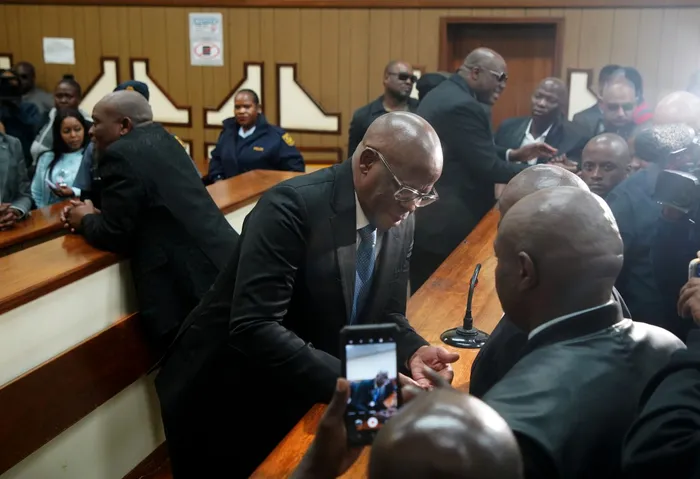
TAXI boss Joe ‘Ferrari’ Sibanyoni (centre) consults with his legal team after extortion and money laundering charges against him and his co-accused were struck off the court roll in the Kwaggafontein Magistrate’s Court, Mpumalanga, on May 13.
Image: Oupa Mokoena/Independent Media
Professor Sipho P. Seepe
Franklin D. Roosevelt, the 32nd president of the United States, famously observed that “In politics, nothing happens by accident. If it happens, you can bet it was planned that way.”
The National Prosecuting Authority’s (NPA) latest embarrassment — the striking off the roll of the case against taxi boss Joe “Ferrari” Sibanyoni and his co-accused in Mpumalanga — fits neatly into this pattern. It is not an isolated blunder, but another episode in the steady erosion of public trust in the institutions meant to dispense justice.
The chaos engulfing the NPA is not merely a case of gross incompetence. That much is obviously evident. It is also part of a broader strategy to weaponise law enforcement agencies: shielding allies of the powerful while pursuing political opponents with selective zeal. This is no accident of governance; it flows from structural design. There is a method to the seeming madness.
Former Deputy Chief Justice Dikgang Moseneke laid this bare in his 2014 paper, Reflections on South African Democracy — Transition and Transformation. He noted the remarkable concentration of appointment powers in the hands of the President under Chapter 5 of the Constitution and related legislation.
The President appoints, often at his exclusive discretion, the Chief Justice and Deputy Chief Justice, the National Director of Public Prosecutions, the Public Protector, the Auditor-General, the national police commissioner, the Governor of the South African Reserve Bank, the Commissioner of SARS, and the military command. These powers of appointment are coupled with powers of removal.
Moseneke questioned whether South Africa’s democratic project is well served by such a powerful central executive. His caution has proved prophetic. The Phala Phala scandal — involving the theft of undeclared foreign currency stashed at President Cyril Ramaphosa’s private farmhouse — tested these institutions.
The NPA, Public Protector, police, and Reserve Bank responded with a collective “see no evil, hear no evil, speak no evil.” Processes were bent to protect the appointing authority. As journalist Adri Senekal de Wet aptly observed, the tragic irony of Ramaphosa’s presidency is that the very state agencies meant to hold power accountable have been repurposed to shield him.
This protection is sustained by a pervasive narrative that Ramaphosa represents the best South Africa has to offer. The record says otherwise. In his Sunday Times article of 1 February 2026, economist Duma Gqubule dismantled this myth.
Politically, Ramaphosa was sold as popular, business-friendly, and acceptable to white voters. Yet the ANC suffered two national electoral disasters under him: losing 4.65 percentage points in 2019 and 17.32 points in 2024. These accounted for the bulk of the party’s decline since 2009.
Economically, the contrast is starker. Average annual GDP growth was 2.7% under Nelson Mandela (1994–1999), 4% under Thabo Mbeki (1999–2008), 1.9% under Jacob Zuma (2009–2017), and a mere 0.6% under Ramaphosa (2018–2024). Zuma’s “nine wasted years” delivered growth three times faster than Ramaphosa’s tenure.
Supporters blame Covid-19, yet the economy was already collapsing beforehand — GDP grew just 0.3% in 2019, with three consecutive quarters of decline pre-pandemic. Meanwhile, 155 emerging and developing countries averaged 3.7% annual growth over the same period. Objectively, Ramaphosa’s presidency ranks as the worst since 1994.
The same institutional architecture that protects the favoured can be turned ruthlessly against those who fall foul of the establishment. The NPA’s weaponisation against perceived Zuma allies began years ago, cheered on by partisan mainstream media and elements of civil society. Selective prosecution on flimsy grounds has become standard. Cases often collapse in court or drag on interminably, serving more to harass and paralyse opponents than to deliver justice.
The treatment of Duduzane Zuma stands as a glaring example. Branded a fugitive by mainstream media, he was arrested and manacled upon returning for his brother’s funeral. The case collapsed for lack of evidence. Undeterred, the NPA recharged him with culpable homicide over a fatal car crash. Again, the court acquitted him, finding prosecutors had failed to prove their case beyond a reasonable doubt.
Former ANC secretary-general and Free State premier Ace Magashule has endured years of delay after arraignment, with the NPA repeatedly claiming it is not trial-ready. This is not only political persecution; it violates Section 35(3)(d) of the Constitution, which guarantees every accused the right to a trial that begins and concludes without unreasonable delay.
Matshela Koko successfully challenged similar abuse. After charges of fraud, corruption, and money laundering were struck off the roll in the Middelburg Specialised Commercial Crimes Court, Koko remarked: “The NPA is doing South Africans a big disservice. You cannot make such allegations, investigate them for more than five years, bring me to court, wake me up at six o’clock in the morning… More than twelve months later, you are not ready to take me to trial. What we see here is a hate crime.”
The case against Duduzile Zuma-Sambudla reveals the depths of this institutional animosity. She stands accused of inciting the 2021 unrest and looting through the deployment of emojis. Absent the normalised hatred for anything associated with Jacob Zuma, the case would be laughable. It insults the agency and dignity of African people by suggesting emojis alone could spark an orgy of violence.
The unrest was primarily triggered by the Constitutional Court’s decision imposing what amounted to detention without trial — a move echoing apartheid-era excesses — and reflected righteous anger from communities pushed to the brink.
South Africans do not need to be lectured about the abominable practice of detention without trial. They can see it and smell it from afar. Detention without trial is simply diabolical. It needs to be condemned in whatever guise it presents itself, even if the Constitutional Court sanctions it. The apex court should also be outrightly condemned. It holds no monopoly on justice.
The involvement of British-born private investigator Paul O’Sullivan in the initiation of this case is telling. He had become the judge, the jury and the executioner. His relentless pursuit and apparent privileged access to power corridors expose the deeply political nature of these prosecutions. He has functioned effectively as a henchman for the establishment.
While pursuing such weak cases with vigour, the NPA shows no appetite for matters where prima facie evidence exists — Phala Phala being the prime exhibit. Even as the Madlanga Commission probes corruption in the criminal justice system, the NPA remains the weak link. It cannot be trusted to prosecute without fear, favour, or political calculation.
The Constitution’s heavy concentration of executive power has enabled this capture. When institutions meant to serve justice instead serve the interests of the incumbent, democracy itself is hollowed out.
The NPA’s repeated failures are not random incompetence but symptoms of a system functioning as designed — to protect power and punish dissent. Until this structural fault line is confronted, South Africa’s institutions of justice will continue to dispense selective outcomes rather than equal justice. The public, increasingly cynical, deserves better.
* Professor Sipho P. Seepe, Higher Education and Strategy Consultant.
** The views expressed do not necessarily reflect the views of IOL or Independent Media.