France-Africa Summit: A New Era or Just More of the Same?
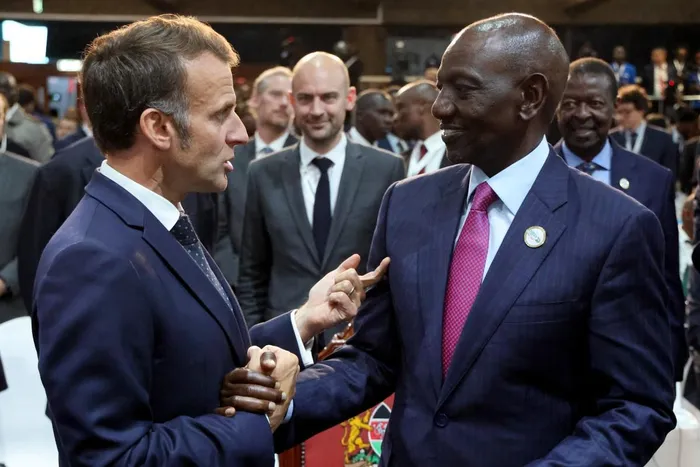
FRENCH President Emmanuel Macron (left) and Kenya's President William Ruto interact ahead of the Africa Forward Summit's closing plenary session in Nairobi, Kenya on May 12.
Image: AFP
Ashraf Patel
The saying that Africa is always on the ‘menu and not on the table’ has been a narrative of critical scholars who decry the lack of African agency in the international order.
The formation of the New Partnership on African Development (NEPAD) in 2002 was the boldest attempt at ‘decolonising African institutions and development partnerships', symbolising the aspiration for enhanced agency.
20 years later, the broader dream and vision lie in tatters.
African conflicts and civil wars have mushroomed to an all-time high. From Sudan to the DRC to the Sahel region and Northern Mozambique, the amplification of conflicts has led to deeper migration problems as well as new conflicts in critical mineral zones, deepening the social, environmental and gender crises.
‘Summitry’ is a term that denotes the proliferation of African ‘development initiatives’, AGOA, FTAs EU-AU Summits, G20 and China's FOCAC.
France-Africa Summit
The Africa Forward Summit in Nairobi in early May 2025 was another such conference. For the first time, France held its Africa summit in an English-speaking country, and €14bn of French investment and €9bn of African investment were signed off. "Partnership of equals," ‘business and not aid’ as the narrative. Yet have we diagnosed how decades of ‘development aid ‘were also part of the underdevelopment of Africa?
The 2026 France-Africa Summit, officially titled the Africa Forward Summit, took place on May 11–12, 2026, in Nairobi, Kenya. The historic event was co-hosted by French President Emmanuel Macron and Kenyan President William Ruto, marking the first time the summit was held in an African nation that was not a former French colony.
Key Outcomes and Agreements
- Financial Pledges: France and various international partners secured commitments of up to 27 USD billion (approx. €25 billion) toward investments in sustainable development, infrastructure, green energy, and technology.
- Global Financial Reform: African leaders strongly pushed for a re-evaluation of risk pricing by global credit rating agencies. The leaders argued that exaggerated risk assessments unfairly inflate borrowing costs for African states.
- New Partnership Doctrine: The summit signalled a definitive pivot away from traditional geopolitical and security ties to a "co-investment" model focused on the youth, digital innovation, and creative and cultural industries.
But according to African commentator Marion Stacy, it's 'more of the same’.
“Past Franco-African summits have produced similar declarations from the 2013 Elysée Summit for Peace and Security to the 2021 Montpellier summit on financing African economies. Where are the results? The CFA franc still ties 14 African countries to France. French companies still dominate key sectors”, she asks.
The summit had the ‘business as usual ‘element with the Africa–France Business Forum 2026 which hosts a business forum and talks focused on the potential benefits of artificial intelligence. AI, climate initiatives and weapons manufacturing, as well as the small-business ventures that have emerged through these priorities, are areas of cooperation and investment between African countries and the former colonial powers.
The same problem presents itself in relation to the AI economy, which is being championed by France. It is cheap labourers in Kenya who have been doing much of the legwork to keep AI applications going. According to Marion Stechy, “Large language models and other applications need to be trained and monitored by humans, and they are often trained in Kenya’s so-called 'AI sweat shops. ' Kenyans are doing much of the data labelling and content moderation AI work”
It is indeed ironic that although President Macron championed the Paris AI Safety summit in 2025, none of the values of that AI safety filtered into the France-Africa Summit, but the focus was on AI business and tech start-ups, yet noting that Kenya is the home of AI sweatshops that have seen large levels of exploitation by Big Tech.
It is well documented that currency volatility is eating Africa’s development gains. South Africa’s G20 outcomes created the Manuel Finance Panel, which is further diagnosing Global finance and African finance and debt challenges.
Stagnation on Cost of Capital Commission
The Summit proclaimed a “breakthrough for the operationalisation of NAFAD, endorsed by African Heads of State during the African Union Summit earlier this year and further anchored through the Abidjan Consensus adopted last month. Under the NAFAD framework, the African Development Bank Group will leverage its triple-A balance sheet, convening power and partnerships to strengthen African financial institutions capable of mobilising investment at scale.
At the centre of this first phase stands ATIDI, the Nairobi-based pan-African investment and credit insurer identified as the flagship institution to anchor Africa’s continental guarantee architecture. It was, in fact, France that proposed the Cost of Capital commission at the G20 in 2025.
The new NAFAD initiative may confuse rather than complement, leading to further’ fracturing of the need for an integrated African financial-debt-trade and payment model solutions. NAFAD is yet another finance model and has some elements, such as the cost of capital. But essentially an initiative of France and the EU, it can also be interpreted as a G7 creditor nation-led agenda. Here, the agenda setting of the North is in play.
Stagnation of a Borrowers Club
The G7 and Paris Club are effective clubs representing creditors and mega banks that lend to national governments of the Global South. For years, the African Union and G77 have discussed the idea of a ‘Borrowers Club’ as a mechanism of collective bargaining to address the asymmetrical power of the Paris Club. Yet this idea has stagnated.
But the core African Debt challenges remain:
A) IMF Conditionalities,
B) Need for Debt write-offs and re-scheduling,
C) Reduce cost of capital by creditor nations and global banks, and o
D) The ‘high cost of capital.’
Pan African Payment System
An important element is the Pan-African payment System that requires piloting and implementation. Local and regional currencies are an effective mechanism in reducing capital and trade commission costs and can deepen trade and investment. Multiple currencies and de-linking from the dollar. Trade in regional currencies and selective de-dollarisation need serious design work.
Kenyan development economist Prof Attiya Waris proposes more substantive interventions.
Deeper regulation, such as Tax, capital controls and prudential rules, are levers African states already hold. Used well, they shape where capital goes and who benefits in cross-border project finance. A trans-African rail or road network cannot be built when every national system runs on different specifications and different currencies. The summit talked about ports and hotels. It said little about how the continent finances the big projects that knit it together. ( Attiya Waris, May 2026 )
There is also the G20 Inequality Panel that is being considered by the UN, noting that the UN Pact of the Future requires reporting on progress on the SDG agenda. Monitoring of Development aid pledges is crucial to avoid duplication.
As Africa, and the world entered a brave new world in 2026, with multiple wars around energy and oil that have constrained supply chains and led to a grave cost-of-living crisis in the Global South. It is time for critical reflection on whether the various summits and conferences are contributing or stalling Africa’s development pathways.
At this point, Africa’s development future is being eaten away, summit by summit.
* Ashraf Patel is a Senior Research Associate at the Institute for Global Dialogue, UNISA.
** The views expressed do not necessarily reflect the views of IOL, Independent Media or The African.