Maduro's Capture: A Turning Point for Multilateralism and Global Governance
GEOPOLITICS
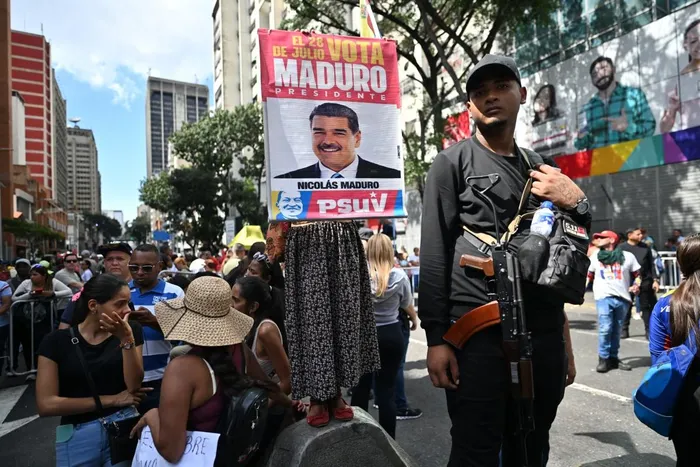
An armed supporter of ousted Venezuelan President Nicolas Maduro stands next to another one holding a poster of him during a demonstration in Caracas on January 4, 2026, a day after he was captured in a US strike.
Image: Juan Barreto / AFP
Zamikhaya Maseti
The capture of Nicolás Maduro has most certainly unsettled the international system and offers a clear illustration of how Donald Trump’s Conservative Republicanism has evolved from a domestic ideological formation into a disruptive force in global geopolitics.
Its central tenet, Make America Great Again, has subsequently been externalised, extending into the Caribbean Basin and now asserting itself within Venezuela. Clearly, this outward projection of ideological power has contributed to a paralysis of multilateral governance, weakening both institutional authority and collective restraint.
In 2025 alone, unilateral United States actions facilitated regime change in Syria following the removal of Bashar al-Assad, exacerbated instability in Iraq and Yemen, intensified strategic pressure on Iran and Cuba, and culminated in the bombing of Islamic State positions in Nigeria. Accordingly, these developments signal a recalibration of international norms in which force increasingly precedes consensus.
This recalibration most certainly reopens the unresolved question of sovereignty in the contemporary world order. Sovereignty, long treated as the juridical foundation of international relations, was never a mere abstraction. For much of the Global South, it was a hard-won political achievement forged through struggle against colonial domination and external control.
Clearly, the outward projection of Conservative Republicanism into Venezuela does not represent a historical rupture, but a return to familiar patterns under new ideological language. Subsequently, sovereignty appears no longer as an inherent attribute of statehood, but as a conditional status, extended selectively and withdrawn strategically.
Accordingly, the rules-based international order reveals itself not as collapsed, but as unevenly applied, rigid for the weak and elastic for the powerful. The paralysis of multilateralism that follows from this conditional application of sovereignty is neither accidental nor temporary. It is structural. Institutions established to mediate power, most notably the United Nations, continue to command rhetorical respect while being routinely bypassed in practice.
Clearly, multilateralism has not been abandoned through a formal declaration, but hollowed out through systematic circumvention. Decisions relating to war, regime change, and coercive intervention are increasingly taken outside collective forums and subsequently presented to the world as fait accompli.
Accordingly, international institutions are reduced to instruments of after-the-fact legitimisation rather than genuine sites of deliberation and restraint. This institutional paralysis subsequently exposes a deeper erosion of international law itself. The UN Charter, conceived as the normative backbone of the post-war international system, explicitly prohibits the use of force against the sovereignty and territorial integrity of states except in narrowly defined circumstances of self-defence or with Security Council authorisation.
Clearly, this framework was never intended to eliminate power from international relations, but to discipline it. When these limits are disregarded, international law does not cease to exist. It is repurposed. Accordingly, legality becomes selective, invoked to justify unilateral action while the procedures that confer legitimacy are ignored. Most certainly, this signals not the absence of law, but its instrumentalisation.
The most dangerous consequence of this trajectory lies in the precedent it establishes. Once powerful states demonstrate that they can act outside agreed rules without consequence, others will follow. What begins as an exception is subsequently normalised. Clearly, this is how instability spreads, not through sudden collapse, but through repeated acts that quietly erode restraint.
Accordingly, diplomacy weakens, and trust between states diminishes. Countries no longer rely on shared rules to manage disputes, but on force, threat, and strategic calculation. Most certainly, this does not produce order. It produces a world of managed instability, where peace is fragile and dependent on power rather than the rule of law.
This trajectory carries immediate and troubling implications for Africa. Clearly, the continent is not treated with any form of exceptionalism in this emerging doctrine of unilateral force. The bombing of Islamic State positions in Nigeria by the United States most certainly placed the African Union under acute institutional strain.
The Union’s response was subsequently complicated by Nigeria’s own framing of the incident as a joint operation, a posture that constrained the AU’s ability to act decisively in defence of Nigeria’s sovereignty as envisaged in its Constitutive Act.
Article 4 affirms the principles of sovereign equality and non-interference among Member States, while permitting collective intervention only under grave circumstances such as genocide, war crimes, and crimes against humanity.
Accordingly, the inability to assert these principles with authority exposed the limits of continental agency when external force is normalised through bilateral consent. This does not diminish Nigeria’s agency, but it underscores Africa’s continued vulnerability to coercive power. Most certainly, no African state should assume immunity.
Even South Africa, with its diplomatic stature, strategic economy, and history of principled multilateral engagement, cannot discount the possibility that it is being carefully assessed within this evolving geopolitical calculus. At the same time, Israel’s decision to open an embassy in Kenya must be read not as an isolated diplomatic gesture, but as part of a broader strategic value chain through which external powers seek to reorder influence across the continent.
Subsequently, Africa is not merely observing this global shift; it is increasingly positioned as one of its testing grounds. Accordingly, the capture of Nicolás Maduro must now be read as a cautionary lesson for Africa, and for the African Union in particular. It demonstrates how swiftly sovereignty can be overridden when unilateral power is normalised and multilateral restraint weakened.
Most certainly, this moment demands more than procedural diplomacy. It calls for the AU to craft a deliberate counter-strategy, one that elevates collective African agency and compels renewed engagement with the United Nations Security Council to contain and limit the snowballing effects of Trump’s Conservative Republicanism.
Such a strategy would insist on restoring the primacy of international law, reinforcing multilateral authority, and reasserting that African sovereignty is neither negotiable nor expendable. Clearly, such a strategy would once again position and strengthen the African continent as a consequential actor in global geopolitics. This was the posture consciously assumed by the architects and midwives of the African Renaissance, notably Thabo Mbeki, Olusegun Obasanjo, and Abdoulaye Wade, who understood that Africa’s marginal location in global affairs was neither accidental nor inevitable.
Through initiatives such as the New Partnership for Africa's Development, they sought to reposition the continent within the architecture of global decision-making, insisting on a recalibrated multilateral order and a strengthened United Nations capable of reflecting the lived realities of the post-colonial world.
This was a mission they pursued relentlessly and unashamedly, often against prevailing global orthodoxies and internal hesitation alike. Today’s African leaders confront a comparable historical moment. Most certainly, they are called upon to reclaim that assertive continental posture and to advance the unfinished task of securing Africa’s place not at the margins of global governance, but firmly within its centre as a shaper of norms rather than a passive recipient of their consequences.
Accordingly, Africa must lead from the front in dislodging and disrupting Donald Trump’s notion of a so-called judicious transition, which in substance amounts to a regime-change agenda underpinning his Conservative Republicanism doctrine. Where this logic manifests, whether in Venezuela or elsewhere in the world, it must be confronted, resisted, and contained whenever it raises its ugly head, lest unilateral power be normalised as an acceptable instrument of global governance.
* Zamikhaya Maseti is a political economy analyst and holds a Magister Philosophae(M.Phil) in South African Politics and Political Economy from the erstwhile University of Port Elizabeth, now Nelson Mandela University.
** The views expressed do not necessarily reflect the views of IOL, Independent Media or The African.