New NDPP Andy Mothibi Faces a Tough Task to Fix Broken NPA
NATIONAL PROSECUTING AUTHORITY
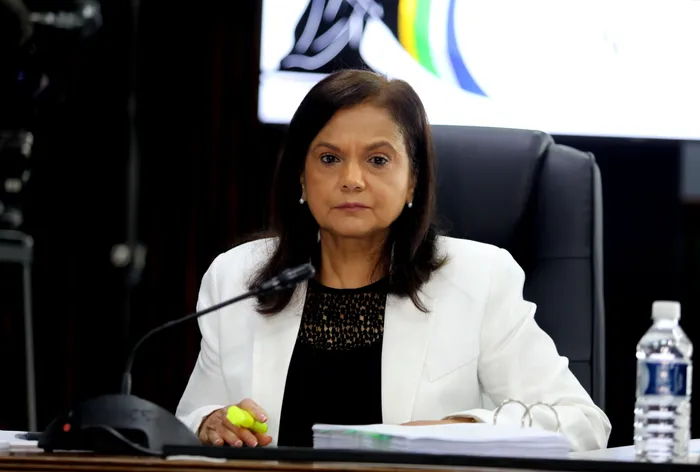
OUTGOING NPA boss Advocate Shamila Batohi's conduct came under intense scrutiny at the Nkabinde Enquiry into the fitness of Advocate Andrew Chauke to hold office.
Image: Oupa Mokoena/Independent Newspapers
Prof. Sipho Seepe
Asked a direct question by the CNN award-winning journalist, Christiane Amanpour, on whether he has “any information that might implicate President Zuma in any acts of corruption”, the late Pravin Gordhan responded matter-of-factly. “No, I don't have any personal information, but as I said, there are all sorts of suggestions not just about the president”.
Interestingly and embarrassingly so, Amanpour asked the most basic question that had escaped South Africa’s journalistic fraternity. Hoodwinked by the so-called state capture narrative, the media fraternity eagerly lapped up everything coming out of Gordhan’s mouth.
In the end, Gordhan was exposed as nothing more than a petty, jealous, and probably racist state capture propagandist. It didn’t help at the time that, for the media fraternity, South Africans were divided into saints and demons. Anyone with a remote connection to the former President Jacob Zuma was considered a demon.
The likes of the former Public Protector Busisiwe Mkhwebane were routinely targeted. The Constitutional Court stopped this infectious conduct in its tracks.
In a majority judgment penned by Justice Madlanga, the apex court remarked. “There appears to be a developing trend of seeking personal costs orders in most, if not all, matters involving the Public Protector…. with no consideration whatsoever of special circumstances that justified the order…. And in the instant matter, the High Court – in its conclusions – has carefully selected and used epithets and particular nouns that are suited to awards of personal costs orders, but there is not a scintilla of evidence to support those epithets and particular nouns and, therefore, the conclusions. Thus, the conclusions simply cannot stand up to scrutiny.”
Justice Madlanga concluded by pointing out that “courts must be wary not to fall into the trap of thinking that the Public Protector is fair game for automatic personal costs awards.”
The appointment of Advocate Shamila Batohi as National Director of Public Prosecution came at a time when citizens were perceived as either good or bad. Batohi wasted no time in embracing the so-called state capture narrative. In doing so, she quickly branded herself corruption buster in chief.
She promised to solve high-profile cases. She failed. Spectacularly so.
Batohi’s tendency to hide behind the so-called state capture could take her so far, and no further. Providing the background behind her resignation in late 2021, the head of the National Prosecuting Authority's (NPA) Investigating Directorate, Hermione Cronje, cited deep institutional dysfunction, resource constraints, and an inability to implement necessary reforms.
Cronje reportedly felt isolated. She reportedly averred. "It was very exhausting and frustrating because on the one hand you are trying to build a case and on the other hand you have nothing. You have no staff, no infrastructure, no budget, just generally no support."
Batohi has had enough time to institute the necessary reforms. She dismally failed to do so. Instead, the NPA relied on “temporary or borrowed staff who were often overwhelmed or inexperienced, and an inability to recruit top talent due to uncompetitive government pay scales.”
Athol Trollip, ActionSA MP, could not have been clearer.
“Under Batohi’s leadership, the NPA reels from one scandal to the next. South Africans are left wondering if these failures are merely a result of incompetence or if there is a deliberate agenda to protect the corrupt.”
While Batohi has sought to blame others for her unquestionably poor track record, the way she conducted herself in the ongoing commissions reveals that she was the personification of incompetence and all that is wrong with the NPA.
During her appearance before the Ad Hoc Committee of Parliament, for instance, Batohi came across as dishonest. She feigned ignorance of the repeated submissions made by former Mayor Herman Mashaba. Mashaba had, starting in 2019, implicated Gauteng Director of Public Prosecutions (DPP) Advocate Andrew Chauke in allegedly refusing to investigate over 6,000 cases totalling more than R35 billion.
Batohi was forced to backtrack after ActionSA MP Dereleen James presented emails showing Batohi was copied on these reports. She has since been accused of enabling within the National Prosecuting Authority (NPA). Batohi found herself in hot water after she tried to irresponsibly link the suspended Gauteng Director of Public Prosecutions (DPP) Andrew Chauke to activities related to the so-called state capture. When quizzed, she admitted that she had no personal knowledge or evidence to support her imputation.
To cast aspersions against colleagues seems to come easily to Batohi. That she has lasted so long in the position is a serious indictment of the self-proclaimed defenders of constitutionalism and the rule of law. In what could be described as a display of pomposity and total disrespect, Batohi decided to abandon, while under cross-examination, an inquiry set to look into Gauteng Director of Public Prosecutions Advocate Andrew Chauke's fitness to hold office.
Batohi’s conduct drew a sharp rebuke from the inquiry's chairperson, retired Justice Bess Nkabinde.
Nkabinde remarked. “Advocate Batohi, you have been totally disrespectful to everybody… we have been so patient with you… Today you decided to be totally disrespectful to this hearing, not only to us but to everybody here.”
A clearly incensed chairperson of the Portfolio Committee of Justice and Constitutional Development, Mr Xola Nqola, concurred. “[Batohi’s] abrupt departure and subsequent refusal to continue testimony without consultation, despite being on the witness stand, are deeply troubling. It constitutes an unacceptable disregard for the principles of accountability and respect for due process. The National Prosecuting Authority (NPA) is the cornerstone of our criminal justice system, and its leadership must at all times exemplify the highest standards of integrity, professionalism, and commitment to justice.”
The highest standards of integrity and professionalism were clearly absent. Batohi’s lack of fitness became glaringly obvious when the NPA became reluctant to prosecute Ramaphosa following a detailed report by an independent parliamentary panel, which established, prima facie, that Ramaphosa is in serious violation of the law and the constitution. Batohi could not bite the hand that fed her.
President Ramaphosa’s decision to appoint Advocate Andy Mothibi, the current head of the country’s Special Investigating Unit (SIU), to replace Batohi has solicited mixed reactions.
In some quarters, Mothibi is seen as someone who, like Batohi, would shield Ramaphosa from being accountable for his misdeeds on the Phala Phala farmgate scandal. Mothibi was appointed after the panel, chaired by Justice Minister Mmamoloko Kubayi and composed of leaders of the legal fraternity and Chapter 9 institutions, advised the President that none of the interviewed candidates were suitable for the role of NDPP.
The decision by President Ramaphosa to abandon the use of a panel to appoint the Mothibi comes as no surprise. The use of the presidential panel was always deceptive. Appointing the head of the NPA through parliament is the surest way to shield the NPA from executive influence and control. So far, the jury is out on whether Mothibi would rise to the challenge of ensuring that the NPA exercises its functions without fear, favour, or prejudice.
* Professor Sipho P. Seepe, Higher Education and Strategy Consultant.
** The views expressed do not reflect the views of the Sunday Independent, IOL, Independent Media, or The African.