Iran, Venezuela, and BRICS: Understanding the Fight for Sovereignty
GEOPOLITICAL TENSIONS
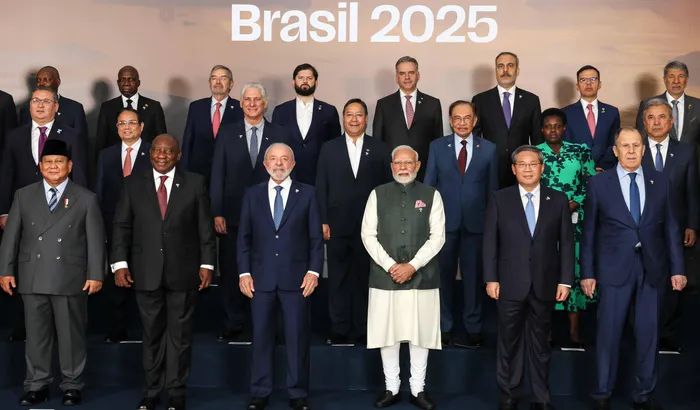
Heads of State and Government from BRICS Member Countries pose for a family photo at the XVII BRICS Summit at the Museum of Modern Arts held in Rio de Janeiro, Brazil on July 7, 2025. What makes BRICS threatening is its calls for de-dollarisation, says the writer.
Image: GCIS
Phakamile Hlubi-Majola
Fears of a confrontation between Iran and the United States are resurfacing. As tensions escalate, Iranian President Masoud Pezeshkian has moved swiftly to consult leaders across the Middle East, seeking to reinforce diplomatic and regional support.
At home, however, the country finds itself shaken by a wave of protests driven by soaring inflation, collapsing wages, and a widening cost-of-living crisis. Iran is still reeling from last year’s devastating war with Israel in June last year, cynically named the “Red Wedding Strike”, which was also supported by the U.S.
It is easy to view the unrest purely as an expression of domestic frustration. However, that would overlook the long shadow cast by decades of U.S.-led sanctions, and more importantly, the unmistakable signs of foreign interference shaping the moment. The sanctions regime imposed on Iran, which is backed by Western superpowers, is responsible for the economic pressures faced by the country, and this is fuelling domestic upheaval.
Israeli Prime Minister Benjamin Netanyahu has gone as far as urging Iranians to “stand up” and seize the “opportunity” for regime change. This was not an expression of solidarity, but rather an example of overt interference. Since 2024, and again amid 2025 escalations, his video appeals targeting the Iranian population have been promising that Israeli military operations would “clear the path” to their freedom, and he encouraged them to rise and overthrow the state.
Even Israel’s own media reporting made the posture plain: Netanyahu told his Cabinet that Jerusalem “stands with” Iranians seeking freedom and that this could be a pivotal moment. These remarks were delivered as Washington signalled readiness to “intervene” if crackdowns by the government against protesters mounted. In short, the information battlespace was primed long before any street battles emerged.
Let’s draw a hard line: Iranians have the right to protest, to dissent, and if they wish, to replace their government. But acknowledging that right does not mean pretending the current moment is purely organic.
Israeli officials and their U.S. interlocutors have moved in lockstep to narrate Iran’s unrest as a regime-collapse countdown, while Mossad-linked Farsi accounts and messaging explicitly encourage people to take to the streets.
Israel’s sudden enthusiasm for Iranian protests fits a longstanding pattern: pressure the rival, shape the narrative, and keep the possibility of destabilisation alive. This approach has been applied repeatedly across the Middle East and Latin America, often under the banner of “supporting democracy.” But in practice, it has little to do with democratic ideals and everything to do with geopolitical interests.
Nowhere is this clearer than in Venezuela.
For years, Washington openly backed Venezuela’s opposition, recognising a parallel “interim” government in 2019 and establishing a heavy sanctions regime to force outcomes on the ground.
More recently, the strategy escalated into a naval blockade of sanctioned tankers, vessel seizures, and then an unprecedented U.S. military invasion that resulted in the kidnapping of President Nicolás Maduro and the First Lady.
This has been justifiably widely criticised as trampling on sovereignty and international law. Officials then tied the “transition” to U.S. control over oil flows and postintervention investments, with talk of “running” the country through its energy sector. Trump went as far as declaring himself the ‘Acting President of Venezuela – this is unheard of.
These actions should not be seen as isolated crises but theatres in a wider effort to disrupt BRICS, isolate China, and preserve U.S. dominance, in particular, the dollar’s centrality. BRICS expanded meaningfully in 2024/25, bringing in Iran, Egypt, Ethiopia, and the UAE, with Indonesia.
The bloc now represents a massive share of the global population and PPP-measured GDP. Crucially, its formation includes energy heavyweights whose alignment can reshape trade and payments.
What makes BRICS threatening is its calls for de-dollarisation. This is reflected in the local currency settlements, alternative payment rails, and its political goal to reduce sanction exposure for its members. China-Russia commerce has shifted decisively into yuan and rubles.
The yuan even overtook the dollar as the most traded foreign currency on Moscow’s exchange in 2023. This is how de-dollarisation actually happens, transaction by transaction, thus eroding the habit of dollar settlement even if the Greenback remains dominant.
For Washington, that’s an economic and geopolitical red line. Every step BRICS takes to expand non-dollar trade, especially in energy, challenges the petrodollar architecture that has long underpinned U.S. hegemony.
Analysts across the spectrum acknowledge the trend: BRICS states are building a more multipolar financial ecosystem that steadily chips away at exclusive dollar dependence, even as the dollar remains liquid and dominant.
The numbers tell the story: the dollar still anchors the system, but its share of global reserves has slid to multi-decade lows of about 56–57%, while usage of “other” currencies and gold diversifies upward. This is an example of attrition, and sanctions have accelerated the search for alternatives.
Seen through this lens, destabilising Iran (a new BRICS member), and “managing” Venezuela’s oil taps, are about disciplining supply, policing payment choices, and warning other capitals, especially in the Gulf, that wandering too far from the dollar carries dire consequences.
Democracy is collective self-rule by the majority. It cannot be delivered by airstrikes, choreographed social media psyops, or foreign custodianship of national resources. When outside powers script a country’s politics while blockading, sanctioning, or seizing its assets, they are not “promoting democracy.”
What we are witnessing in real time are the pre-structuring outcomes in service of foreign interests and the limitation of the agency of the people who must live with the consequences. That is straightforward imperialism at its worst.
In Iran, Netanyahu’s appeals, amplified by Western media ecosystems, are part of a coercive narrative architecture designed to weaken a rival under the halo of “freedom.”
In Venezuela, the post-seizure of oil announcements, complete with the talk of U.S. companies “fixing” the industry and the direct control of sale proceeds, expose the core bargain on offer, which is political rearrangements, in exchange for resource access on someone else’s terms.
BRICS is not a panacea. Its members do not agree on everything. But its expansion and its push for settlements in local currencies are a direct response to the weaponisation of the dollar system. Whether you celebrate or lament that trend, it’s real, and it will shape how states respond to crises like Iran and Venezuela.
At any rate, the U.S. and its allies are in no position to criticise Iran, Venezuela, or any nation for that matter. In recent weeks, the U.S. has jailed journalists, shot and killed unarmed civilians in the street who were engaged in peaceful demonstrations, and it has unlawfully detained U.S. citizens, including children.
Trump’s presidency has unmasked the façade of adherence to the rules-based order and exposed America’s hypocritical role as a ‘human rights defender. Trump's administration is driving full-blown imperialistic plunder by any means necessary.
Supporting Iranians’ right to protest means defending the principle that Iranians must decide their future, even if their choices displease Washington or Tel Aviv. Supporting Venezuelans’ right to choose their leaders means rejecting any foreign “solution” that treats their oil as collateral and their institutions as disposable.
Sovereignty is the necessary container for democratic change. Without it, “freedom” becomes a lever for external agendas, and protesters are reduced to pawns on a chessboard.
While you may have misgivings about Nicolás Maduro or Ayatollah Ali Khamenei, that does not justify turning a blind eye to blatant foreign interference.
History teaches us that such interventions have catastrophic consequences. Iraq and Libya stand as grim reminders. They have been reduced to rubble, their societies fractured, and their citizens displaced.
They are a stark warning that imperialist meddling does not bring freedom; it brings ashes.
* Phakamile Hlubi-Majola is a professional communicator and former journalist. She writes in her personal capacity.
** The views expressed do not necessarily reflect the views of IOL, Independent Media or The African.