Steenhuisen's Resignation Shatters DA's Facade of Leadership Superiority
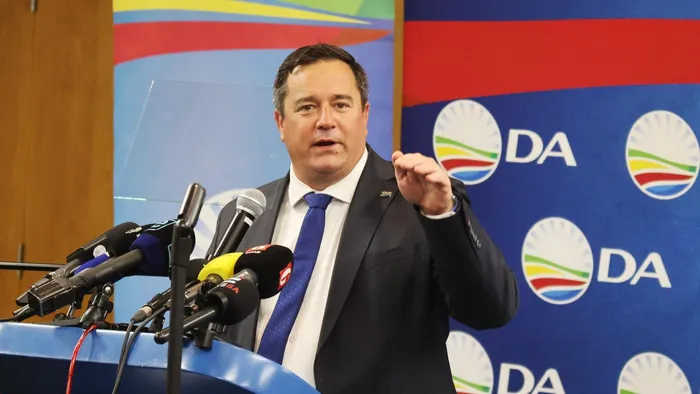
John Steenhuisen announced his stepping down as Democratic Alliance leader at a press conference held in Durban on February 4. Steenhuisen’s departure reflects the DA's history of a revolving door of leadership. Announcing a step back months ahead of a congress deviates from convention and suggests other forces are at play, says the writer.
Image: Boitumelo Pakkies/ Independent Newspapers
Dr. Reneva Fourie
South Africa’s Government of National Unity was meant to mark the Democratic Alliance’s arrival as a governing party. Instead, it has exposed strains that the organisation has long struggled to contain.
On Wednesday, February 4, John Steenhuisen confirmed that he would not stand again as federal leader at the DA’s congress in April. He cited the need to focus fully on his role as Minister of Agriculture, particularly given the foot-and-mouth disease outbreak that continues to threaten livestock farmers, food security, and export markets.
This carefully worded statement, however, illustrates the DA’s longstanding proficiency in narrative management and spin doctoring. The party has repeatedly demonstrated skill in deflecting attention from intra-party discord and personal controversies by redirecting focus outward, often reframing national government developments as reflections of its own influence while downplaying the contributions of coalition partners or preceding administrations.
Pressures to remove Steenhuisen had built steadily over the preceding months. In late 2025, allegations relating to his personal finances resurfaced. Reports of a default judgment of approximately R150 000 on credit card debt entered the public domain, alongside claims that a party issued a credit card had been used for personal purchases, including food deliveries and household goods.
While an internal inquiry cleared him of misusing party funds, the episode nevertheless reinforced perceptions of blurred lines between personal conduct and public responsibility. In a political culture increasingly shaped by economic precarity and declining trust, such controversies reverberate beyond their technical resolution.
Older personal matters were also revived. Steenhuisen’s resignation as DA leader in KwaZulu-Natal in 2010, following reports of an extramarital relationship with Terry Kass Beaumont, whom he later married, was cited as evidence of lingering vulnerabilities.
The relevance of events more than a decade old might reasonably be questioned. Their reappearance, however, speaks to the intensified scrutiny that accompanies proximity to state power and the thinner margin for error faced by leaders who once operated at a distance from the executive.
More damaging still was a public clash with Dion George, formerly Minister of Forestry, Fisheries and the Environment. George accused Steenhuisen of engineering his removal in November 2025 to protect commercial interests linked to captive lion breeding and trophy hunting. He alleged connections between industry actors and his successor, Willie Aucamp.
George had previously blocked Steenhuisen’s access to the party credit card over spending concerns. His resignation from the DA in January 2026, followed by outspoken criticism of the party’s trajectory within the GNU, amplified perceptions of factionalism, ethical unease and unresolved questions about influence and accountability.
Steenhuisen’s departure reflects the DA's history of a revolving door of leadership. Announcing a step back months ahead of a congress deviates from convention and suggests other forces are at play, rather than a straightforward personal choice. The forthcoming congress now seems destined to centre on intense leadership contests and power struggles rather than policy priorities, with factional manoeuvring escalating as the party experiences executive authority within the GNU.
Speculation surrounds Helen Zille's involvement. As chairperson of the Federal Council, she exercises substantial influence over party structures and processes. Strained relations between Zille and Steenhuisen emerged during the initial GNU negotiations with the ANC, revealing competing centres of power. Zille's reputation as a highly strategic and controlling political figure suggests she may have played a pivotal role in shaping the conditions that led to Steenhuisen's announcement.
The DA's assertion, which veiled Steenhuisen’s stepping down announcement, that national-level progress derives from its own contributions, lacks substance. The party has consistently opposed progressive legislation and social programmes aimed at addressing historical inequalities and promoting inclusive development. Many such initiatives have proceeded despite DA resistance, building on foundations laid by earlier administrations.
Furthermore, Steenhuisen's claim that he must abandon party leadership to focus on government duties ignores established realities: detailed policy execution and implementation fall largely to technocrats and civil servants. Politicians perform oversight functions and seek coherence within policy frameworks predominantly determined by the largest coalition partner, the ANC.
For all its rhetoric, the DA falls well short of possessing the capacity to govern South Africa on its own terms. Its elevated position stems primarily from ANC weaknesses and the splintering effect of the uMkhonto weSizwe Party's participation in 2024, which likely denied the ANC an outright majority. The DA itself has made no substantial inroads beyond its established urban and demographic strongholds, failing to expand support meaningfully among broader constituencies.
Candidates positioned as potential successors appear ill-equipped to meet the demands of steering Africa's largest economy and serving as a prominent Global South actor. Comparisons between figures like Cape Town mayor Geordin Hill-Lewis, at 39 years old and with municipal experience, and President Cyril Ramaphosa, who brings decades of leadership in trade unions, business negotiations, and international diplomacy, highlight a sharp disparity in stature, experience, and cross-societal credibility.
Supported extensively by business interests, the DA has cultivated a narrative that casts any coalition emphasising pro-poor, redistributive policies as inherently disastrous, punting the label ‘doomsday’ coalition. This framing distorts the landscape. Several left-leaning parties and movements possess intellectual depth, historical legitimacy, and expertise that surpass the DA's offerings.
Azapo's Prof Itumeleng Mosala commands respect across academic and business communities. The South African Communist Party draws on a distinguished tradition of resistance. It features what is arguably the highest concentration of advanced academic qualifications among South African political formations, including leaders such as Jeremy Cronin, Lechesa Tsenoli and Dr Rob Davies.
If any coalition poses genuine risks of political regression, it will more accurately describe arrangements resembling the abandoned Moonshot Pact. Such an alliance would reduce the country to a proxy of the United States interests while dragging its politics back towards the exclusions and hierarchies of the apartheid era. It would narrow democratic choice, weaken popular sovereignty, and replace transformative ambition with managerial obedience to external power. The consequences of operating within such a political framework are now becoming visible inside the DA itself.
John Steenhuisen’s withdrawal from the DA leadership contest reveals how immersion in the Government of National Unity has exacerbated rather than alleviated the party’s internal weaknesses. What was presented as a means to national influence has instead magnified factional divisions, personal scandals, financial scrutiny, and ideological compromise.
The April congress will act as a critical test of the DA’s capacity to manage leadership transition amid intensifying succession battles. Yet the persistent reliance on narrative deflection, combined with limited popular reach and uneven readiness to govern, suggests that proximity to power has deepened rather than resolved the party’s fundamental constraints.
Realising South Africa’s full potential will require political leadership rooted in social mandate and moral clarity, not coalitions sustained by expediency and insulated from the realities facing most South Africans. Without such leadership, arrangements that prioritise power-sharing over people’s needs risk perpetuating inequality and deepening disillusionment with the democratic project.
* Dr Reneva Fourie is a policy analyst specialising in governance, development and security.
** The views expressed do not necessarily reflect the views of IOL, Independent Media or The African.