SONA 2026: Policy Tweaks Not Enough To Bridge SA's Economic Divide
STATE OF THE NATION ADDRESS
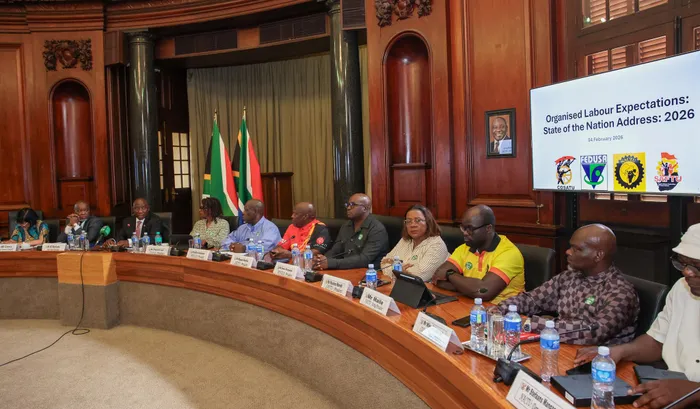
President Cyril Ramaphosa engages with leaders of Organised Labour as part of his broader engagement with social partners ahead of the 2026 State of the Nation Address. The meeting with COSATU, FEDUSA, NACTU and SAFTU was held at the Union Buildings on February 4.
Image: GCIS
Dr. Reneva Fourie
On February 12, South Africans will once again listen to the President’s State of the Nation Address. For many, the ritual will feel familiar, yet distant. The President’s words will ring true for some and be entirely unrelated for most.
This division captures the central, enduring contradiction of a country whose people are generally nice, who fought a profound revolution for prosperity, equality and harmony, yet who live within systems that do not work for the majority. While the country is hardly a failed state, it is necessary to recognise that the current prosperity remains beyond the reach of most citizens.
This division is not new. In the early 2000s, former President Thabo Mbeki formally articulated the concept of South Africa’s two economies. He acknowledged that marginalised communities struggled to be absorbed into the economic mainstream. This analysis prompted significant government investment into medium, small, micro and collective enterprises.
Later, the political analyst Steven Friedman provided a more precise characterisation. He described South Africa as a country of ‘insiders’ and ‘outsiders’: those who benefit from the formal market economy and those who are structurally excluded from it.
The government has indeed made strides in developing the informal economy, but these interventions have not come anywhere close to addressing the systemic challenges that underpin the national economy. The economic architecture and the state apparatus often work in tandem to exclude the majority and maintain a cycle of poverty.
Business interests can thrive on a vast pool of desperately unemployed people, who are forced to sell their labour for a pittance. Meanwhile, state interventions, however well-intentioned, frequently only reinforce the position of those already inside the system.
Attempts by outsiders to gain entry are routinely thwarted. They lack the most basic material resources and meaningful access to power. The existence of constituency offices across the country does little to bridge this fundamental gap.
When people in these communities, in their despair, abandon formal hope, they are often labelled negatively. Their reliance on the temporary relief provided by a social grant, or their turning to substances to numb their circumstances, is framed as a personal failing rather than a systemic outcome.
This dynamic extends beyond the economy into the realm of crime, which also has its insiders and outsiders. Sophisticated syndicates collaborate with elements of power to amass unimaginable wealth with impunity. Others steal, peddle or commit petty crimes purely as a means of survival.
The majority, however, simply wallow in a quiet despair. They watch the cars drive by, see restaurants filled with patrons, and observe clothing stores bustle with activity. They gradually accept that a standard way of life for some will forever remain out of reach for them.
The annual address will follow a familiar cadence. The public will listen to a recitation of the wonderful things the government has done, and the wonderful things it plans to do, knowing with a weary certainty that these wonderful things are not about them. As Steven Friedman correctly observed, insider politics is characterised by a performance of speaking for the poor, executed without any substantive consultation with those who actually live in poverty.
The speech will likely announce that the economy is improving and detail interventions to boost youth employment. This will be heard against the backdrop of the fact that the vast majority of young people will remain without work.
It will state that tax collection has improved and that fiscal debt is stabilising. This technical reassurance will coincide with the persistent reality of hunger and social grants that increase by a mere pittance.
There will be announcements of improvements in the network industries, while communities continue to experience daily electricity outages and water shortages. The logistics sector may be praised, yet the rail system remains incapable of transporting goods safely and efficiently. This failure results in more trucks on the roads and the continuing tragic loss of loved ones in road accidents.
The address will cite the successes of commissions and task teams in combating corruption and crime. The public, however, will know that this will have little impact on the ground-level collusion among some in the local police, the courts, and those guilty of crime.
The event will also feature its ancillary spectacle, the fashion parade. The admiration of the lifestyle of the powerful will be presented as an inspiration. It suggests that maybe, one day, others could also attain such a position and, in doing so, contribute to building the local fashion industry.
For many outsiders, it is merely a brief peek into the insulated world of the insider. For them, the State of the Nation Address is an irrelevant pageant. Regardless of the output, the outcome is perceived as immutable. Inequality will deepen, and poverty, hunger and joblessness will remain entrenched.
This profound disillusionment has eroded the perceived value of elections scheduled for later this year among a significant portion of the populace. The outsiders know the system does not recognise them. More than that, they understand it is consciously constructed to retain their exclusion. Voting feels like a ritual of endorsement for a structure designed to keep them on the outside.
Their political agency has been hollowed out. In the face of this, community solidarity becomes their essential solace. It is a space where mutual difficulties transcend harsh judgment, where neighbours share the little they have, and where a fragile dignity is preserved through collective endurance. This informal solidarity network is the real social safety net, operating in the stark absence of meaningful systemic inclusion.
The challenge, therefore, is not simply one of policy tweaks or increased public investment. It is a more fundamental crisis of political and economic belonging. This unresolved duality strains the country’s peace and its famed harmony.
South Africans may be nice, and we may desire systems that work, but for as long as the architecture of the state and the economy perpetuates the division between insiders and outsiders, that desire will remain a distant aspiration for the majority.
The future stability of the country depends on a genuine, structural dismantling of this divide, moving beyond speaking for the outsiders to finally, meaningfully, integrating them into the fabric of a shared economic and political life.
* Dr Reneva Fourie is a policy analyst specialising in governance, development and security.
** The views expressed do not necessarily reflect the views of IOL, Independent Media or The African.