Navigating sovereignty: Africa's role in the US, China Rivalry
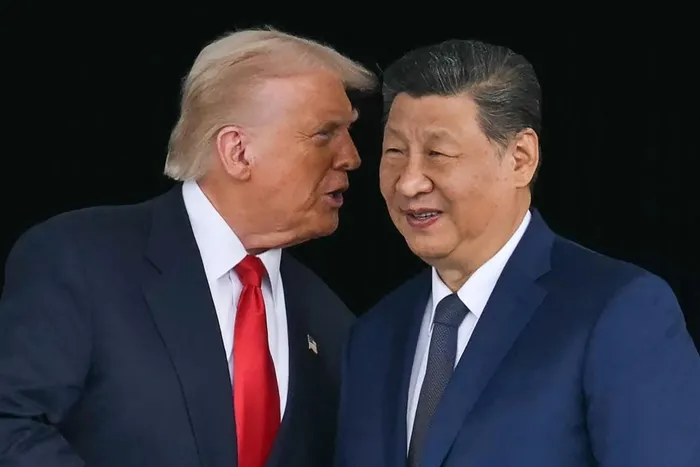
US President Donald Trump (left) talks to China's President Xi Jinping at the Gimhae Air Base, located next to the Gimhae International Airport in Busan on October 30, 2025.
Image: AFP
Kim Heller
Post-colonial Africa remains both pawn and prize in the rigged play of imperialistic expansion and extraction.
The stakes are rising as the competition for global supremacy between the United States and China heightens. Africa has the opportunity to emerge as a victor, rather than an eternal loser.
Africa's trump card is its vast mineral wealth and strategic geopolitical value. Nevertheless, it has failed time and time again to come up with a winning hand, seemingly unable to transform its economic and geopolitical strength into sustainable economic sovereignty.
It is time for the Continent to change the rules of the game, stop being the joker in the pack and take charge of the Continent's riches, value chains, revenues and developmental outcomes. If it fails to do so, the immense structural dependence on foreign nations will ultimately kill any promise of Continental sovereignty.
As Africa's reliance on China increases, the United States, which has paid scant attention to Africa's well-being and economic fortunes over recent years, focusing largely on security arrangements, has been forced to reevaluate its economic strategy for Africa.
The U.S. has not taken China head-on economically. Rather, the U.S. focus has been on proposing trade-aligned infrastructure projects and financial mechanisms to shift the Continent's mineral flows away from China and into U.S.-aligned supply channels.
The large-scale Lobito Corridor project is a U.S. flagship. While it links the DRC and Zambia to Angola's Atlantic coast, and is a positive boost for regional development and integration, the corridor is first and foremost a security passage for the U.S.
Over the past few decades, China's partnership with Africa has been built on mining concessions, the steady exchange of infrastructure for resources, and financing terms less conditional than those offered by many Western powers, including the United States.
China's partnership terms and conditions are far more favourable than those typically offered by Western powers. China may be a 'better partner', but this is no game-changer for Africa. Local beneficiation remains curtailed.
Further to this, economic value chains remain externally controlled, and skills transfer is poor. In the Democratic Republic of Congo (DRC), the majority of operations are carried out by Chinese companies. So too is global refining capability. There is still an injustice in play as Africa continues to provide raw materials vital to the global green transition. Economic power and yields remain offshore, while African nations gain little benefit from extraction and suffer environmental damage.
In the guise of global domination, Africa is no equal partner with either China or the United States. The Continent, lured and inspired by the prospect of new alliances, tends to engage with too much cordiality and too little clout.
True sovereignty is not based solely on resource ownership, but on the firm foundation of product processing, distribution, and pricing, as well as market access. In this respect, the Continent remains curbed rather than empowered. Africa's shift towards Beijing and away from Washington is often celebrated as a real ace for Africa.
However, China, like the U.S., operates within a global power deck that still places Africa at the bottom of the pile. China may offer more favourable terms and fairer engagement terms than Western players. However, China-Africa relations have not prioritised the structural transformation needed to enable Africa to move up the value chain and claim its rightful share of the benefits.
There are small shifts in the right direction, as some African nations begin to shape the terms and conditions of partnering. Recently introduced cobalt export quotas in the DRC are encouraging. This has not only stabilised prices but has also begun to disrupt old patterns of rampant resource exports.
Africa would do well to use the U.S.-China rivalry to bolster its negotiation strength. There is no obligation nor benefit for Africa to choose sides. Rather, Africa should showcase its wingspan and scope by acting collectively rather than on a fragmented basis. Coordinated bargaining will see Africa win.
The African Union's Africa Green Minerals Strategy (AGMS), adopted in 2025, is a strong continental blueprint for regional industrialisation, sustainability, and climate resilience. AGMS could serve as a powerful negotiating platform to set and ensure minimum access terms, aligned policies across African states, and optimise development across the Continent. Alignment between national strategies, the AGMS, and the African Continental Free Trade Area (AfCFTA) can build integrated value chains.
This will benefit domestic and regional priorities and boost Africa's collective leverage in the mineral economy. Beneficiation for Africa must become non-negotiable. Without this, colonial economic patterns will continue to be reproduced rather than rooted out. Without domestic refining, processing and manufacturing, Africa will continue to be dealt a poor hand, while foreign nations will continue to enrich themselves on Africa's riches.
Financial sovereignty is king. Strongly diversified funding sources and robust domestic revenue mobilisation will help Africa to negotiate from a position of strength.A stronger regulatory environment is necessary. This will include enforcing labour rights and ensuring adequate environmental protection. While this may repel quick economic wins, it will enable longer-term, more sustainable partnerships with foreign partners.
Without good governance, accountability and institutional capacity, country sovereignty is always fragile and under threat. Unless these fundamentals are in place, economic prosperity and sovereignty remain imperilled.
With global demand for critical minerals expected to increase significantly, Africa is well-positioned for growth. This is a prized opportunity for the Continent to define the terms and conditions of engagement with international partners.
African states can become rule-makers in this critical game of U.S.-China rivalry and broader contest over critical minerals. The question is whether Africa is sophisticated enough to exploit the tussle between these two superpowers for its people or will it forever remain a subservient player. The time to act is now, while the rivalry keeps the cards in play.
If Africa fails to take advantage of this historical opportunity, it will remain trapped in an ever-exploitative cycle of non-beneficiation and lack of transformation. The rigged play will continue, and the promise of economic sovereignty will slip away.
Once again. If this is the outcome, Africa should be held culpable in its own lack of sovereignty.
* Kim Heller is a political analyst and author of No White Lies: Black Politics and White Power in South Africa.
** The views expressed do not necessarily reflect the views of IOL, Independent Media or The African.