Curbing SONA Opulence Amid Poverty, Unemployment Crises
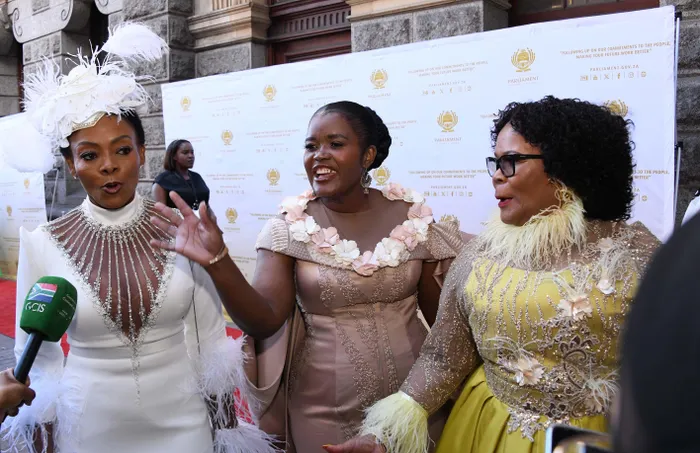
Guests at the SONA 2024 red carpet before President Cyril Ramaphosa delivered his annual address in Cape Town on February 8, 2024.
Image: GCIS
Prof. Bheki Mngomezulu
The State of the Nation Address (SONA) is an annual event whereby the sitting President of the country addresses the joint sitting of the National Assembly and the National Council of Provinces (NCOP) in terms of Section 42(5) of the Constitution. It brings together the three arms of government: the executive, the legislature, and the judiciary.
Its dual purpose is to afford the president the opportunity to reflect on what the government has achieved since the previous SONA and to outline the government’s programme for the new year. In so doing, the president identifies any challenges the government experienced but also tells the nation how those challenges will be addressed. SONA marks the official opening of parliament for the current year.
Previously, since 1994, SONA has contained key priorities presented during the ANC’s January 8 statement, discussed at the ANC lekgotla, and in the Cabinet Lekgotla. This was so because the ANC was the governing party. Whatever policy decisions and priorities that were adopted at Luthuli House would find expression in parliament through deployed ANC members.
Following the outcome of the 2024 general election, where the ANC obtained 40.18 per cent, which was far below the fifty-plus-one threshold, coalition politics kicked in at the national level. This meant that while the ANC’s January 8 statement and the ANC Lekgotla would still matter, the cabinet lekgotla was bound to be different. The views of other coalition partners would henceforth have to be factored in before the SONA is finalised.
In other words, SONA is no longer an ANC promise to the South African public. Instead, it is the agenda set by the government for all coalition partners. If its promises are delivered, accolades can no longer go to the ANC but to the coalition government.
Similarly, if the government fails to deliver on its promises, the ANC cannot be the only party to shoulder the blame, but all ten political parties currently members of the multiparty coalition government. This was the case with the 2025 SONA and the 2026 SONA, which were delivered by President Cyril Ramaphosa on Thursday, February 12, 2026.
Another context is that every year SONA happens when the country’s economy is ailing and failing to grow by even 2 per cent. Meanwhile, countries like Ghana see their economies growing by over 5 per cent.
The sad reality is that, as the country’s unemployment rate is alarming, crime statistics are high, and housing construction records a serious backlog, SONA continues to present a false notion of a country of opulence.
Millions of rands are spent on an event that lasts for less than three hours. Is this razzmatazz necessary? What is the use of being extravagant for one day, setting the agenda for the whole year, only to fail to implement the government’s programme due to the shortage of funds? There is no logic in that.
One of the justifications provided for an extravagant SONA is that it contributes to the economy through flights and accommodation, among other things. While this is factually correct, it is analytically flawed. Most of the people who attend SONA have their expenses paid for by the state.
This year’s SONA was not different. The political leadership from all nine provinces descends to Cape Town, leaving the people they lead languishing in poverty, water scarcity, and other related matters. Yes, premiers should attend, but other leaders should remain in their provinces to provide services to communities.
Another concern with SONA is that Members of Parliament (MPs) and other guests go all out to buy the best outfits for the day. Meanwhile, children from neighbouring communities struggle to raise registration fees at various tertiary institutions. While it is true that these MPs use their own money, such money could assist in alleviating poverty and reducing the number of students who fail to meet their registration fee requirements.
If more students register for their academic programmes and complete their qualifications, the country’s education profile is positively impacted. Some of them assist in creating jobs for themselves and other people. This is a double-edged sword. It assists the government in reducing unemployment while also contributing to economic growth.
With SONA now behind us, the same extravagance will be witnessed when the country’s nine provinces prepare for their State of the Province Addresses (SOPAs). What we saw on Thursday with SONA will be repeated during provincial SOPAs. This will happen while communities are not receiving basic services.
Some provincial governments and municipalities fail to use their allocated funds and eventually return those funds to the national treasury. Between 2020/2021 and 2023/2024 financial years, about R10 billion rand was returned to the treasury. Provinces that were the worst culprits were Gauteng, Limpopo, North-West, and Free State. This does not mean that the other five provinces were not guilty of the same transgression.
The message from the discussion above is clear. As a country, we must cut our cloth according to its size. There is no need to waste money on SONA and SOPAs when people do not receive basic services.
Firstly, our national assembly and our executive are bloated. Even some of the First World countries operate on trimmed but more efficient governments. When they have events like SONA, they keep their budget low.
The fact that we have so many ministers and deputy ministers is enough. The fact that each of them uses more than one car and has two official residences in Pretoria and Cape Town is enough. A lot of money is used per minister. To add salt to a blistering wound, when we place leaders on special leave and appoint others in their positions, we pay both but still claim that the country has no money. This does not make sense.
Given our current socio-economic situation as a country, we should do things differently. The SONA that we inherited from the apartheid regime cannot be kept in the same manner. SONA and SOPAs should be used to set the government’s agenda, not to demonstrate unnecessary opulence and extravagance.
* Prof. Bheki Mngomezulu is Director of the Centre for the Advancement of Non-Racialism and Democracy at Nelson Mandela University.
** The views expressed do not necessarily reflect the views of IOL, Independent Media or The African.