Rethinking Criminal Justice Reform: Moving Beyond Force
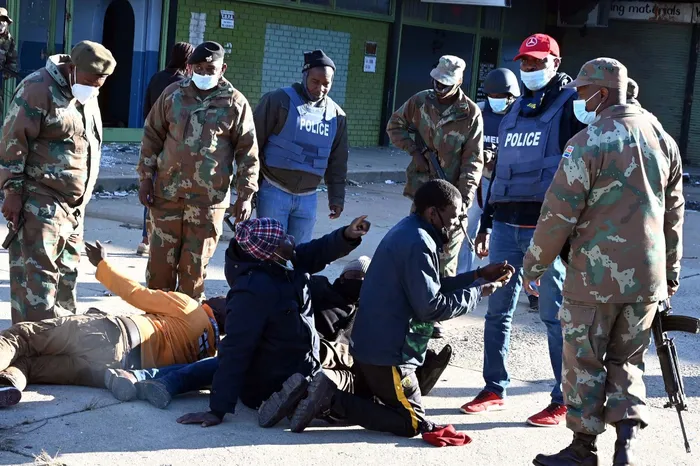
A joint SAPS, SANDF during the Covid pandemic in Johannesburg's Alexandra township. A safer society will not be built through force alone but through redistribution, accountable governance and empowered communities, says the writer.
Image: GCIS
Dr. Reneva Fourie
As the country marks 70 years since the historic women’s march to the Union Buildings against pass laws, 50 years since the Soweto student uprisings, and 30 years since the adoption of the Constitution that underpins South Africa’s democracy, we are compelled to ask whether the democratic state has succeeded in creating the conditions under which the majority of South Africans can live without fear, deprivation, or structural violence.
Crime statistics from the South African Police Service, covering the first half of the 2025/26 financial year and released in November 2025, present a deeply troubling picture. While overall murder rates have decreased nationally, the Western Cape stands as a stark exception, with four of the country’s five worst murder stations located within its borders.
Violence against women and children remains critically high and continues to rise in specific categories. An estimated ten women are still killed every day. During the six months under review, alone, nearly 200 rapes were recorded on school grounds. Gang violence, firearm proliferation and entrenched inequality continue to shape everyday life in many communities.
Crucially, the Madlanga Commission has become a focal point for exposing institutional rot, with its hearings laying bare not only entrenched corruption but also the widespread frustration and obstruction experienced by oversight bodies, such as the Independent Police Investigative Directorate (IPID).
Testimonies from IPID officials have illustrated their persistent struggles: a lack of municipal cooperation, repeated failures by the National Prosecuting Authority to act on strong evidence, and political interference that undermines both investigations and prosecutions. This paralysis has normalised impunity and emboldened criminal networks.
Against this backdrop, it was fitting that a substantial portion of President Cyril Ramaphosa’s State of the Nation Address, delivered on 12 February, focused on crime and corruption. A central question is whether the government is prepared to confront the root causes of crime or manage crisis after crisis with force.
While the president acknowledged systemic failures, he also introduced repressive state mechanisms to address the symptoms rather than the cause. Crime is inseparable from entrenched inequality, poverty, unemployment and the unresolved legacies of apartheid, reinforced by ongoing neoliberal economic policies.
Although President Ramaphosa's speech acknowledged some social determinants of crime, it ultimately prioritised militarised enforcement and incremental reforms over transformative redistribution and meaningful community empowerment.
This orientation reflects the broader trajectory of the Government of National Unity, which has increasingly adopted centrist governance within a capitalist framework. The result is an emphasis on stability and incremental reform rather than big changes to ownership, wealth and power.
There were elements of the address that gestured towards potentially constructive approaches. Coordinated socio-economic interventions, such as improved street lighting and continued access to social services, deserve recognition.
Investment in public infrastructure and welfare can mitigate desperation-driven offences stemming directly from economic marginalisation. However, these measures will remain ineffective unless implemented with urgency and sufficient scale.
The recruitment of 5,500 additional police officers builds on prior promises but avoids deeper reforms required within the police service. While technology upgrades are welcome, many officers work under difficult conditions, earning wages that do not cover the cost of living.
Reform must prioritise competitive salaries, comprehensive training in community engagement and de-escalation techniques, and transparency through regular audits. Reliable vehicles, functional computers and access to reliable, secure, fast internet must be provided. Technology alone cannot compensate for these systemic failures or restore public trust.
The continued outsourcing of key state functions has enabled corruption to flourish. Businesses bribe and kill to secure lucrative tenders, hollowing out public institutions. Proposals to introduce lifestyle audits and implement the Madlanga Commission – and that of other commissions established to fix the criminal justice system – are long overdue. Working-class and black communities bear the brunt of this failure. The criminal justice system is now unmistakably at a tipping point.
The proposed Whistle Blower Protection Bill could empower citizens and workers to expose corruption without fear. It has to be passed urgently and adequately resourced. Streamlining gun laws and targeting illicit economies such as counterfeit goods using artificial intelligence and data analytics might disrupt criminal exploitation in informal sectors, but they carry serious risks if not rooted in community leadership and accountability.
Strengthening anti-corruption bodies, including the Hawks and the National Prosecuting Authority, alongside procurement reforms, could redirect resources lost to corruption back into social programmes. Systemic corruption, weak prosecutions and the ongoing danger faced by whistleblowers and investigators cannot be resolved through slow, piecemeal change. Decisive and immediate reform is essential to prevent total institutional collapse.
However, the call for yet another criminal justice reform initiative modelled on Operation Vulindlela is misguided. Creating a new coordinating body dilutes accountability and drains public resources. Existing institutions must function effectively now. Justice delayed is justice denied, and delay has become a defining feature of the system.
Given South Africa’s history of authoritarian policing under apartheid, the renewed emphasis on law and order is troubling. The address’s pivot to zero tolerance and full force of the law evokes punitive neoliberalism, sidelining calls for restorative justice and properly funded community-led safety initiatives. Framing organised crime as the most immediate threat to democracy obscures the conditions that allow criminal networks to flourish.
Mass unemployment currently exceeding 32 per cent nationally, severe youth joblessness, inadequate housing and persistent gender inequality all contribute to the social environment in which violence takes root. These conditions are themselves shaped by the neoliberal policies underpinning Operation Vulindlela thinking.
The deployment of the South African National Defence Force to combat gang violence and illegal mining is particularly alarming. Unfortunately, circumstances have deteriorated to the point that military deployment has become a necessary evil.
Militarising civilian spaces consistently leads to human rights abuses in poor, black communities, as seen in past operations where soldiers have been accused of excessive force. This must remain an absolute last resort and a strictly temporary measure. Treating social crises with repression echoes apartheid era tactics and risks escalating violence rather than resolving it.
Any military intervention must be short-term and immediately followed by decriminalisation of survival economies, investment in worker-owned cooperatives and inclusive local development. Sustainable safety depends on economic justice, decent work and social dignity.
As South Africa enters 2026, safety cannot be separated from equality. Unless urgent, systemic reform of the criminal justice system is undertaken now, public trust will continue to erode, and violence will intensify.
A safer society will not be built through force alone but through redistribution, accountable governance and empowered communities.
* Dr Reneva Fourie is a policy analyst specialising in governance, development and security.
** The views expressed do not necessarily reflect the views of IOL, Independent Media or The African.