Budget 2026: Is There Political Will To Break From Neoliberal Orthodoxy?
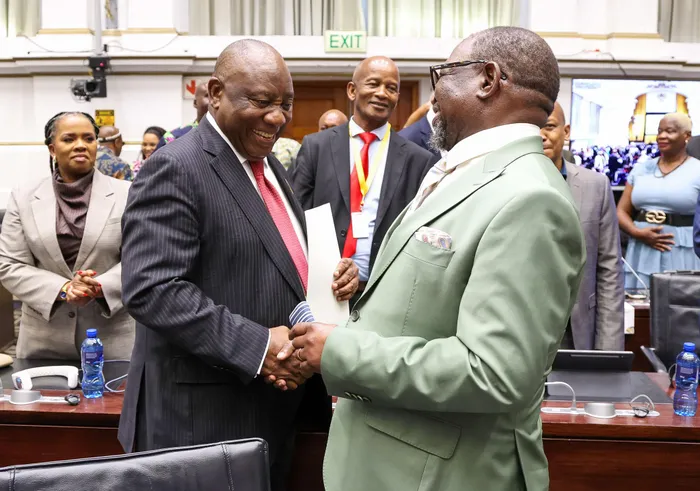
President Cyril Ramaphosa (left) congratulates Finance Minister Enoch Godongwana following the tabling of the Medium-Term Budget Policy Statement (MTBPS) in Parliament, Cape Town on November 12, 2025. The fiscal journey of the past decade reveals a government caught between grand ambition and the harsh arithmetic of austerity, says the writer.
Image: Jairus Mmutle/GCIS
Dr. Reneva Fourie
When President Cyril Ramaphosa stood before Parliament on 12 February 2026 to deliver his State of the Nation Address, he painted a picture of a country finally turning the corner. With four consecutive quarters of GDP growth, two primary budget surpluses, and the end of load shedding, the speech was rich with optimism.
Yet the fiscal journey of the past decade reveals a government caught between grand ambition and the harsh arithmetic of austerity.
The 2025 budget cycle exposed deep fissures within the Government of National Unity. The postponed budget, the VAT dispute, and the contested Medium Term Budget Policy Statement revealed a coalition constrained by unresolved ideological tensions over taxation, spending priorities, and the role of the state.
The 2026 Budget Vote will be a decisive test. It will show whether narrative cohesion around the government’s programme indeed exists. It will also determine whether resources align with the ambitions articulated in the State of the Nation Address, or whether the fiscal framework will once again undermine them.
Expansionary Promises Meet Fiscal Constraint
The expansionary ambitions – and the contractionary fiscal framework that governs them – mark a clear contradiction. The president speaks of infrastructure investment, hiring thousands of police officers and labour inspectors, expanding social grants, and ending child stunting. Yet the fiscal trajectory remains one of consolidation.
Baseline allocations across departments are frozen or trimmed in real terms, and new commitments are expected to be absorbed within existing ceilings. Debt stabilisation and market confidence remain the overriding priorities.
The implications of this contradiction are felt most sharply in frontline public services that underpin the democratic state. Below-inflation allocation restricts the ability to employ unemployed doctors, strengthen clinics, expand early childhood education, recruit teachers, and stabilise public transport infrastructure. In many cases, these allocations remain uncertain or are reduced in real terms.
Privatisation And Underfunding Weaken The State
An equally stark contradiction is that between the government's rhetorical commitment to a capable developmental state and its active dismantling of that state through privatisation. Strategic public functions are increasingly outsourced to private actors, while state capacity continues to erode.
There is increased private sector participation in energy, ports, logistics, water, and municipal services. Treasury presents these arrangements as efficiency-enhancing and fiscally prudent. Yet the budgetary reality is that revenue streams are diverted to private profit, public institutions are hollowed out, and accountability is weakened.
State-owned enterprises are key to industrialisation, and a national industrial policy requires that public expenditure and SOE procurement be critical instruments for leveraging industrial development in South Africa. The leveraging of procurement by SOEs is viewed as central to driving the localisation agenda in support of SMMEs, investments, industrial capacities, and meaningful public job creation.
The scale of resources devoted to SOEs in recent years, and the controversy surrounding their use, cannot be ignored. However, the problem is not that SOEs are publicly owned but that they have been captured, underfunded, and mismanaged. The solution is not to hand strategic assets to private interests but to rebuild public capacity, enforce accountability, and resource SOEs to fulfil their mandates.
The flagship one-trillion-rand infrastructure programme illustrates this conundrum. While presented as transformative, it lacks binding conditions on job creation, local procurement, or industrial development.
Without such alignment, the 2026 Budget Vote risks authorising large-scale capital spending that reproduces the failures of past infrastructure booms: cost overruns, limited employment impact, and private capture of public investment.
Local government offers an even clearer warning. As municipalities are pushed towards the privatisation of water, electricity, and waste services, residents increasingly face higher costs, uneven access, and declining accountability. These shifts occur without any significant acknowledgement of the structural underfunding that prevents municipalities from fulfilling their constitutional obligations.
The 2026 Budget Vote will therefore be underpinning a model in which local government is starved of resources, communities bear the consequences of service failure, and privatisation is presented as the only solution.
Fiscal Choices Deepen Social Distrust
The implications of the 2026 Budget Vote extend beyond service delivery to questions of sovereignty. The continued prioritisation of inflation targeting, debt stabilisation, and investor confidence, often under pressure from international financial institutions, narrows the democratic space for economic choice. Economic health is increasingly measured by bond spreads rather than traditional metrics such as employment, production, or social outcomes.
Consequently, trust in government is extremely low. Most South Africans believe political leaders are untrustworthy and disconnected from ordinary life. This distrust is rooted in people’s lived experiences characterised by failing socio-economic infrastructure and services, and persistent unemployment.
Economic data reinforces this fracture. More than half of South Africans report going often without a cash income, and one in four often experience food insecurity. Measurable improvements in economic inclusion and household wellbeing will prove a critical test for the GNU going forward. Yet the fiscal framework offers no such improvements.
Calls for national dialogue and social compacts, while welcome, cannot substitute for material delivery. Budgets, not speeches, are the primary instruments for building trust. If the allocations do not match the commitments of the State of the Nation Address, the credibility gap will widen further.
The Budget Will Define Sovereignty
As South Africa faces growing external pressure linked to its foreign policy positions, internal resilience becomes more important. Diplomatic disputes, sanctions threats, and economic coercion expose the limits of symbolic sovereignty.
A state weakened by austerity lacks the institutional muscle to defend its sovereignty. A police service constrained by budgets cannot protect communities. An under-resourced defence force cannot secure borders. An intelligence apparatus weakened by austerity cannot effectively counter foreign interference.
The 2026 Budget Vote will therefore play a strategic role. Funding decisions for security, border management, intelligence, and diplomacy are not optional extras. They are preconditions for meaningful sovereignty. A state that cannot resource these functions risks reducing independence to rhetoric.
Stability without transformation is no longer politically or socially sustainable. If the government is serious about job creation, it must fund public employment. If it is serious about ending hunger, it must allocate resources to that end. If it is serious about rebuilding municipalities, it must resource them. Expansionary rhetoric requires expansionary resources. And fiscal discipline must serve developmental goals, not replace them.
The fundamental question posed by the 2026 Budget Vote is whether South Africa can resolve its internal contradictions before external pressures exploit them. Fiscal anchors cannot feed children. Credit ratings cannot provide healthcare. Budget surpluses cannot secure sovereignty. And a state that cannot materially provide for its people will struggle to defend itself from those who seek to undermine it.
Ultimately, the 2026 Budget Vote will reveal whether the Government of National Unity possesses the political will to break from the neoliberal orthodoxy that has failed the majority of South Africans.
This week's budget must answer whether this government serves bondholders or citizens, whether it will overcome the spatial unevenness apartheid bequeathed or entrench it further, and whether it believes sovereignty is a rhetorical posture or a material reality. South Africans have heard the promises. Now we must see the numbers.
* Dr Reneva Fourie is a policy analyst specialising in governance, development and security.
** The views expressed do not necessarily reflect the views of IOL, Independent Media or The African.