Coalitions and Austerity: Navigating South Africa's Economic Challenges
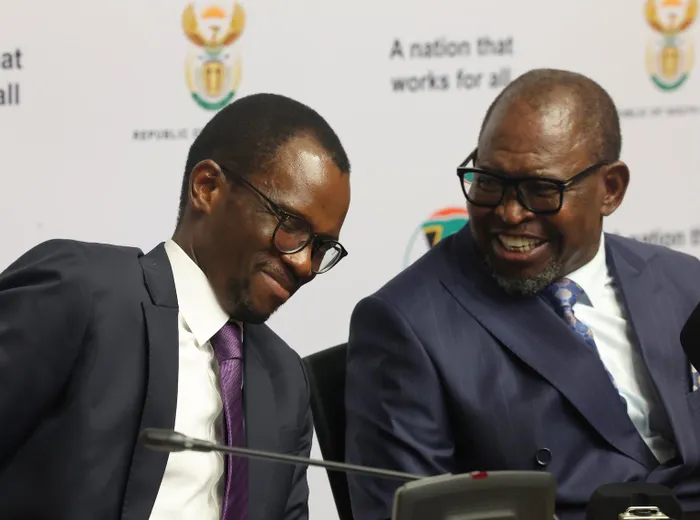
Finance Minister Enoch Godongwana and his deputy David Masondo at a media briefing on the 2026 budget held in Cape Town on February 25.
Image: GCIS
Clyde N.S. Ramalaine
The recent budget speech by Minister of Finance Enoch Godongwana did not merely present fiscal numbers; it revealed a deeper ideological posture about power, knowledge, and accountability within South Africa’s evolving Grand Coalition moment.
Godongwana is captured on video, where he briefly reflects on Trevor Manuel's tenure and admits that, while wearing various hats within the ANC, he would have condemned Manuel’s budgets out of sheer ignorance.
In this account, he claims that he would attack Manuel’s budget speeches and then leave to enjoy his then favourite libation, Heineken beer, because he had neither interest in nor a real understanding of the outcomes of the delivered budget.
This is not innocent nostalgia; it is a loaded political confession. It exposes a troubling disposition toward critique, democratic engagement, and the technocratic capture of the state. Let us attempt to unpack Godongwana’s newfound wisdom.
Godongwana’s statement betrays an impatience with critique rather than a mature appreciation for its necessity. When he implies that criticism of the budget is the luxury of those outside the seat of responsibility, he subtly delegitimises dissent.
Yet in a constitutional democracy, critique is not a luxury; it is the oxygen of accountability. The irony is striking. For decades within the governing party, Godongwana occupied strategic positions, with economic affairs as the central axis. He was not an outsider. He was not a casual commentator. To now suggest that criticism is detached irresponsibility is to rewrite his own political biography.
More fundamentally, this posture signals a technocratic authoritarian impulse. It suggests that once one occupies office, one must be shielded from the discomfort of interrogation. Such a stance weakens democratic culture.
Budgets are not sacred texts immune to scrutiny; they are public instruments that shape the lives of the poor, the working class, and the marginalised. To discourage critique is to discourage democratic participation itself.
Godongwana’s logic implies that criticism arises from a lack of understanding. This is deeply troubling. It constructs a binary: those who govern and therefore “know,” and those who question and critique, therefore “do not know.” This framing is epistemologically arrogant and politically dangerous. It creates a priesthood of economic expertise and reduces the public to silent spectators.
History teaches us otherwise. Some of the most significant economic critiques globally have come from outside the corridors of power. Consider the interventions of figures such as John Maynard Keynes or Joseph Stiglitz, who challenged prevailing orthodoxies precisely because they questioned what was presented as settled wisdom. Knowledge grows through contestation, not conformity. To equate critique with ignorance is to freeze intellectual development and entrench policy stagnation.
Equally concerning is the subtle personalisation of the budget. Godongwana speaks as though a critique of the budget is a critique of himself. This is a dangerous conflation. The budget is not the minister's. The budget is not the Treasury. The budget belongs to the people. It must remain open to interrogation without the emotional defensiveness that arises from a personal affront.
Such personalisation reflects a deeper crisis in South African governance: the fusion of office and ego. When public officials internalise policy as personal identity, dissent becomes betrayal, and accountability becomes hostility. This tendency has historically eroded institutional integrity. Institutions weaken when leaders personalise them.
Perhaps the most revealing aspect of Godongwana’s remarks is his reverence for unnamed experts “who know how the economy works.” This signals the consolidation of technocratic capture. Must the question be asked: Who are these custodians of economic truth? Are they independent? Are they accountable? Or are they representatives of global capital, ratings agencies, and market orthodoxy?
This posture suggests an assimilation into a narrow neoliberal consensus. It elevates a particular economic worldview as neutral, objective, and unquestionable. Yet economics is not a neutral science; it is deeply ideological. Competing schools of thought exist. The developmental state vision once articulated by the ANC itself drew from alternative traditions, including structuralist and postcolonial frameworks. To now defer uncritically to technocratic elites is to abandon that intellectual heritage.
Moreover, this stance reveals a psychological shift: from political leadership to economic deference. Instead of shaping economic policy in line with democratic mandate, the minister appears to seek validation from market actors. This is not leadership; it is submission dressed as prudence.
Another disturbing layer in Godongwana’s reflection is the silent but powerful assumption that austerity is the unquestionable orthodoxy of responsible governance. In his language and posture, one detects not merely fiscal caution but an internalised conviction that there exists only one path to economic credibility: restraint, consolidation, and the disciplining of public expenditure. Austerity in this framing becomes not policy but doctrine.
This theology of austerity has increasingly shaped South Africa’s fiscal discourse over the past three decades. From the era of Trevor Manuel and the introduction of GEAR to the current consolidation frameworks under Cyril Ramaphosa and Enoch Godongwana, the dominant assumption has been that fiscal discipline will inspire investor confidence and stabilise the economy. Yet growth has stagnated, inequality deepened, and unemployment hardened into a structural crisis.
What is troubling is not merely the policy itself, but the absence of meaningful debate about alternatives. Austerity is presented as inevitable and technocratic, beyond ideological contestation. This depoliticisation of fiscal policy strips citizens of the right to imagine different futures. It echoes the neoliberal refrain that there is no alternative, reducing democratic politics to administrative management.
Yet globally, austerity has been widely contested. Economists have argued for a more activist state, strategic public investment, and the reimagining of fiscal space. South Africa’s Reconstruction and Development Programme originally envisioned such a developmental trajectory before it was eclipsed by market orthodoxy.
The danger of treating austerity as gospel is that it moralises fiscal restraint. It casts the state as a household, public spending as indulgence, and social investment as recklessness. In this moral universe, the poor become liabilities rather than citizens.
Godongwana’s deference to those who “know the economy” must therefore be read in this context. It suggests that acceptable policy parameters are set by an elite consensus equating responsibility with contraction. This is not neutral. It is ideological. It forecloses debate on wealth taxation, industrial policy, strategic borrowing, and public-led growth, shielding austerity from democratic scrutiny under the cloak of expertise.
The question must therefore be asked: who benefits from austerity? While fiscal consolidation is justified in the language of national stability, its burden is disproportionately borne by the working class, the unemployed, and the historically dispossessed.
The politics of austerity often protects capital while disciplining labour. A truly democratic fiscal discourse would treat austerity as one option among many, not as a revealed truth. It would ask whether consolidation in a context of deep inequality is prudence or surrender.
Until such interrogation becomes central to South Africa’s public life, austerity will continue to function as an unchallenged creed, recited in budget speeches and endured by the poor.
Godongwana’s remarks are therefore not merely anecdotal. They reveal a governing elite increasingly deferential to technocratic authority. The issue is whether power remains accountable, whether the budget remains a democratic instrument or becomes the guarded domain of economic priesthood. A healthy democracy requires a finance minister who invites scrutiny. For when critique is silenced, policy becomes dogma, and the poor pay the highest price.
* Dr Clyde N.S. Ramalaine is a political scientist and analyst whose work interrogates governance, political economy, international affairs, and the intersections of theology, social justice, and state power.
** The views expressed do not necessarily reflect the views of IOL, Independent Media or The African.