US, Israel's War on Iran: A Litmus Test for BRICS Solidarity and Unity
MIDDLE EAST CONFLICT
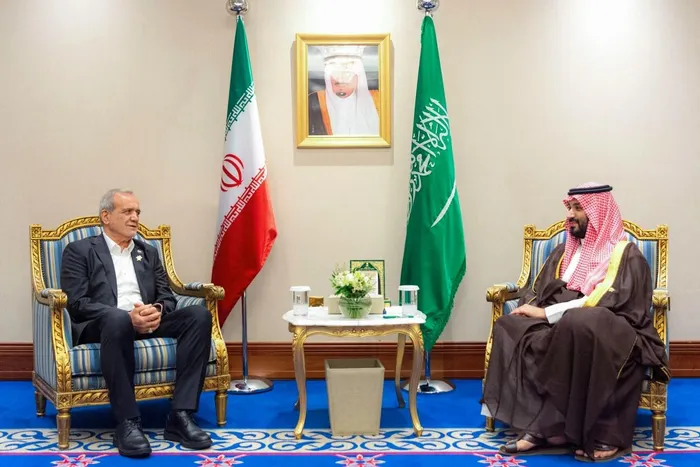
Saudi Arabia's Crown Prince Mohammed bin Salman (right) at a meeting with Iran's President Masoud Pezeshkian in Doha on September 15, 2025, on the sidelines of the 2025 Arab-Islamic emergency summit. The changes in the geopolitical landscape present a new dynamic for the BRICS bloc to contend with, says the writer.
Image: SAUDI PRESS AGENCY / AFP
Mikatekiso Kubayi
At its founding in 2009, in Yekaterinburg, Russia, the BRICS bloc set out a clear framework for its cooperation and a method of operations that guides it towards its goals.
One of the key pillars of this framework is also the first one: Political and Security cooperation. Its chosen method of operations, the consensus approach, has allowed it to advance over the last 16 years with a fair degree of success, resulting in tangible growth and expansion.
The changes in the geopolitical landscape, characterised by Canadian Prime Minister Mark Carney as ‘rapture’ at the World Economic Forum in Davos in January 2026, present a new dynamic for the bloc to contend with. In what many argue is an iconic speech, Prime Minister Carney argued for the need to unite middle powers to ensure a global order in which rules apply equally to all (Carney, 2016).
Two events in 2026 create urgency for reconsidering the founding arrangements of the BRICS bloc in 2009. The first one is the BRICS naval exercises in South Africa’s waters from 9 to 16 January 2026, and the second is the US-Israeli attack on Iran, a BRICS member, on 28 February 2026.
The 2026 BRICS naval drills, although planned many months and a sovereign right of South Africa and its fellow BRICS members to hold, generated much spectacle and consternation over Iran’s participation.
Under pressure from the US and some domestic forces, many complaints were made about the risk that Iran’s participation would place on already-strained South Africa-US relations. The military was instructed not to allow Iran to participate, an instruction that seems to have gotten lost along the way, allowing it to do so. Investigations and the establishment of a commission to report directly to the President have since been established.
Notwithstanding that India opted not to participate and instead held its own a short while later, a BRICS member sought to prevent another from participating in the long-planned BRICS exercise in its sovereign waters.
A few weeks later, the second event was to occur, also involving Iran, and in this case, an unprovoked US-Israeli attack on Iran. This attack killed the sitting head of state, Ali Hosseini Khamenei, his daughter, son-in-law, and grandson. It also killed more than 175 school children, of whom 165 were girls. The attack also killed the Secretary of the Defence Council, the defence minister, and the head of the commander-in-chief of Iran’s Islamic Revolutionary Guard Corps (IRGC).
This is against the background of months of US military buildup in the Middle East and negotiations on Iran’s nuclear program, with reports of significant progress being made. The response of the Iranian state, which had long before made public that it would act should it be attacked, was to attack US military assets in the region, including those in fellow BRICS members such as the UAE.
Standing Principles of the BRICS Bloc
The BRICS bloc decided at its first summit that the centrality of international law and the United Nations (UN) are at the core of its agenda. It took this decision after significant reflection on the nature of global governance and the centuries-long struggles of developing economies to achieve their fair share.
The UN Charter, which forms the basis of international law and advocates peace and development, was crafted after the devastating human tragedy of World War 2. It succeeded the League of Nations, which failed to prevent war, and was eventually adopted by what would today constitute up to 193 members (UN, 2026).
The 2026 geopolitical landscape has undoubtedly been dramatic. It followed a similarly turbulent 2025 under the Trump administration that the Liberation Day Tariffs (White House, 2025) were invalidated by the US Supreme Court on 20 February 2026.
Both sets of dramatic events can be characterised by unilateralism, transactional diplomacy, might-is-right, and the sheer brutality of military and trade power. The BRICS bloc has chosen to stand against a different pillar when it said in 2009 that,
"We express our strong commitment to multilateral diplomacy, with the United Nations playing the central role in dealing with global challenges and threats. In this respect, we reaffirm the need for a comprehensive reform of the UN with a view to making it more efficient so that it can deal with today's global challenges more effectively. We reiterate the importance we attach to the status of India and Brazil in international affairs and understand and support their aspirations to play a greater role in the United Nations (BRICS, 2009).”
The bloc continued to strengthen its framework and consistency, which has characterised its advance ever since. Its attractiveness to many developing economies has not been solely on account of the sheer size of its collective market, its fast-growing financial power, and its technological know-how. Its attractiveness also rests on the idea that all states have a role to play in advancing humanity's interests. It therefore said in its reflections in 2010 that,
“We share the perception that the world is undergoing major and swift changes that highlight the need for corresponding transformations in global governance in all relevant areas … We underline our support for a multipolar, equitable and democratic world order, based on international law, equality, mutual respect, cooperation, coordinated action and collective decision-making of all States (BRICS, 2010).”
It is this belief in the collective responsibility to craft a future for humanity that guarantees peace and development, and that informs the first pillar of the cooperation framework. This includes all parties to conflicts worldwide. It is this belief that continues to generate its attractiveness to new applicants for membership, as emphasised in 2011, in South Africa’s first year as a member, when it said that,
“It is the overarching objective and strong shared desire for peace, security, development, and cooperation that brought together the BRICS countries with a total population of nearly 3 billion from different continents. BRICS aims at contributing significantly to the development of humanity and establishing a more equitable and fair world (BRICS, 2010).”
Can the BRICS Bloc Demonstrate Global Leadership?
The BRICS bloc was aware of the global security architecture in 2009 as much as it was aware of the global financial architecture. It was aware of these when it expanded in 2023 into the BRICS+, on the back of its history of maturity in dealing with contestation and conflict.
It was aware of the multitude of US bases in the Middle East, including in two member countries, the UAE and Saudi Arabia. China made waves when it helped reconcile Iran and Saudi Arabia, something previously considered impossible. South Africa’s efforts in Iraq on the matter of the Weapons of Mass Destruction myth, and the experiences of other members of the bloc, make it capable and equipped to lead a diplomatic effort not only to restore peace but to shape a new order of rules that apply to all equally.
Given its enormous influence in geopolitics, its geographic spread, and its role in global finance, the bloc can overcome this storm, which appears to be tailored to break it apart at the seams. It is now for the bloc to engage other actors with like minds on global governance, such as those who agree with Prime Minister Carney on the need for middle powers to come together to build a table for all and avoid a menu of most.
After all, most states appreciate the role and centrality of the UN and would want to see it reformed into a stronger and fairer central pillar of what ought to be a better multilateralism, even if one or two states in the world hold a different view.
* Mikatekiso Kubayi is Senior Researcher at the Institute for Global Dialogue, UNISA and is Research Fellow at the Institute for Pan African Thought and Conversation.
** The views expressed do not necessarily reflect the views of IOL, Independent Media or The African.