Budget Blues: Beating the Same Drum on SA's Skills Revolution
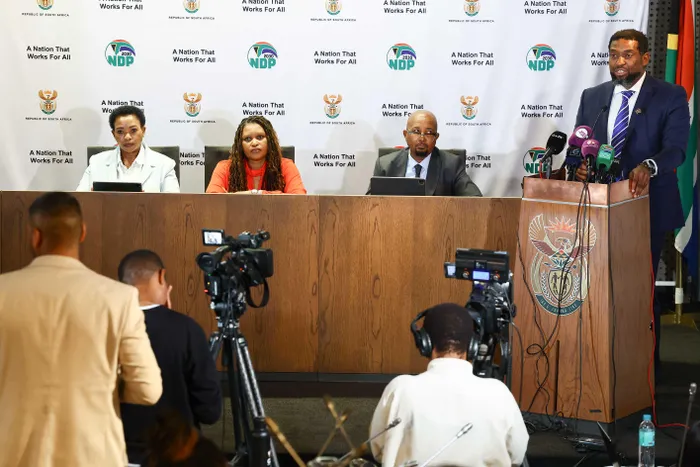
Minister of Higher Education and Training Buti Manamela addressing a media briefing on the plans of the Post School Education and Training (PSET) Sector held in Pretoria on January 22. Until accountability is enforced consistently and poor performance is met with decisive action, the gap between funds collected and meaningful skills outcomes is likely to continue, says the writer.
Image: GCIS
Edwin Naidu
The Budget once again highlights the challenges South Africa faces in ensuring that funds allocated for skills development are used solely for that purpose.
It is easy to bandy about claims that large portions of South Africa’s skillsdevelopment funding have been “lost to corruption”, but this requires careful qualification.
Unfortunately, the Auditor-General of South Africa (AGSA) does not publish a single consolidated figure quantifying the number of skills-development monies written off as corruption. Instead, AGSA reports focus on irregular, fruitless and wasteful expenditure, as well as material irregularities, across public entities, including Sector Education and Training Authorities (SETAs).
A glance at media reports over the past year provides plenty of anecdotal evidence suggesting that the annual amount of more than R80 billion on skills development does not reach its intended beneficiaries.
In the most recent audit cycles, the Auditor-General has repeatedly flagged serious governance failures within several SETAs, including non-compliance with procurement rules, weak contract management, and payments made without adequate evidence of value received.
These findings indicate heightened risk exposure and poor stewardship of public funds, but irregular expenditure is not automatically classified as corruption, nor does it necessarily mean that funds have been permanently lost. In many cases, matters remain under investigation or subject to recovery processes.
Importantly, the AG has reported recoveries of public funds using its expanded remedial powers, including recoveries linked to SETA-related contracts where payments were made contrary to Treasury regulations. These recoveries demonstrate that, while significant amounts have been mismanaged, not all irregular expenditure has been written off, and accountability mechanisms are increasingly being applied.
By contrast, estimates frequently cited in public debate—most notably the claim that approximately R21 billion in skills funding is wasted annually—originate from civil society organisations, such as the Organisation Undoing Tax Abuse (OUTA), without whom no one would have held government accountable.
These figures are based on advocacy analysis and long-term patterns of underperformance and adverse audit outcomes, not on quantified write-offs confirmed by the Auditor-General. While such estimates highlight the scale of concern around value for money in the skills system, they should not be conflated with AGSA audit findings.
The distinction matters. The Auditor-General’s work identifies audit risk, non-compliance, and governance failures, while organisations such as OUTA argue that the cumulative effect of these failures amounts to systemic waste. Both perspectives point to a deeply troubled skillsdevelopment ecosystem, but they rest on different evidentiary bases.
What is beyond dispute is that persistent adverse audit findings, limited consequence management, and repeated leadership failures within parts of the SETA system have undermined confidence in how skills development levies are used. Until accountability is enforced consistently and poor performance is met with decisive action, the gap between funds collected and meaningful skills outcomes is likely to continue.
President Cyril Ramaphosa demands a skills revolution to drive economic growth, hoping it will allow him to close the curtain on his presidency with tangible success. Ironically, Ramaphosa was once ahead of his time in innovation.
In July 2019, he became the first South African president to address guests via hologram at the Digital Economy Summit in Midrand. For a leader often accused of being stuck in the mud, it was a glimpse of the future, which never came. Few would dispute that it has largely been downhill since. The president’s long-promised reboot has never arrived.
With skills development a buzzword in Finance Minister Enoch Godongwana’s Budget speech, it was fitting that one of the few genuine success stories in the sector recently borrowed from the president’s hologram playbook.
Yershen Pillay, the charismatic chief executive of the Chemical Industries Education and Training Authority (CHIETA), insists innovation is not a slogan but a way of operating. On 13 February, Pillay delivered opening remarks to his stakeholders via hologram, modelling what future-ready leadership can look like in practice.
Under his leadership, CHIETA has built tech-savvy Smart Centres in rural areas across all nine provinces. More than 60,000 people have already passed through these centres. That is an impact you cannot deny—and precisely what all SETAs should be striving for.
Having interviewed many SETA heads over the years, it would be dishonest to suggest that all is well. CHIETA is one of 21 authorities, one of the few doing an effective job. Only a handful are doing a genuinely good job. Not all can boast clean audits year after year. Yet even where problems predated Pillay’s tenure, the glory days did not stop.
If any other SETA is achieving comparable impact—changing lives through innovation at scale—they are doing a poor job of telling that story. Or worse, they are spending public money unwisely to do so. Unfortunately, the broader narrative around skills development bears little resemblance to CHIETA’s experience. Beyond a sprinkling of good, the picture is bleak.
By his own admission, Godongwana told Parliament that levy income is projected to reach R88.2 billion over the 2026 medium-term expenditure framework. Yet he conceded that many of the institutions entrusted with this money are failing to equip people with the skills required to drive economic growth.
In response, the National Treasury has commissioned the Government Technical Advisory Centre to conduct a comprehensive review of the national skills ecosystem in the year ahead. This may be the closest South Africa comes to determining whether it is getting value for the billions collected annually from corporate levies.
Minister of Higher Education and Training Buti Manamela has welcomed the Budget and reaffirmed the government’s commitment to skills development, expressing hope that it will help grow the economy. But hope alone is not policy.
If Manamela is serious, he must raise the bar on leadership. No SETA chairperson or CEO should be reappointed without a clean audit. In his first round of appointments, the Minister has been criticised by the Economic Freedom Fighters (EFF), which approached the North Gauteng High Court to have his appointments of several SETA CEOs and board members declared “invalid and unlawful.”
They argue the process lacked transparency and was irregular. In October 2025, Manamela reappointed eight SETA CEOs within 24 hours, a move the EFF claims is part of the ANC’s broader practice of cadre deployment, which they say undermines the integrity of public institutions.
SETAs have long been controversial. Manamela’s predecessor, Nobuhle Nkabane, was removed after similar disputes over appointments. The EFF previously called for the withdrawal of SETA administrators, citing mismanagement and political interference.
A skills revolution needs people committed to skills development, people of integrity. Manamela was certainly ill-advised in reappointing several of the eight when the evidence before him was clear that their performance was greed-focused and anti-skills development. But he will probably get another chance to right the wrongs.
SETAs play a crucial role in vocational training and skills development in South Africa. Disputes over leadership could disrupt programs aimed at addressing unemployment and workforce readiness.
Manamela must break the mould of his predecessors and put South Africa first. He must concede that SETAs have become a piggy bank for some and act, rather than being forced to act via the courts; otherwise, the only revolution that remains is the evolution of the SETA fatcats who carry on without any consequences.
Even President Ramaphosa may agree that the skills system needs a serious reboot. It should begin by removing those underperformers at SETAs. If you do not meet the AG’s standard in terms of managing the organisation’s finances, step down. A real skills revolution cannot start without accountability or a commitment to shifting the dial, not just for one's own bank balance.
* Edwin Naidu heads Higher Education Media Services (HEMS), an education media start-up, publishing www.ednews.africa
** The views expressed do not necessarily reflect the views of IOL, Independent Media or The African.