Tigray Conflict a Threat to the Horn of Africa's Stability
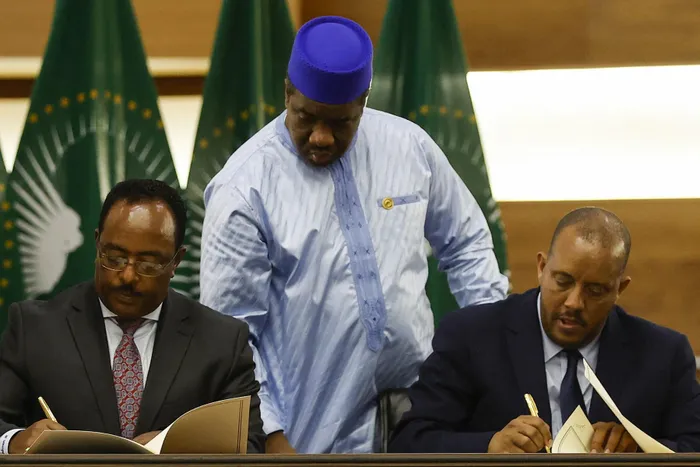
Redwan Hussein (left), representative of the Ethiopian government, and Getachew Reda (right), representative of the Tigray People's Liberation Front (TPLF), sign a peace agreement between the two parties following African Union-led negotiations in Pretoria on November 2, 2022.
Image: AFP
Kim Heller
Just three years after the guns in Ethiopia's Tigray region were silenced, old conflicts appear to be reigniting.
The Pretoria Peace Agreement, facilitated by the African Union, was signed in November 2022. At the time, it was widely lauded as a landmark accord for peace, reconciliation, and stability. According to estimates, over 600,000 lives were lost in the Tigray war of 2020–2022, and crucial infrastructure was wrecked.
The 2022 peace agreement aimed to end hostilities through demilitarisation, the withdrawal of foreign forces – including those from Eritrea – and the restoration of federal authority in Tigray.
Over the past three years, relative stability appeared to take hold. However, the loud thunderclap of conflict can now be heard in northern Ethiopia, as Tigray once again threatens to implode. While the 2022 accord delivered short-term relief, its failure to address and resolve the root causes of the conflict – serious, long-standing political grievances and territorial disputes – is now leading to the flames of warfare rising again.
There has been no justice and accountability for the war crimes committed. Eritrean forces have failed to withdraw, despite assurances to do so. Nor has there been the promised true power-sharing.
Power struggles among Tigray's political leadership continue to brew a potentially deadly mix of frustration and friction. Like many peace agreements, the 2022 Pretoria Agreement was more focused on managing conflict than resolving it.
According to the 2025 United Nations World Food Programme country brief of Ethiopia, close to 4.4 million women and children require treatment for malnutrition. There are over 800,000 displaced people in Tigray living in makeshift, poorly serviced and overcrowded camps and centres.
In late January 2026, violent clashes between Ethiopian federal troops and militia aligned with the Tigray People's Liberation Front raised grave unease about the possibility of a return to war.
As expected, there has been widespread domestic and international condemnation. There have been calls for restraint, demands for an immediate ceasefire and pleas for unrestricted humanitarian access. But it is not enough. Any crusade to silence the guns that fails to root out unresolved crises and historical hurt is never a sustainable solution.
Neither are spirited-sounding official statements that fail to include rigorous remedial action from national and international bodies. While there has been some respite in the conflict in recent weeks, the situation remains tense. Unresolved territorial claims and political tensions, especially in Western Tigray, are a loaded gun for future volatility and violence.
Ethiopia's internal tensions are unfolding at a time when the country is caught in a prolonged dispute with Sudan and Egypt over the Grand Ethiopian Renaissance Dam on the Blue Nile. While not directly related to the current violence in Tigray, this dispute adds to and amplifies the level of mistrust and lack of cooperation in the Horn.
In an article published in The Conversation on 20 February 2026, Yohannes Gedamu, a Senior Lecturer of Political Science at Georgia Gwinnett College, reflected on the possibility that Ethiopia and Eritrea are on the cusp of war yet again.
He writes that, despite the 2018 peace agreement between the two countries, fault lines persist. Unpacking the present tensions, Gedamu points to two key issues.
The first and foremost is access to the sea. Ethiopia's President Abiy Ahmed has been pushing for sovereign sea access, which is causing tension among neighbouring countries. In particular, the Ethiopian President has declared that the country has a historical claim to the port of Assab in Eritrea. Eritrean government officials have rejected Ethiopia's maritime ambitions, describing these as an illegitimate transgression of international law rather than an expression of legitimate sovereignty.
The second fault line, according to Gedamu, is Eritrea's alleged support of various Ethiopian rebel organisations and movements since 2022—an accusation Eritrea has denied.
Abiy Ahmed was awarded the Nobel Peace Prize in 2019 for ending the violent conflict between Ethiopia and Eritrea. At the time, he was widely celebrated as a much-needed peacemaker on the Continent.
However, this reputation has been severely dented as tensions with Eritrea intensify and conflict with Egypt and Sudan over the Renaissance Dam project continues. There has also been some alarm about how dissent within Ethiopia has often been met with brute state force. Securitised governance under the Abiy Ahmed administration has tended to prioritise suppression over reconciliation. This has bruised his standing as an exemplary leader.
The President has failed to reconstruct the regional governance structure in Tigray in a way that would address historical grievances over land and inclusivity, and deliver a sustainable, peaceful solution.
As is too often the case in peace deals on the Continent, short-term stability was privileged over justice. Robust political dialogue and strong accountability mechanisms have not been pursued.
The Ethiopian President's forceful, almost militarised posture on sea access as a matter of sovereign entitlement is hardly the posture of a peacemaker. This posture has diminished regional cooperation and created discord and discomfort in the Horn.
The Horn of Africa cannot afford yet another protracted conflict. There is an urgent need to drive federal renewal, troop withdrawal, and the resolution of long-standing territorial disputes. Fair access to the sea must be agreed upon in a way that benefits the region and avoids unfair domination by a single country.
An eruption in Ethiopia and intensified regional conflicts could see the Horn of Africa descend into a cataclysmic crisis. If ever there is a time for Abiy Ahmed to show his acumen as a peacemaker, it is now. It is a test he dare not fail.
* Kim Heller is a political analyst and author of No White Lies: Black Politics and White Power in South Africa.
** The views expressed do not necessarily reflect the views of IOL, Independent Media or The African.