Factional Divides Deepen as DA Leadership Race Heats Up
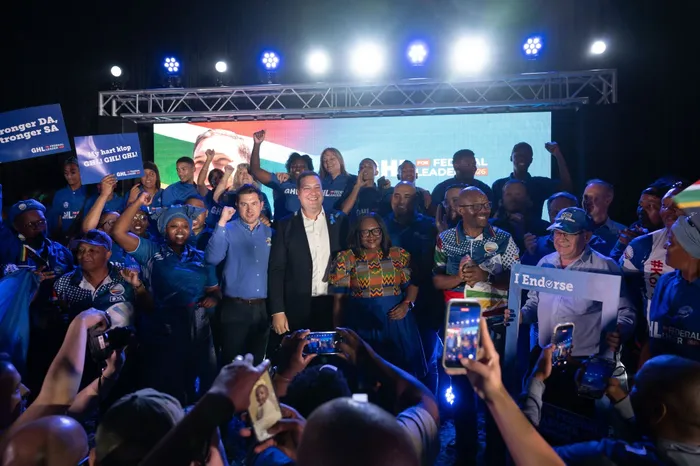
Cape Town Mayor Geordin Hill-Lewis (centre) addresses supporters and party leaders after declaring his bid to succeed John Steenhuisen as leader of South Africa's Democratic Alliance (DA), at the Elsies River Civic Centre in Cape Town February 27.
Image: Henk Kruger/Independent Media
Dr. Reneva Fourie
The Democratic Alliance’s federal congress in April 2026 is being framed as a moment of renewal for South Africa’s largest opposition party.
With party leader John Steenhuisen stepping aside after confirming he will not seek re-election, a new leadership contest has opened. Cape Town mayor Geordin Hill-Lewis has quickly emerged as the favourite, presenting himself as the polished face of a younger generation of leadership.
Yet the drama surrounding the race masks a more uncomfortable truth. Behind the spectacle of internal competition lies a striking continuity in the Democratic Alliance’s political project. Regardless of who emerges victorious in April, the party is unlikely to pursue transformative policies capable of addressing South Africa’s stubborn high levels of unemployment, poverty and inequality.
The reason is structural rather than personal. For decades, the DA has been anchored in a political and financial ecosystem closely tied to corporate interests, professional elites and middle-class constituencies.
These relationships have shaped the party’s ideological outlook and practices and placed clear limits on how far it can move towards redistributive policies in a country still defined by racialised inequality. The leadership contest might change personalities at the top, but it is unlikely to change the interests that shape the party’s direction.
Steenhuisen’s decision not to run again followed weeks of internal tensions within the organisation. Although he framed his departure as the completion of a political mission that helped bring the DA into the Government of National Unity after the 2024 election, factional dynamics inside the party have been impossible to ignore.
The leadership race is unfolding in the shadow of powerful internal figures and long-standing networks that continue to shape the organisation’s direction.
Among the most influential is Helen Zille, the former party leader and current chairperson of the DA’s Federal Council. Zille remains one of the party’s most formidable strategists and organisers. Although she rejects claims that she controls the party’s internal machinery, her influence within its structures and ideological debates remains considerable.
Hill-Lewis is widely seen as emerging from the political tradition associated with Zille’s leadership. As mayor of Cape Town, he has continued the “true blue” project, a technocratic, pro-business model of governance that mirrors Zille’s own tenure as Premier of the Western Cape. His multi-million-dollar wall along the N2 is a physical embodiment of DA politics: to conceal the shacks, ignore the inequality and project a false image of wealth.
Other figures within the party have emphasised different priorities. Solly Msimanga, the DA’s Gauteng leader and former mayor of Tshwane, has called for greater internal democracy and more influence for provincial and local party structures.
His intervention highlights long-running tensions over how power is distributed within the organisation. Yet these debates remain largely procedural. They seldom extend to fundamental disagreements about economic policy.
In practice, the real divide inside the DA is not ideological but tactical. One faction believes the party should work pragmatically within the Government of National Unity to demonstrate its ability to govern.
Another fear is that such cooperation risks weakening the party’s identity as a robust opposition force. Both camps, however, share a broadly liberal economic outlook rooted in market-driven growth, limited state intervention and fiscal conservatism, with little interest in improving the lives of the poor and marginalised.
This consensus helps explain why the leadership race has produced little debate about the economic transformation that remains one of South Africa’s most urgent challenges. The DA has long opposed transformation-based policies such as Black Economic Empowerment.
The party has proposed an “Economic Inclusion for All Bill” to replace BEE, which ignores the historical reality that wealth and ownership in South Africa remain deeply racialised. Without deliberate measures to address that legacy, the market will continue to entrench the ownership patterns of the apartheid era.
Healthcare reform presents a similar divide. The DA has been one of the most consistent critics of the proposed National Health Insurance system. While the NHI is currently halted pending a Constitutional Court challenge, the DA has celebrated this delay. Party leaders argue that the NHI could destabilise the healthcare sector and impose heavy financial burdens on the state.
However, the resources exist. The NHI threatens the lucrative private healthcare market that serves a relatively small and wealthy minority. The fight against the NHI is a fight to preserve a two-tiered health system that the DA's backers profit from.
Meanwhile, the majority of South Africans continue to rely on underfunded public clinics and hospitals.
Foreign policy differences also reveal the party’s distinct political alignment. The African National Congress has historically adopted a strong pro-Palestine position, rooted in the solidarity networks of the anti-apartheid struggle. That stance resonates with many South Africans who see parallels between apartheid and the Palestinian experience.
The DA, by contrast, has consistently adopted a stance more favourable to Israeli interests. This is not merely a diplomatic difference; it is a reflection of donor influence. Key figures and funding networks within the DA have historical and ideological ties to Zionist organisations.
This alignment with Zionist interests is a direct result of a funding pipeline that prioritises international corporate and ideological allies over the foreign policy preferences of the local majority. It is yet another proof point that the DA's constituency is not the townships, but the boardrooms and their international allies.
Ultimately, the significance of the DA’s leadership contest lies less in who wins than in what it reveals about the party’s political limits. Leadership changes can refresh a brand and alter a party’s tone. They rarely alter the social interests that anchor its politics.
For many South Africans, the central question is whether any major political party can advance policies capable of reshaping the country’s economic foundations. The DA is structurally constrained in its ability to represent the interests of the majority because doing so would require a break with the very interests that sustain it.
Until the party confronts those constraints, its leadership contests will remain what they have always been: a reshuffling of the deck chairs on a ship steadfastly sailing away from the shores of transformation.
* Dr Reneva Fourie is a policy analyst specialising in governance, development and security.
** The views expressed do not necessarily reflect the views of IOL or Independent Media.