US, Israel War on Iran: Understanding the Economic Shock in SA
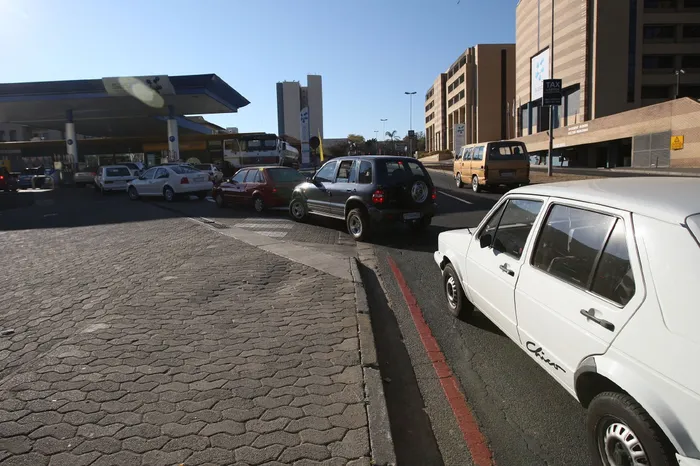
Motorists queuing for fuel in Randburg, Gauteng following a hike in petrol and diesel prices. For South Africa, the looming oil shock is more than an economic inconvenience. It is a warning about the country’s structural vulnerability to global energy markets, says the writer.
Image: Independent Media Archives
Dr Clyde N.S. Ramalaine
The unfolding crisis in the Middle East is no longer a distant geopolitical spectacle seen only through international headlines. It is rapidly becoming a global economic event whose consequences will extend far beyond the battlefields and diplomatic arenas where the conflict is unfolding.
History repeatedly reminds us that when the Middle East trembles, the world economy shudders. Energy markets react first, financial markets soon follow, and eventually the shock filters down to the everyday lives of ordinary citizens across continents.
What is emerging is not merely another regional confrontation but the early contours of a potentially significant global economic disruption.
At the centre of this looming crisis lies one of the most strategically sensitive waterways on earth: the Strait of Hormuz. Though narrow in geographical terms, this maritime passage is a critical artery of the global energy system.
Nearly a fifth of the world’s oil supply passes through these waters each day, meaning the stability of international oil markets depends heavily on uninterrupted tanker traffic through this corridor.
When tensions escalate in this region, markets respond almost immediately. Oil traders do not wait for supply to disappear before adjusting prices. Risk is priced into markets long before any physical disruption occurs. Even the threat of tanker attacks, naval blockades, or military escalation in the Persian Gulf can send energy prices rising sharply.
Economists and energy analysts have long warned that significant disruption in the Strait of Hormuz could push global oil prices toward levels once considered unimaginable. Since the start of hostilities, on February 28, prices have already surged by roughly 20–25%.
Some projections suggest oil could climb toward the psychologically devastating threshold of $200 per barrel should shipping routes become restricted or unstable. Whether that level is reached or merely approached through speculation, the anticipation alone carries powerful economic consequences.
Financial markets respond quickly to uncertainty. Shipping insurance costs increase, freight rates climb, and currency markets become volatile. Import-dependent economies are usually the first to experience the pressure.
For wealthy nations with diversified energy supplies and substantial fiscal reserves, the shock is severe but manageable. Strategic petroleum reserves can be released, governments can cushion consumers through subsidies, and stronger currencies help soften the blow of higher global prices.
For developing economies, however, the story is far more precarious. South Africa stands particularly exposed to global oil volatility because of its structural dependence on imported crude. The country produces very little of the oil it consumes.
When global oil prices rise, the increase is transmitted almost immediately into the domestic fuel price. The situation is further complicated by exchange-rate dynamics. Since oil is traded in US dollars, any weakening of the rand amplifies the impact of rising international prices.
In practical terms, South Africans pay the price twice: once through the global oil increase and again through currency depreciation.
Should oil prices surge dramatically, the first visible impact will appear at the petrol pump. Yet the petrol price is only the beginning. Fuel occupies a unique position within modern economies because it influences nearly every sector of economic activity. Transport systems depend on it. Agricultural production requires it. Manufacturing relies on it. Retail supply chains cannot function without it.
When fuel prices rise sharply, the economic ripple spreads across the entire economy. Public transport fares increase. Freight and logistics costs climb. Farmers pay more to run tractors, operate irrigation systems, and transport produce to markets.
Manufacturers face higher production costs. Retailers then pass those increases to consumers through higher prices. Fuel, in this sense, is not merely another commodity. It is the bloodstream of economic life.
Once fuel prices escalate, food inflation soon follows. South Africa’s food system depends heavily on long-distance transport networks that move agricultural goods from rural production areas to urban consumption centres. Grain travels long distances to major cities. Fresh produce moves across provinces before reaching supermarket shelves. Livestock must be transported to processing facilities.
Every kilometre travelled involves fuel. When diesel costs rise significantly, the price of transporting food increases accordingly. The cost is then absorbed across the food value chain until it finally appears in the supermarket basket. Bread becomes more expensive. Maize meal rises in price. Vegetables, fruit, and meat follow the same upward trajectory.
This is where the economic shock reveals its most troubling dimension: its unequal impact on society. While a national economic crisis affects all citizens in some measure, its consequences are rarely distributed equally. In South Africa’s highly unequal society, the burden of rising fuel and food prices will fall disproportionately on the poor.
Wealthier households possess buffers that allow them to absorb rising costs. Higher-income families typically spend a smaller share of their income on food and transport. They have savings, assets, and access to credit that allow them to weather temporary inflationary pressures.
For poorer households, the situation is entirely different. Millions of South Africans already spend the majority of their income on necessities, particularly food and transport. When these two categories experience simultaneous price increases, household resilience collapses quickly. The economic margin within which many families survive is already narrow. Rising fuel prices, therefore, translate directly into reduced living standards.
The consequences appear quietly but powerfully in daily life. Families begin purchasing less nutritious food. Transport costs force workers to reconsider job opportunities located far from home. Informal traders struggle to maintain profit margins. Pensioners stretch their limited income across rising expenses.
What might appear in economic reports as “inflationary pressure” becomes, in lived reality, the erosion of household survival. The situation becomes even more complicated when monetary policy enters the equation.
Central banks typically respond to rising inflation by increasing interest rates to slow consumer spending. Yet higher interest rates carry their own consequences. Mortgage repayments rise. Small businesses face more expensive borrowing costs. Consumer demand weakens. Economic growth slows.
The result can be a precarious economic condition known as stagflation — a combination of rising prices and stagnant economic growth. Stagflation is notoriously difficult for policymakers to manage.
Efforts to control inflation risk suppress economic activity, while attempts to stimulate growth may intensify inflation. Governments, therefore, find themselves navigating a narrow and uncomfortable policy corridor.
Beyond these economic mechanisms lies a deeper geopolitical reality. The Middle East crisis is unfolding within an already fragile global system characterised by geopolitical rivalry, supply-chain vulnerabilities, and economic uncertainty.
Energy markets are responding not only to immediate supply concerns but also to broader fears about regional escalation, sanctions regimes, and disruptions to maritime trade routes. In such an environment, uncertainty itself becomes an economic force.
Yet the deeper tragedy remains the unequal distribution of suffering that follows global crises. The individuals who will feel the sharpest effects of rising oil prices are the very people who possess the least influence over the geopolitical decisions that produce them.
A street vendor in Soweto, a taxi driver in Cape Town, or a farm worker in Limpopo has no voice in the strategic calculations taking place in Washington, Tehran, Tel Aviv, or Brussels. Yet the cost of bread in their homes will be shaped partly by decisions made thousands of kilometres away.
This is the harsh arithmetic of globalisation. The Middle East crisis, therefore, exposes a fundamental reality about the contemporary world: wars are no longer confined to battlefields. Their economic consequences travel through financial markets, shipping routes, and energy pipelines until they arrive quietly at the kitchen tables of ordinary families.
For South Africa, the looming oil shock is more than an economic inconvenience. It is a warning about the country’s structural vulnerability to global energy markets. Without accelerated investment in energy diversification, improved public transport systems, and stronger economic resilience, global crises will continue to manifest as domestic hardships.
When tensions around the Strait of Hormuz intensify and oil prices surge dramatically, the consequences will not simply appear in economic statistics or commodity charts. They will appear in shrinking grocery baskets, rising taxi fares, and the quiet anxiety of families trying to survive another month in an already unforgiving economy.
In an interconnected world, distant wars rarely remain distant for long. Sometimes they arrive not with soldiers or missiles, but through the rising price of fuel and the unequal economic burden that follows.
* Dr Clyde N.S. Ramalaine is a political scientist and analyst whose work interrogates governance, political economy, international affairs, and the intersections of theology, social justice, and state power.
** The views expressed do not necessarily reflect the views of IOL or Independent Media.