Militarisation of Townships a Deflection from SAPS Failures
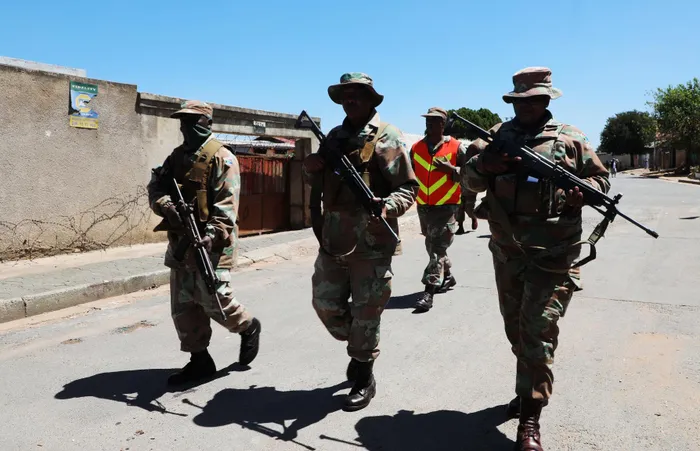
Members of the SA National Defence Force on patrol in Eldorado Park as part of President Cyril Ramaphosa's deployment of the military in support of the SA Police Service's campaign to clamp down on crime in township hotspots.
Image: Timothy Bernard/Independent Newspapers
Prof. Itumeleng Mothoagae
As both a son of Soweto and an academic deeply engaged with decolonial thought, informed by organic intellectualism, my memories are engraved with the heavy rumble of the Casspir and the sight of young men in camouflage patrolling our streets.
I lived through apartheid's States of Emergency, when the "rule of law" was a euphemism for suspending Black humanity. Today, as I analyse the President’s 2026 State of the Nation Address (SONA) and the deployment of the South African National Defence Force (SANDF) to combat zama zama activity and gang violence, I see not a "new" solution but a haunting return to colonial logic, treating Black spaces as zones of death.
My critique comes from lived experience, not the detached perspective of academia. In his speech, the President presented a "Theatre of Power," using the language of "war" on crime to reassure wealthy suburbs and investors that the state maintains control.
But this theatre needs a villain: the Black body. We face a complex tragedy. While transnational mafias run illegal mining operations, terrorising townships, the state targets marginalised individuals, those desperate zama zama foot-soldiers and innocent youth, labelling them as "pathological threats" rather than addressing the despair that drives their actions.
As I highlighted in my work, "The Unfinished Business: A Decolonial Reflection on the State of Emergency Song by Simphiwe Dana," we are caught in a cycle where the "emergency" is an ongoing state.
Dana’s powerful words resonate:
“Black bodies strewn in the streets, fires burning, brothers lost.
Where are the youth of 1976?
Sellout black leaders, forgotten memories festering in the youth…”
Dana’s indictment exposes a fundamental betrayal, indicating that current leadership continues the same "emergency" measures that characterised apartheid, now justified through militarised operations.
We have seen this story before. The 2026 deployment reflects the 2020 COVID-19 lockdown, when the army was sent to "save us", but instead enacted brutal enforcement reminiscent of the old SADF. Collins Khosa’s tragic death for having a beer highlights this violence.
During both crises, the army was absent from affluent suburbs, where life was regarded as "social" and secure. In townships, however, life is reduced to "biological survival" under the threat of violence. This duality highlights that, in the eyes of the state, the Black body remains "ontologically suspicious."
Ironically, our own communities often demand the military presence that oppresses us, caught in a cruel paradox. We are compelled to seek the very tools of oppression to ensure basic safety. This deployment confirms that our townships remain "death-worlds," where state communication is primarily expressed through violence.
This "theatre" extends into Parliament, where debates expose a deep institutional crisis. While opposition parties like the DA and EFF criticise the deployment as an admission of the police's collapse, we must recognise that this is not merely a calculated plot of oppression but a desperate response from a panicked state.
The Madlanga Commission has revealed a weakened SAPS, exposing a police force infiltrated by the very cartels it should fight. However, we should not mistake state weakness for malice. The government’s loss of control has caused it to deploy its only effective institution, the military, to handle a complex socio-economic crisis.
Today, South Africa exists as two deeply divided nations: one wealthy and protected, the other poor and marginalised. In this neglected South Africa, desperation fuels illegal economies, yet the state reserves its "care" for the wealthy. When addressing townships, biopower transforms into necropolitics, the sovereign authority to decide who may live and who must die.
Instead of tackling the structural poverty that pushes men underground, the state chooses to eradicate them. "Operation Vala Umgodi," which seals off mine shafts and starves those beneath the surface, bypasses justice in favour of exercising the right to take life from the marginalised.
As Caiphus Semenya poignantly expresses it: "The rich get richer, the poor suffer. The status quo can’t go any longer..."
The President and Parliament might view this deployment as a quick fix, but it is a dangerous illusion. By neglecting the "Unfinished Business" of land and mineral democratisation, the state risks a volatile desperation that no rifle can suppress.
The army’s presence transforms our streets into a panopticon, employing crude disciplinary methods through checkpoints and patrols to "correct" a population that the state has abandoned. When the President speaks about "protecting minerals," it reveals the coloniality of power; this military presence chiefly serves the interests of a non-decolonised mining sector, not the residents.
This deployment reveals a failure of decolonial imagination, recognising that the post-apartheid state has no tools beyond those inherited from the past. Instead of dismantling the "plantation," it chooses to police it.
As both a son of Soweto and a scholar of decoloniality, I refuse to accept this militarised peace. The "missing middle" in our governance crisis, land reform, and economic restructuring cannot prevent a syndicate shootout tomorrow. With a compromised SAPS and a colonial military, we face a terrifying vacuum of community safety that demands immediate, localised, community-led policing solutions.
However, we must not let the immediate crisis distract us from long-term solutions. What we need is not a soldier on every corner but the redistribution of land, democratisation of mineral wealth, and recognition of our townships as places of human flourishing.
As the African proverb reminds us, “Until the lion tells his side of the story, the tale of the hunt will always glorify the hunter.” Until we reclaim our narratives and redefine our realities, the "State of the Nation" will stay a state of war against its own people.
* Prof. Itumeleng Daniel Mothoagae is Chair of Gender and Sexuality Studies at UNISA, a C2-rated NRF researcher, and a leading voice in decolonial thought and Black Liberation Theology.
** The views expressed do not necessarily reflect the views of IOL or Independent Media.