Human Rights Day: Reflections on South Africa's Solidarity with Cuba
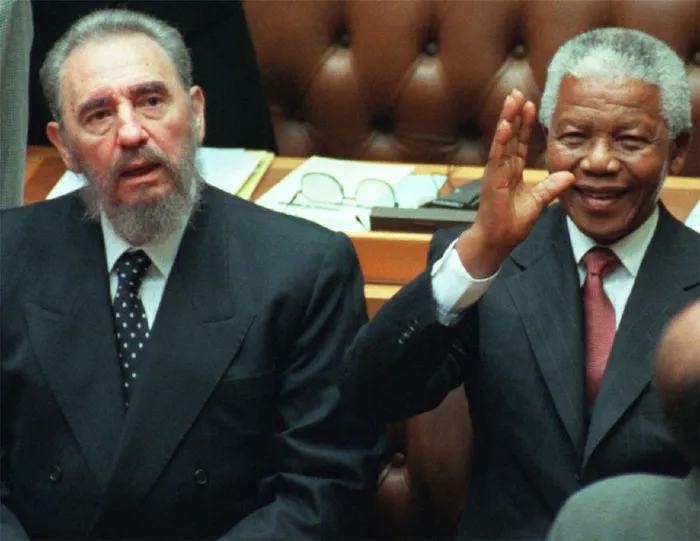
President Nelson Mandela acknowledged the applause of MPs as he took his seat in the National Assembly alongside Fidel Castro during the Cuban leader's state visit in September 1998.
Image: Independent Media Archives
Zamikhaya Maseti
This week, the national grid in Cuba collapsed and plunged 11 million people into darkness. What unfolded on the island was not merely a technical failure of an electricity system already under strain, but a profound expression of a deepening geopolitical crisis.
The shutting off of energy lifelines, particularly the disruption of oil supplies historically sourced from Venezuela, has brought into sharp relief the vulnerability of a small island state subjected to sustained economic pressure.
In this context, the posture of the Trump administration, with its threats to further isolate Cuba and penalise any country that extends energy support, assumes a decisive and troubling significance.
The Cuban crisis, therefore, compels us to reflect not only on the immediacy of the humanitarian and infrastructural collapse, but on the urgent necessity of reviving and deepening a Cuban Solidarity Movement. This movement must take root across Southern Africa, with particular emphasis on Angola, Namibia, and South Africa.
Indeed, South Africa carries a historic and moral obligation to lead such an initiative. There already exists within our country a firm foundation through formations such as the Friends of Cuba Campaign.
However, the responsibility of solidarity cannot remain confined within political organisations alone. It must permeate the consciousness of ordinary South Africans, becoming a lived expression of historical memory and political responsibility.It is therefore necessary that many among our people are educated about the indispensable role Cuba played in our own struggle for national liberation.
The South African liberation struggle was never an isolated national project. It was intrinsically intertwined with the struggles of the peoples of Namibia and Angola, who confronted the same adversary in the form of the apartheid Pretoria regime.
This regime, as history records with sobering precision, enjoyed the backing of conservative forces in the West, including figures such as Margaret Thatcher and Ronald Reagan. At a time when global power configurations were aligned against the liberation movements of Southern Africa, the Cuban people chose a different path.
They chose internationalism. They chose solidarity. They chose to stand with the oppressed. Nowhere is this more evident than in the decisive engagements that unfolded in Angola, culminating in the Battle of Cuito Cuanavale. In that theatre of struggle, Cuban forces fought side by side with the Angolan armed forces, with the combatants of SWAPO, and with the cadres of uMkhonto weSizwe, the military wing of the African National Congress.
The apartheid South African Defence Force, long considered invincible within the region, encountered a formidable and determined alliance of liberation armies. The outcome of that confrontation altered the balance of forces in Southern Africa in a manner that could no longer be ignored by the international community.
Accordingly, the military and political consequences of Cuito Cuanavale found expression in the diplomatic arena. The Tripartite Accord of 1988, concluded between Angola, Cuba and South Africa, created the necessary conditions for the implementation of United Nations Security Council Resolution 435. It was this resolution that provided the legal and political framework for the independence of Namibia, which was ultimately realised in 1990.
Thus, the sacrifices made on the battlefields of Angola were not symbolic gestures of solidarity. They were decisive interventions that reshaped the trajectory of liberation in our region.It is precisely this historical interconnectedness that must inform our present response to the crisis confronting Cuba.
The collapse of the national grid, under conditions of economic strangulation, must be understood as part of a broader pattern in which economic instruments are deployed as mechanisms of coercion. The language may be that of sanctions, tariffs and restrictions, yet the lived reality for ordinary Cubans is one of hardship, uncertainty and deprivation.
A Cuban Solidarity Movement in our time must therefore be both principled and practical. It must educate, organise and mobilise. It must reclaim the historical narrative that binds Southern Africa to Cuba, ensuring that younger generations understand that our freedom was not achieved in isolation.
It must build alliances across society, drawing in workers, students, intellectuals, faith-based organisations and civic formations into a common front of solidarity. It must also assert, with conviction, that the sovereignty of nations cannot be subordinated to the geopolitical interests of powerful states.
In advancing such a movement, South Africa must not hesitate. Our own history demands of us a posture that is neither timid nor equivocal. We are called upon to act with the same spirit of internationalism that Cuba demonstrated when the peoples of Southern Africa stood in need.
The Cuban people are in urgent need of support, and lest we forget, they have themselves been steadfast in strengthening the post Apartheid democratic government in South Africa. Through acts of practical solidarity, Cuba invested in the development of our human capital by training doctors, deploying engineers, and contributing researchers and academics to our institutions of higher learning.
Their presence was particularly felt in historically disadvantaged institutions such as the erstwhile University of Transkei, now known as Walter Sisulu University, where Cuban expertise played a meaningful role in advancing education, skills development and public service capacity. This history of reciprocal solidarity imposes upon us a responsibility that is both moral and historical, to stand with Cuba in its moment of need, just as it stood with us in ours.
The Cuban people are in urgent need of both food and medical support. In this regard, I have had the distinct privilege of engaging directly with the Cuban Ambassador to South Africa, His Excellency Fakri Rodriguez Pinelo, who provided a sobering account of the material conditions currently confronting the Cuban population.
According to the Ambassador, the most pressing food requirements include milk powder, wheat flour, baby formula, canned foods, rice, beans and coffee. These basic commodities have assumed critical importance in sustaining daily life under conditions of severe constraints. Equally, the situation extends beyond food security into the realm of public health.
There is an acute need for essential medical supplies, including medication for blood pressure and diabetes, antibiotics, pain relief medication, and children’s medicines. This comprehensive list of necessities underscores the depth of the crisis and calls for a coordinated and humane response grounded in solidarity and historical responsibility.
The Ambassador further emphasised the critical role that Thought Leadership in South Africa and across the global community must play in shaping public consciousness about the plight of the Cuban people. He made a compelling appeal for sustained intellectual engagement, advocacy and public education as instruments through which solidarity can be deepened and given meaningful expression.
Such Thought Leadership, he argued, does not merely inform, it inspires hope among the Cuban people and serves as a constant reminder that they are not alone in their struggle. It affirms that there exists a community of nations and peoples who recognise their suffering and stand in principled solidarity with them.
We, as the people of South Africa and the broader Southern African region, must therefore internalise this responsibility. We share in their pain, we feel their agony, and we are called upon to respond with both moral purpose and practical action. Indeed, the current moment reveals that the doctrine of Trump’s Conservative Republicanism is not confined to Cuba alone.
It has assumed a global character, affecting nations across continents. No country is immune to its reach, and Africa itself cannot consider itself insulated from its consequences.
As South Africa commemorates Human Rights Day today, it is both necessary and historically appropriate that we consciously link this solemn occasion to the struggles presently being waged by the Cuban people, our steadfast friends in the struggle for national liberation.
The values we affirm on this day, the dignity of the human person, the right to life, and the right to development, cannot be selectively applied nor confined within our borders. They must find expression in our solidarity with those who endure hardship under conditions not of their own making.
The people of South Africa, Southern Africa and the entire African continent are called upon to frown upon Trump’s doctrine of Conservative Republicanism. Everything possible must be done to push back and repel the regime change agenda that seeks to undermine the sovereignty of nations. As the English idiom reminds us, a friend in need is a friend indeed.
* Zamikhaya Maseti is a political economy analyst and holds a Magister Philosophae(M.Phil) in South African Politics and Political Economy from the erstwhile University of Port Elizabeth, now Nelson Mandela University.
** The views expressed do not necessarily reflect the views of IOL or Independent Media.