Conference of the Left: Building a New Path for the Working Class
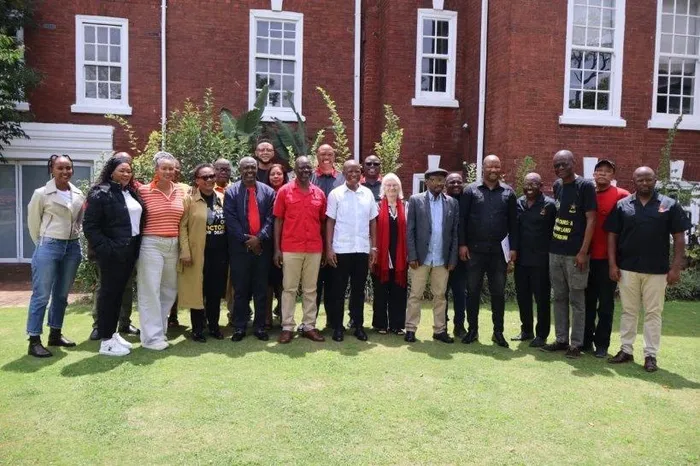
The SACP and EFF held a bilateral meeting regarding the Conference of the Left held in Parktown, Johannesburg, on March 2. This meeting between the SACP and EFF is a concrete advance. It signals an opportunity to forge a new voice for ordinary people, says the writer.
Image: SACP/X
Lucian Davids
On Monday, 2 March, the South African Communist Party (SACP), led by General Secretary Solly Mapaila, met with the Economic Freedom Fighters (EFF).
This was not just another political meeting. It was a step that could change the direction of politics in South Africa. According to the statement released by the SACP, the two organisations agreed that the EFF will send members to join a task team.
This team will help prepare for the upcoming Conference of the Left. It is worth noting that the Conference of the Left is not an SACP-EFF initiative, but rather an initiative involving all progressive trade unions, student and women's formations, civil society, community organisations, left intellectual traditions, and various other movements committed to transforming our state.
For years, many have argued that South African politics is too fragmented and immature for meaningful cooperation between organisations. The right often unites around common objectives, but even their efforts fracture easily, as shown by the Moonshot Pact. The Left has fared worse, lacking a robust, unified programme capable of challenging the current system.
This meeting between the SACP and EFF is a concrete advance. It signals an opportunity to forge a new voice for ordinary people. All Left forces should seize this moment to resist policies that hurt the poor and working class.
The Conference of the Left and the Structural Crisis of Capitalism.
The Conference of the Left will bring together all progressive organisations in South Africa. Its goal is to address the deep inequalities that ordinary people have faced before and after 1994. Last year, our General Secretary called for this conference, and now that promise is being fulfilled.
The SACP has always stood for the working class and the poor. But over time, the alliance that was supposed to bring revolutionary change has instead become a source of pain for workers. The conference is urgently needed. It is meant for those who suffer the most—workers and the poor, especially young people and women.
When we look at unemployment, poverty, hunger, and crime, it is clear who carries the heaviest burden. This can be directly attributed to the structural crisis of South African monopoly capitalism and Western imperialism. These two factors have been mainly responsible for the suffering of ordinary South Africans.
At the heart of capitalism’s agenda is the concentration of wealth in the hands of the few, the de-industrialisation of our country, and the expansion of the services sector, which subsequently leads to financialisation. This means that investments remain fluid and instead of using it for physical infrastructure to help develop our economy to produce final goods for exports and lessen the export of raw materials. The conference seeks to mobilise communities and organisations to have discussions regarding these key issues.
Some of these issues relate to:
(1) Land reform – giving land back to the people,
(2) Public ownership – making sure key industries serve the people, not private profit,
(3) Debt cancellation – freeing poor households from crushing debt,
(4) Climate justice – protecting the environment while ensuring fairness,
(5) Gender liberation – fighting for equality for women and oppressed genders,
(6) Transforming the financial sector – to support development and
(7) Advancing food sovereignty and rural development, to name a few.
None of these is new; these are issues the people had hoped the government would address. Instead, it chose austerity—cutting spending and limiting services. This weakened the state’s ability to provide what people need most.
Trouble in the Tripartite Alliance
The Tripartite Alliance faces serious problems. These problems did not start today. They go back to 1996, when the ANC-led government policies shifted towards neoliberalism. The SACP has always stood for the working class and the poor.
But over time, the Alliance that was supposed to bring revolutionary change has instead become a source of pain for workers. It is unacceptable for a Communist Party and a trade union federation to be part of driving neoliberal policies, knowing that this will harm workers and the poor.
Over the years, the gap between the Alliance partners has grown wider.
This is clear in three ways:
(1) Declining support for the Alliance – fewer people are voting, showing their disappointment.
(2) Neoliberal economic policies – the government has chosen policies that favour big business instead of the poor, and
(3) The ANC’s alliance with pro-capital forces, through the Government of National Unity (GNU), has moved the ANC closer to the interests of the rich. In addition, there is the selling of State-Owned Entities, which once served the people, and the ANC’s refusal to reconfigure the Alliance to reflect real equity and mutual respect of the Alliance partners.
And finally, in the lead-up to the creation of the Government of National Unity, without proper consultation of its [ANC’s] partners.
Therefore, we find ourselves at a crossroads:
(1) Either the Party reconfigures their approach to challenging capitalism and reasserts the voice of the workers and the poor, or
(2) Remains contesting within the Alliance and oversees the rolling out of sustained neoliberal policy. The choice was quite clear in the face of domestic realities within the country, given the suffering of ordinary people.
The Reality for Workers and the Poor
While the Government of National Unity celebrates “achievements” in the president’s State of the Nation Address, workers and the poor cannot relate to these claims. For example, the strengthening of the rand against the dollar means nothing to someone who cannot afford a basket of food.
According to the Pietermaritzburg Economic Justice and Dignity Group (PMBEJD) statistical release, an average food basket costs R5383. The national minimum wage is around R5000. After having paid for transport, rent, school fees and supplies, households only focus on food.
In all likelihood, there would be nothing left to save, and, in some instances, they would be forced to lend money from unscrupulous characters in their community. This is the reality for a minimum wage earner. For the unemployed—especially the youth—the situation is even worse.
The meeting between the SACP and the EFF is not a “one-up” against the ANC; this holds no benefit for the Party. Our goals are strategic and straightforward: we cannot build a developmental state that does not serve its workers and cannot sustain its future.
A Disjunction, A Choice
We are at a disjunction—a crossroads. Either the SACP and other Left forces build a new path that truly represents workers and the poor, or we remain trapped in an alliance that continues neoliberal policies.
We must build a broad, democratic, and militant working-class movement capable of confronting the systemic crisis of capitalism and advancing a socialist alternative. The Conference of the Left is a chance to unite, to fight for land, jobs, equality, and dignity.
It is a chance to build a South Africa where ordinary people—not the rich—set the agenda. The workers and the poor cannot wait any longer. Their struggles must be heard, and their voices must shape the future.
* Lucian Davids is an undergraduate studying Politics, Philosophy and Economics (PPE) at the University of South Africa. He is a District Executive Member of the South African Communist Party (SACP) in the Cape Metro and a National Executive Member of the Young Communist League of South Africa (YCLSA).
** The views expressed do not necessarily reflect the views of IOL or Independent Media.