Phala Phala Saga: Justice Delayed Eroding Public's Trust in the Judiciary
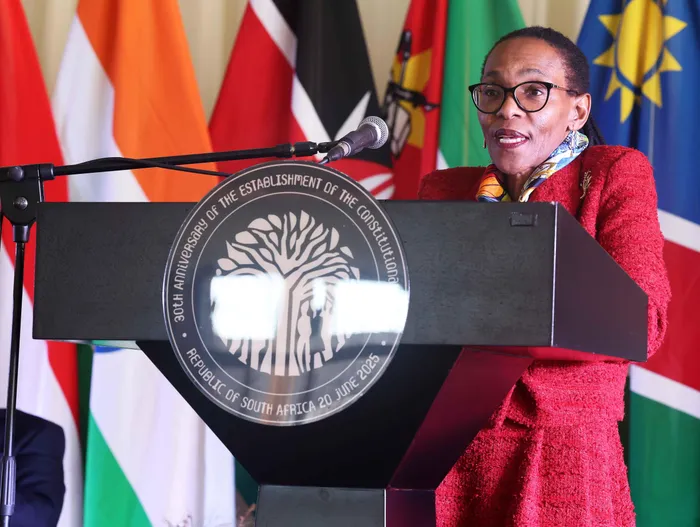
Chief Justice Mandisa Maya addressing the 30th anniversary celebration of the Constitutional Court in Braamfontein, Gauteng on June 20, 2025. As the country celebrates thirty years of the adoption of the Constitution, judges of the apex court must decide how they want history to remember them, says the writer.
Image: GCIS
Prof. Bheki Mngomezulu
As South Africans celebrate three decades of the adoption of the national constitution in 1996, they can look back with pride, knowing that the rights many of them did not have before 1994 are now enshrined in the constitution.
Whether these rights are practised is another issue that has become an ongoing discussion. One of the general concerns is that the phrase in the novel called Animal Farm, which says “all animals are equal, but some are more equal than others”, has gradually become a reality in post-apartheid South Africa.
The Phala Phala saga has been on the agenda for over five years now. It was on February 9, 2020, when an estimated amount of US$580 000 was stolen from President Cyril Ramaphosa’s farm. The matter was not reported to the police, as should be the case. It remains unclear why this was the case.
This issue would have been kept away from the public eye had former state security agent Arthur Fraser not laid formal charges against Ramaphosa on June 2, 2022, at Rosebank Police Station. After the case was considered by different people in the justice system, it landed on the desk of the Chief Justice.
On July 25, 2024, President Ramaphosa appointed Mandisa Maya as the first female Chief Justice of South Africa. Her term came into effect from September 1, 2024, when her predecessor, Raymond Zondo, retired.
One of the cases that has put Chief Justice Maya under serious public scrutiny is the apex court’s failure to deliver its judgment on the Phala Phala matter. While this is not a decision she can take unilaterally, as the highest judge in the land, the public looks upon her to provide astute leadership.
The Constitutional Court’s delay in delivering judgment on this matter has fuelled speculation and raised a wide range of questions which demand answers. Some of these questions are enumerated below.
Does the Constitutional Court respect the constitution it is expected to protect and uphold if it denies the public closure on this very serious matter? If it does not, how does it expect the country’s citizens to respect the constitution and the Constitutional Court?
Secondly, would the court have taken so long to deliver judgment on this matter if it did not involve President Ramaphosa? If the answer to this question is positive, what does that say about the court’s credibility and respect? If the answer is negative, can we say that the Constitutional Court acts with impartiality and objectivity?
Thirdly, how much damage does this delay cause to Chief Justice Maya’s public image as the first black and female Chief Justice in South Africa?
Surely, Justice Maya had performed exceptionally well when she contested this position with Justice Raymond Zondo and others. This was confirmed by the interview panel, which recommended her to be appointed to this enviable position. However, President Ramaphosa invoked his constitutional powers when he ignored the recommendation and appointed Zondo.
When Ramaphosa eventually appointed Maya, this was too little too late. However, it was still applauded. She obtained this position on merit. But can she allow the Phala Phala matter to dent her public image and undo all the gains she has made in her professional history? If that were to happen, it would be very unfortunate.
Fourthly, at the time when the judiciary has been exposed and put under serious public scrutiny on allegations of political influence, does this unexplained delay in delivering judgment on the matter negate or confirm these allegations? Will public trust in the judiciary increase or will it be diminished? If the latter happens, what will be the future of this country?
The sixth question, which is linked to the one above, is the following: would it make sense for the Constitutional Court to tarnish the country’s global image by delaying judgment on a matter that affects one individual at the expense of South Africa?
The seventh and even more important question becomes: does the delay by the Constitutional Court in delivering its judgement make a mockery of the thirtieth anniversary of the constitution, which has generally been hailed as the epic moment for South Africa? What message is this apex court sending to the country and the global community?
The questions posed above epitomise the frustration many South Africans have about the court’s decision not to deliver its judgment. Ironically, the phrase ‘justice delayed is justice denied’ finds expression by the judiciary at all levels – including the justices currently serving in the Constitutional Court.
It does not make sense that political organisations such as the Economic Freedom Fighters (EFF) and others can be forced to lead protest marches demanding that the Constitutional Court must do what it should have done anyway as part of its job.
This delay by the Constitutional Court is unnecessarily raising emotions among South Africans, more especially those who are politically inclined. There are people who interpret this delay to mean that the Constitutional Court judges are sympathetic to President Ramaphosa.
Others interpret the call for the Court to deliver its judgment as an attack on this institution as much as it demonstrates a vendetta against Ramaphosa.
One lingering question is whether the Constitutional Court would have delayed in delivering its judgment in this manner if the Phala Phala matter concerned Ramaphosa’s predecessors.
What makes this whole thing not sit well with many South Africans is that the Namibian nationals who were accused of stealing Ramaphosa’s money were formally charged and are currently being prosecuted. Meanwhile, state institutions such as the South African Revenue Service (SARS) and National Prosecuting Authority (NPA) cleared Ramaphosa of any wrongdoing.
As the country celebrates thirty years of the adoption in the constitution, judges of the apex court must decide how they want history to remember them. Do they want to be remembered as judges who applied the law objectively and consistently or as judges who used their positions to keep South Africans in suspense?
* Prof. Bheki Mngomezulu is Director of the Centre for the Advancement of Non-Racialism and Democracy at Nelson Mandela University.
** The views expressed do not necessarily reflect the views of IOL or Independent Media.