Navigating Political Change: The ANC, DA, and Emerging Forces in South Africa
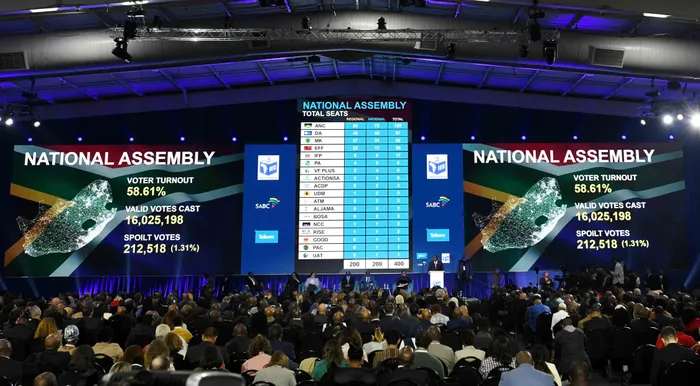
President Cyril Ramaphosa announcing the 2024 national and provincial election results at the IEC's Results Operations Centre in Midrand on June 2, 2024. It must be remembered that the 2024 elections marked a historic inflexion point, as the ANC fell below majority governance for the first time in the democratic era, says the writer.
Image: GCIS
Zamikhaya Maseti
Two weeks ago, the Social Research Foundation released its latest poll results, which merit close analytical scrutiny as South Africa approaches the Local Government Elections later this year. The release of this data does not merely present a snapshot of electoral sentiment; it signals the gradual reconstitution of political equilibrium in South Africa.
In the aftermath of the 2024 electoral rupture, which unsettled the architecture of the ANC’s majoritarian hegemony and disrupted its historically constituted hegemonic bloc, the current data points to a system no longer in free fall, but in cautious realignment.
What is now unfolding is not simply an electoral adjustment, but a renegotiation of consent between political actors and the social forces that sustain them. The African National Congress shows signs of a modest upward trajectory from its 40.18% electoral outcome in May 2024, according to the latest Social Research Foundation polling, while the Democratic Alliance consolidates within a governing framework.
The question is no longer whether the system is fragmenting, but how it is recomposing itself.
This moment demands analytical discipline. Earlier projections had placed the ANC closer to 32% ahead of the forthcoming Local Government Elections, amplifying a narrative of terminal decline. The present data disrupts that thesis. It invites a more calibrated reading of political movement grounded in structure rather than speculation.
The Social Research Foundation offers patterned insights into voter behaviour. Accordingly, the task is interpretive. The first discernible movement is the stabilisation of the ANC. It must be remembered that the 2024 elections marked a historic inflexion point, as the organisation fell below majority governance for the first time in the democratic era. What emerges from the current data is not a resurgence, but a recalibration.
This recalibration reflects a partial reabsorption of voters who had drifted away. Such movement is less an endorsement of ideological renewal than a return to familiarity. In conditions of systemic uncertainty, electorates retreat from experimentation and re-anchor themselves in known political formations. The ANC, notwithstanding its contradictions, continues to function as that centre of gravity.
Parallel to this is the steady consolidation of the Democratic Alliance. Its trajectory is defined by incremental accumulation rather than expansion. Within the framework of the Government of National Unity, the DA has relinquished the classical posture of opposition and assumed governing responsibility. This transition reshapes both its institutional identity and its electoral appeal.
This positioning carries consequences. The DA is increasingly perceived as a governing formation within a shared executive arrangement. For constituencies seeking predictability and institutional continuity, this enhances its credibility. Accordingly, its growth reflects the consolidation of a viable alternative within a maturing democratic order.
However, this consolidation is neither uncontested nor structurally secure.
It is increasingly undermined by the rise of the Patriotic Alliance under Gayton McKenzie. The PA has demonstrated a growing capacity to penetrate and erode the Democratic Alliance’s traditional support base, particularly among People of Colour in the Western and Northern Cape. What is unfolding is not merely competitive displacement, but a slow corrosion of a once relatively stable constituency.
The Patriotic Alliance is repositioning itself as a political home for disillusioned and politically alienated voters within this critical electoral segment, one that has historically oscillated between formations in search of representation and material inclusion.
In this sense, the PA is not simply expanding; it is reconstituting a constituency that carries disproportionate weight in the broader South African electoral milieu. Accordingly, the DA’s challenge is not only to grow, but to defend its eroding social base while attempting to broaden its appeal beyond its perceived demographic core.
If the stabilisation of the ANC and consolidation of the DA form one axis of the emerging equilibrium, the contraction and reconfiguration of insurgent formations form another. The decline of the Economic Freedom Fighters signals the limits of a strategy anchored in perpetual mobilisation without corresponding organisational deepening.
While its ideological posture remains visible, its electoral trajectory suggests that mobilisation, in the absence of institutional consolidation, has diminishing returns.
This contraction must be read alongside the reconfiguration of the populist political space. The EFF no longer operates as the sole repository of protest politics. That space is now fragmented, with formations such as the uMkhonto weSizwe Party and the Patriotic Alliance occupying differentiated segments of disaffection. In this sense, the EFF is not simply declining; it is being outflanked within a reconstituted protest terrain.
Similarly, the uMkhonto weSizwe Party, initially propelled by personality-driven mobilisation and protest sentiment, is now experiencing predictable erosion. Formations that emerge rapidly on the basis of sentiment often struggle to sustain themselves without institutional depth and programmatic coherence. Its trajectory reflects this structural limitation.
Taken together, these developments point to a contraction and differentiation of political space previously occupied by insurgent actors. The electorate appears to be gravitating towards formations that offer a semblance of stability, even where such stability remains contested.
It is within this broader national reconfiguration that provincial dynamics, particularly in KwaZulu-Natal, acquire heightened analytical significance. The province is increasingly emerging as a laboratory of coalition politics, where the uMkhonto weSizwe Party may yet position itself at the centre of a governing arrangement, potentially drawing tactical support from formations such as the Economic Freedom Fighters and the National Freedom Party.
In such a configuration, smaller parties assume the role of kingmakers, their influence disproportionate to their electoral size.
What this scenario reveals is not merely the fluidity of coalition politics but the strategic recalibration of alliances in response to shifting electoral realities. It raises a more fundamental question: whether emerging formations possess the ideological coherence to articulate a progressive theory of political alliances, or whether such coalitions will remain instruments of tactical convenience devoid of programmatic depth.
At the national level, however, an incipient bipolar configuration continues to take shape. On one pole stands the ANC, bearing liberation legitimacy and governance burdens. On the other stands the DA, operating as a countervailing presence within governance itself. Between these poles, smaller parties increasingly assume auxiliary roles within coalition arrangements, albeit with growing tactical significance.
This configuration carries both stabilising and constraining tendencies. On the stabilising side, the weakening and fragmentation of disruptive actors may allow for more coherent coalition formations, particularly at the municipal level, where fragmentation has often produced paralysis. A more structured political field may yield greater predictability in governance outcomes.
On the constraining side lies the risk of convergence. As the ANC and DA occupy increasingly proximate policy terrain, particularly in macroeconomic management and institutional governance, the space for transformative policy innovation may narrow. Stability, in this sense, may be secured at the expense of structural change.
What remains central is the question of electoral constituencies. It is within these formations that the deeper meaning of political movement is located.
Beginning with the African National Congress, its decline in 2024 was not merely numerical, but sociological. The organisation has lost between six and seven million voters, including segments of its historically captive base, particularly beneficiaries of social grants, now estimated at approximately sixteen million citizens. This constituency once formed the bedrock of ANC dominance through tangible improvements in living conditions.
The 2024 outcome revealed a rupture within this relationship. Sections of this base, alongside elements of the lower middle strata, withdrew their support. The pattern reflects abstention, fragmentation, and selective realignment rather than wholesale migration.
The modest rebound in current polling, therefore, presents a narrow but decisive strategic window. The ANC must treat this moment not as recovery, but as a test of renewal. Reconstituting its electoral base requires more than rhetorical repositioning. It demands organisational discipline, credible leadership, and measurable improvement in lived conditions.
Without visible gains in service delivery, employment creation, and local economic participation, the organisation risks exhausting the residual goodwill sustaining its current stabilisation. The voters who have drifted away will not be reclaimed through historical memory alone. They require material evidence that governance can deliver.
The broader implication of the Social Research Foundation’s findings is that South Africa’s political system is entering a phase of measured recalibration. The rupture of 2024 has not produced systemic collapse, but a reordering of political forces around more defined axes of competition.
Yet, equilibrium must not be mistaken for resolution.
The structural contradictions that define South African society remain unresolved. Inequality, unemployment, and spatial injustice continue to exert pressure on the political system. A stabilised political landscape, absent substantive policy innovation, risks entrenching these conditions.
This domestic recalibration unfolds within a shifting global and continental context. The African Union, constrained by its inability to act decisively in moments of geopolitical tension, reflects a broader crisis of multilateral efficacy. At the same time, the reconfiguration of global trade relations and the resurgence of economic nationalism impose additional pressures on middle-income economies such as South Africa.
Therefore, the central question is no longer who gains marginal percentage points, but whether the emerging configuration possesses the ideological clarity and institutional capacity to confront these contradictions. Stability without transformation is merely the management of decline.
In conclusion, the Social Research Foundation poll must be read as an inflexion rather than a destination. It signals the reconstitution of political equilibrium, but leaves unresolved the question of its trajectory. The data reflects movement, but not direction.
Accordingly, the burden now shifts to political leadership. It is no longer sufficient to interpret voter behaviour; it is necessary to respond with programmatic depth and strategic coherence. The terrain has shifted, the equilibrium is reforming, and the illusion of permanence has been decisively broken.
What now confronts South Africa is not a crisis of numbers, but a crisis of political imagination.
* Zamikhaya Maseti is a political economy analyst and holds a Magister Philosophae (M.Phil) in South African Politics and Political Economy from the erstwhile University of Port Elizabeth, now Nelson Mandela University.
** The views expressed do not necessarily reflect the views of IOL or Independent Media.