Power and Pressure: Ramaphosa’s G7 Disinvitation and Its Impact on South Africa
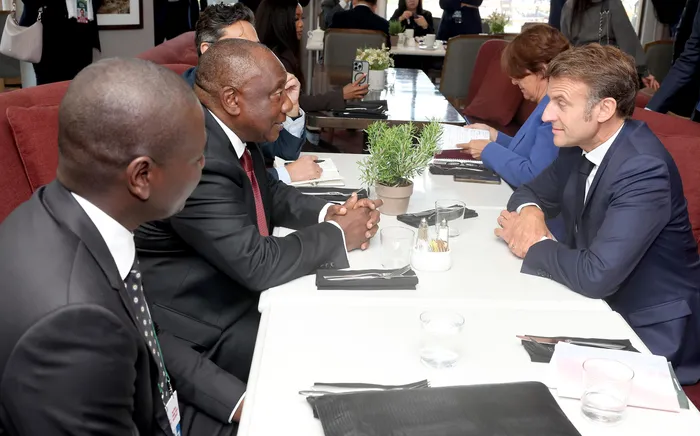
President Cyril Ramaphosa holds a bilateral meeting with his French counterpart Emmanuel Macron on the margins of the G7 Leaders Outreach Summit in Kananaskis, Canada on June 17, 2025. South Africa’s exclusion from the G7 2026 summit hosted by Macron challenges the country’s standing and punctures the curated image of Ramaphosa as a diplomatic statesman whose presence is indispensable, says the writer.
Image: GCIS
Dr. Clyde N.S. Ramalaine
South Africa’s unexpected removal from France’s 2026 G7 guest list is more than a diplomatic embarrassment; it exposes a misreading of influence, alliances, and the limits of middle power status under President Cyril Ramaphosa.
Understanding this requires a brief look at the G7 itself. Comprising seven major advanced economies: Canada, France, Germany, Italy, Japan, the United Kingdom, and the United States, with the European Union also participating. It is an informal forum, operating without a permanent secretariat, and functioning largely through consensus.
The presidency rotates annually, and in 2026, France holds the host nation role, responsible for organising the summit and setting its agenda.
Critically, the host nation has the prerogative to invite non-G7 countries, a power that carries significant diplomatic weight. While formally resting with the host, invitations are invariably shaped by broader geopolitical pressures and often reflect negotiated consensus.
In 2025, Canada, hosting the G7, invited India, South Africa, Brazil, South Korea, and Ukraine. France initially extended an invitation to South Africa for 2026 but subsequently disinvited it, replacing the country with Kenya. Official explanations cite thematic priorities, yet the circumstances suggest a strategic calculus influenced by Washington.
Diplomatic exclusions are common; disinvitations are not. Being invited and then removed introduces public embarrassment and signals objection. If France reversed an invitation in good faith, the implication is clear: its autonomy was constrained within a broader alliance context, demonstrating the United States’ enduring influence.
Emmanuel Macron framed South Africa’s absence as a reflection of the host’s discretion. Kenya’s inclusion was justified publicly by regional influence, climate diplomacy, and alignment with multilateral development initiatives.
Implicitly, the selection signals Western preferences: Kenya offers a predictable partner, whereas South Africa, under Ramaphosa, increasingly complicates relations with Western powers. Macron’s framing thus operates on two levels: a narrative of thematic inclusion and an implicit recalibration shaped by U.S. preferences.
Cyril Ramaphosa, in a live ENCA interview on 26 March, insisted South Africa was “not invited”, a distinction he framed as within France’s sovereign rights. He emphasised continued engagement through other global platforms, presenting the episode as procedural rather than politically significant.
On the surface, his explanation appears diplomatically tidy. Yet absence in international diplomacy is rarely neutral; it signals alignment, estrangement, or recalibration. To sidestep why South Africa was excluded exposes a presidency more invested in managing perception than confronting strategic realities.
A persistent tension emerges between South Africa as a sovereign actor and Ramaphosa as an individual seeking to craft a distinctive foreign policy legacy. The 6th and 7th administrations have framed global engagement through the lens of Ramaphosa’s personal narrative, portraying him as a capable mediator, moral interlocutor, and bridge-builder between the Global South and Western powers.
This individualised approach risks conflating state interests with personal branding, where strategic decisions are filtered less through national calculus and more through legacy imperatives.
In the G7 disinvitation, this tension is palpable: South Africa’s exclusion challenges the country’s standing and punctures the curated image of Ramaphosa as a diplomatic statesman whose presence is indispensable. The episode reveals the fragility of a foreign policy overly reliant on symbolic weight rather than institutionalised strategic credibility.
Ramaphosa’s posture of indifference, claiming South Africa is “not concerned,” reflects a broader foreign policy drift: a state oscillating between asserting global relevance and passively accepting marginalisation.
Moreover, the framing is disingenuous: a formal invitation had initially been extended. Presenting the outcome as a mere procedural omission distorts events and functions, turning it into diplomatic spin over an embarrassing moment.
Deference to the host’s rights is diplomatically correct, yet politically incomplete. The G7 operates within informal hierarchies where exclusion is rarely unilateral. Ramaphosa’s explanation reads less as fact and more as strategic silence—avoiding external pressure, sidestepping implications for South Africa’s standing, and reflecting a presidency comfortable managing perception rather than confronting power.
This episode punctures a long-standing illusion: that European powers can act independently of U.S. influence. While France retains autonomy, the G7 functions as a coordinated forum among aligned powers. Any outsider’s invitation must meet collective comfort standards; if Washington signals discomfort, France is likely to adjust, not in subservience, but in alliance maintenance.
South Africa’s G7 disinvitation aligns with a pattern of exclusion. When South Africa, as the G20 host of 2025, was denied participation by the Washington G20 in 2026, no European ally intervened. This reinforces that South Africa is not viewed as indispensable within Western forums.
The French disinvitation is unlikely to be the last: the UK hosts G20 in 2027, and if Washington could influence France, London could act similarly. While each host exercises discretion, it is exercised within a shared strategic ecosystem.
The deeper issue is South Africa’s assumptions. Under Ramaphosa, there appears to have been an overestimation of the country’s indispensability and a false belief in European willingness to absorb diplomatic friction.
Moral and historical capital, South Africa’s Global South identity, BRICS engagements, and legal interventions at the International Court of Justice do not automatically translate into strategic inclusion.
From a political-theoretical perspective, South Africa’s approach reflects a classic misreading of what realist scholars describe as “capability versus perception.” While the country projects indispensability to the Global South, it overestimates its ability to convert normative authority into tangible European support.
Realist theory emphasises that states act to preserve influence, security, and aligned interests, not moral credibility alone. Expecting European backing despite U.S. discomfort is a miscalculation of structural power: support is contingent on shared alignment and subject to Washington’s gravitational pull. This exposes a gap between perceived normative significance and alliance politics, showing that symbolic capital cannot substitute for leverage.
Part of South Africa’s miscalculation lies in a persistent overestimation of its middle power status. Middle powers, states that are not global hegemons but possess regional influence, can exert diplomacy effectively only when they align with prevailing global structures and demonstrate reliability. South Africa has assumed symbolic leadership in Africa, and the Global South automatically translates into strategic clout in Western-led forums.
This conflation misreads middle power mechanics: influence is earned through alignment, coalition-building, and demonstrated utility, not reputation or moral authority. The G7 disinvitation underscores the limits of this perception, revealing that middle power status is conditional and must be actively reinforced, lest it be overshadowed by more predictable actors like Kenya.
This overestimation feeds directly into South Africa’s strategic ambiguity. The country oscillates between asserting independence and seeking accommodation, leaving Western powers uncertain of its reliability. Ambiguity has a shelf life: to Western powers, the question is reliability within forums designed for policy coordination among like-minded states. Uncertainty invites exclusion.
This moment signals a shift in perception: South Africa is not merely a disagreeing state but one whose presence complicates consensus. Disagreement can be managed; perceived misalignment can lead to outright exclusion. The distinction is critical: the incident is not a diplomatic slight but a test of strategic clarity.
South Africa must confront hard questions: Can it maintain its current foreign policy posture without further marginalisation? Does it wish to bridge blocs or be identified with one? What form of global influence is sought, and in which arenas? These are not abstract; they define South Africa’s place in a polarising world.
The disinvitation of President Ramaphosa is neither isolated nor accidental. It reflects the realities of power: quiet, decisive, and indifferent to self-perceptions. South Africa’s struggle is not legitimacy, history, or voice; it is misjudging how these assets are weighed in spaces defined by alignment and trust.
This reassessment is not accidental. South Africa’s misperceived influence, embodied in overreliance on moral authority and assumed indispensability, collided with alliance realities, resulting in diplomatic exclusion. Global powers, acting on strategic calculations rather than reputation, recalibrated their evaluation of South Africa’s usefulness.
As I always suggest, we all need mirrors to see our real size; this disinvitation may have served as a sobering moment for Ramaphosa personally, a chance to confront the limits of his influence and the boundaries of his diplomatic stature.
Ultimately, the lesson is stark: power invitations are not granted based on self-perception but on assessments of utility to prevailing agendas. In this instance, South Africa, and by extension its leadership, appears to have been reassessed and found wanting.
* Dr Clyde N.S. Ramalaine is a political scientist and analyst whose work interrogates governance, political economy, international affairs, and the intersections of theology, social justice, and state power.
** The views expressed do not necessarily reflect the views of IOL or Independent Media.