Israel's Death Penalty Law: A Grave Injustice for Palestinians
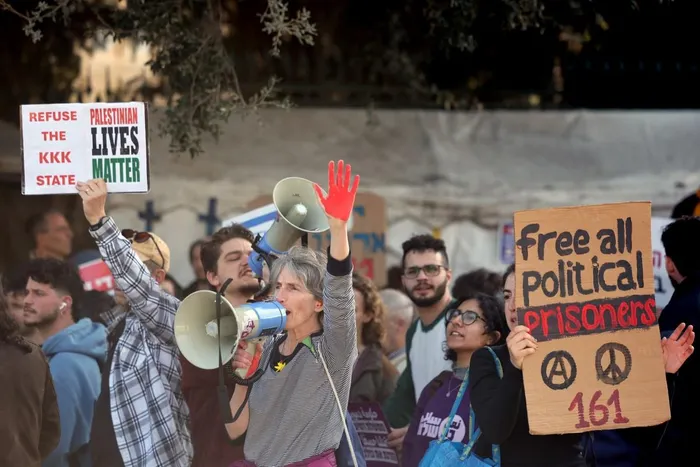
Protesters gather outside the Knesset, the Israeli parliament, in Jerusalem on March 31, 2026, during a demonstration against the passing of a law allowing for the death penalty against Palestinians. Under the new law Palestinians in the West Bank convicted by Israel's military courts of carrying out attacks classified as "terrorism" will face the death penalty as a default sentence.
Image: AFP
Woody Aroun and Anna Weekes
The enactment of draconian new death penalty laws for Palestinian political prisoners by the Israeli parliament (the Knesset) deserves condemnation in the strongest possible terms.
The new law is yet another Israeli onslaught against the Palestinian people and makes Israel the first state since Nazi Germany to institute the death penalty for one race but not another.
Passed on 30 March, the law mandates the death penalty for Palestinians convicted in Israeli military courts of killing Israelis, even through acts of resistance. It will come into effect within 30 days.
The military court system is neither fair nor just. Prosecutors and judges are not impartial legal experts but Israeli soldiers in uniform acting for the state. Palestinians may have legal representation, but not during interrogations, where extreme forms of torture, including gang rape, often occur. Lawyers can be prevented from consulting their clients for days or weeks.
There is also a highly limited appeals process, and the new law states that no appeals will be allowed for Palestinians convicted of killing Israelis.
The law is exceptionally broad. Palestinians who have not killed Israelis but are linked in any way, by the Israeli army, to a death can be arrested, tried in a military court and hanged. This opens the door to extreme abuse.
Take the West Bank village of Bili’in, visited by the late Archbishop Desmond Tutu. This village of 600 inhabitants has held weekly peaceful protests against Israeli soldiers who cut down and burn 500-year-old olive trees, their staple crop.
At one such protest, one of us witnessed the infiltration of “Mistaravim” — Israeli special forces dressed as Palestinians. These agents threw large rocks at Israeli soldiers while Palestinians marched with flags. As troops opened fire, the agents used the chaos to arrest leaders of the village Popular Committee.
Under the new law, had one of those rocks killed a soldier, the entire Popular Committee could have been convicted of orchestrating the killing and sentenced to death.
Palestinians have faced dubious trials in Israeli military courts since the occupation of the West Bank in 1967. The Palestinian Prisoner Support and Human Rights Association, Addameer, reports that 99% of Palestinians charged in these courts are found guilty, including for acts such as throwing stones at heavily armoured Israeli vehicles.
Military Order 1651 classifies stone-throwing as terrorism, punishable by up to 20 years in prison. Another order criminalises carrying the Palestinian flag and restricts printing pamphlets without military permission. These courts should be shut down, not granted greater powers.
The law does not apply to Israelis in West Bank settlements, which continue to expand despite being internationally unlawful. Israeli settlers who kill Palestinians are tried in civilian courts, which rarely act against them.
This law will undoubtedly lead to hundreds of Palestinian activists being sent to the gallows and will also affect Palestinians in Gaza, which Israel has occupied since the start of its genocide.
Numerous governments and organisations, including Amnesty International, have condemned the law as an act of aggression that arbitrarily imposes the death sentence on prisoners convicted of “political crimes.” Criminalising such acts raises serious legal and human rights concerns in the context of resistance to occupation.
Judicial systems are not neutral; they are ideological. Even so, the rule of law must align with internationally recognised principles, including the United Nations Universal Declaration of Human Rights and broader international human rights law.
Like apartheid South Africa, Israel has abandoned fundamental standards of international human rights law. Documented torture, enforced disappearances, arbitrary detention without trial of men, women and children, and contempt for institutions such as the International Court of Justice and International Criminal Court demand more than passive UN resolutions. Calls for boycott, divestment and sanctions (BDS) are growing, alongside demands for stronger action to hold Israel accountable.
In response, Hamas has called on the UN and the Red Cross to take urgent action to halt this “criminal overreach” and protect prisoners. The International Committee of the Red Cross has intervened in conflicts before; it must now intensify efforts to stop this law. If such calls cause discomfort, the words of Nelson Mandela remain relevant: “What matters is not only the good the ICRC brings but the evil it prevents.”
Currently, more than 9,300 Palestinians, including women and children, are held in Israeli prisons. B’tselem, the Israeli Information Centre for Human Rights in the Occupied Territories reports that as of 29 March 2026, 3,329 Palestinians are detained without trial, echoing practices of apartheid South Africa.
The South African government must take a strong stand against this sharp Israeli escalation of atrocities against the Palestinians. It cannot continue allowing coal exports to Israel. South African coal supplies 55% of Israel’s coal, effectively supporting the oppression of Palestinians. The government must impose comprehensive sanctions and end this trade.
* Woody Aroun is a former Parliamentary researcher for NUMSA and a former political prisoner. Anna Weekes is a research associate at Rhodes University’s Journalism and Media Studies department and lived and worked in the West Bank for three years.
** The views expressed do not necessarily reflect the views of IOL or Independent Media.