Why the UN Declaration on Slavery Needs Action, Not Just Words
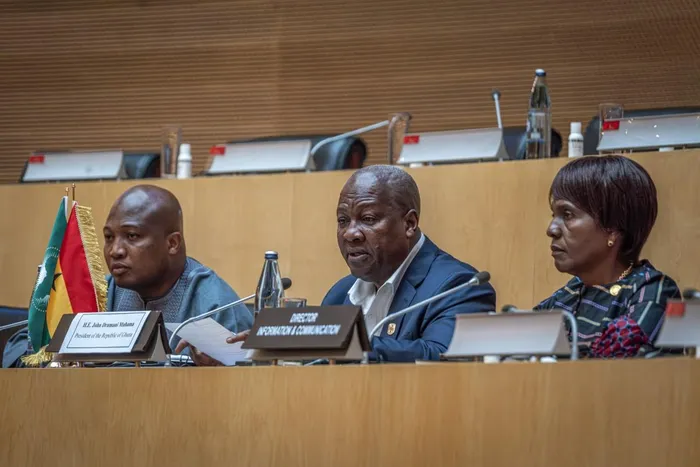
John Dramani Mahama (centre), President of the Republic of Ghana, addresses a press conference on the theme “Ancestral Debt, Modern Justice: Africa’s Unified Case for Reparations” during the 39th Ordinary Session of the Assembly of the African Union at the AU Headquarters in Addis Ababa on February 15, 2026.
Image: AFP
Kim Heller
The recent declaration by the United Nations General Assembly, which recognises the 'trafficking of enslaved Africans and racialised chattel enslavement of Africans as the gravest crime against humanity', is historically significant.
While it is long overdue, the world has finally named a devastating historical crime whose aftershocks continue to reproduce an unjust global order, unequal power relations, and economic and geopolitical imbalances.
This historical declaration undercuts the well-peddled and false narrative of slavery that slavery is part of a distant, forgotten age, rather than an omnipresent feature in today's racial hierarchies of economic extraction and distribution.
Naming slavery as the gravest crime against humanity will not in itself disrupt global systems of power or root out uneven patterns of accumulation or the deep-seated structural inequality caused by this crime. Too often, history has shown us that even the most poignantly articulated declarations are wishful wands which lack the magical might to vanquish structural ills.
Although the declaration acknowledged the need for reparatory justice as "a concrete step towards remedying historical wrongs,” systems of economic, cultural, and epistemological domination are not vaporised by symbolic gestures or cries for justice.
Power cares little about the prose of proclamations or moral appeals.
The resolution, spearheaded by Ghana with the support of the African Union and the Caribbean Community, received overwhelming backing at the UNGA meeting held on 25 March 2026. There were 123 votes in favour. The United States, Israel, and Argentina voted against the resolution, while 52 countries abstained, including the United Kingdom and all 27 members of the European Union.
That global powers opposed or abstained is not merely an act of political or moral bankruptcy. It is an economically calculated decision to avoid the question of the unpaid debt of historical ills and injustices.
Reparations threaten to disrupt the global power matrix. Reparatory justice demands the concession of a measure of wealth and historical accountability. It is also a painful reminder that black pain matters less.
In his seminal work, How Europe Underdeveloped Africa, Walter Rodney frames the transatlantic slave trade not only as a humanitarian catastrophe but also as a foundational pillar of global capitalism.
Rodney points out that empires in Europe are direct beneficiaries of the deliberate underdevelopment of Africa and the brutal extraction and exploitation of its people, labour, and resources. He unmasks the tale of Western prosperity as a ruthless accumulation of wealth, stolen wealth, and labour.
Similarly, Omali Yeshitela in his book, Stolen Black Labour, exposes how centuries of unpaid African labour were used to midwife global capitalism and nurture Western industrialisation.
Today, the illicit wealth yielded through slavery has been institutionalised through neo-colonial states and financial systems.In a statement issued by the African Union on 26 March 2026, the Chairperson of the AU Commission described the declaration as an important step toward addressing the enduring legacy of slavery, truth, justice, and healing.
The AU designated 2025 as the Year of "Justice for Africans and People of African Descent Through Reparations" and launched its Decade of Reparations (2026–2036). The time has come for the African Union to show its mettle. It is highly unlikely that United Nations member states will move to implement meaningful reparations.
Even those who voted in support of the declaration are unlikely to move beyond symbolic support, as these nations continue to benefit from unequal global power relations and economic distribution.
The South African experience illustrates the serious pitfalls of symbolic change. The lack of large-scale economic redistribution by the ANC government, coupled with the lack of moral fortitude of white South Africans to offer reparations, has failed to root out historical injustices and crimes against humanity.
The African Union and its allies across the Continent and the Global South will need to act on the premise that historical justice cannot be achieved through the benevolence of those who benefit from the oppressive economic order.
If reparatory justice is to be done rather than merely declared, coordinated political, economic, and intellectual solidarity, strategy, and political action are needed across Africa and the Global South.
The abolishment of slavery, the end of colonialism and the dismantling of apartheid were won through sustained struggle and strategic mobilisation of the oppressed against the system, not mere declarations. Continued dependency on a global economic system which is designed to underdevelop and exploit Africa is nothing less than self-enslavement.
If a titanic wave of decolonised economic reconfiguration and a strong crest of self-determination do not accompany reparation drives, Africa will lose yet again. The world has recognised slavery as the gravest crime against humanity.
However, Africa will need to lead the charge to dismantle its legacy, in all its manifestations, including economic, cultural, epistemological, and psychological damage. Reparations can never erase the grotesqueness of slavery, its immeasurable human loss, and the ever-festering and untreated open and bloody wound on Africa.
Millions of Africans were forcibly taken from the Continent and dehumanised into commodities for profit. There can be no greater violation of humanity. Those who did not perish in the horrendous transatlantic journey were to face the intolerable cruelty of slavery.
It is up to Africa to ensure that the UN declaration is not relegated to a large stack of paper victories widely celebrated but never acted upon. There is nothing unrealistic or impractical about reparations. It can and must be done with the same human drive for dignity and justice that saw the abolition of slavery.
* Kim Heller is a political analyst and author of No White Lies: Black Politics and White Power in South Africa.
** The views expressed do not necessarily reflect the views of IOL or Independent Media.