Collapse of ANC, SACP Alliance A Betrayal of Revolutionary Ideals
REMEMBERING CHRIS HANI
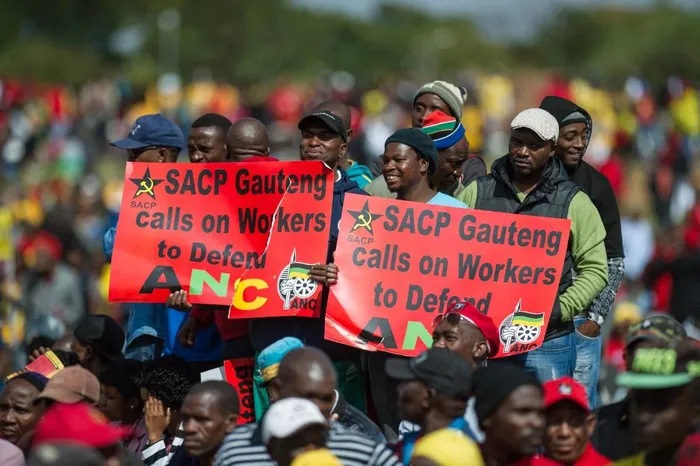
Cosatu and SACP members display their support for the ANC at a May Day rally held in Mamelodi on May 1, 2016. Today, the ANC leadership treats its longstanding alliance partner, the SACP, as enemy number one while embracing neoliberal and right-wing parties such as the Democratic Alliance and Freedom Front Plus, says the writer.
Image: AFP
Dr. Reneva Fourie
This week, as we commemorate Solomon Mahlangu, executed by the apartheid regime on 6 April 1979, and the assassination of Chris Hani on 10 April 1993, the contrast between past sacrifice and present political reality is stark.
Mahlangu embodied the courage of the working class and youth in the armed struggle. Hani, as general secretary of the South African Communist Party, member of the African National Congress national executive committee, and chief of staff of Umkhonto we Sizwe, epitomised the principle of dual membership that bound communists and nationalists in a common revolutionary project.
Yet today, the ANC leadership treats its longstanding alliance partner, the SACP, as enemy number one while embracing neoliberal and right-wing parties such as the Democratic Alliance and Freedom Front Plus.
The ANC has always constituted an ideologically contested terrain, a multi-class nationalist movement whose internal contradictions reflect the broader class dynamics of South African society.
Tensions with the SACP, rooted in scientific socialism, have always existed. Nonetheless, the two converged as the ANC saw the black working class as the primary motive force of national liberation. Racial oppression under colonialism and apartheid made national consciousness essential before class consciousness could develop. Communists recognised and adapted to this reality.
The International Socialist League, founded in 1915, and the Communist Party of South Africa (CPSA) after 1921, contested elections independently or with the Labour Party, until the proclamation of the 1950 Suppression of Communism Act.
However, following the Comintern decision, the CPSA, at its seventh conference (29 December 1928-2 January 1929), resolved to work within national organisations such as the ANC while maintaining its independence. This strategy paved the way for the alliance of communists, nationalists and labour, legitimising dual and triple membership.
This rationale was rooted in material conditions. Colonial capitalism entrenched racial and gender discrimination so deeply that only the broadest united front could dismantle it. National unity was needed before class unity. When racism and state repression defined life, the SACP put aside immediate socialist agitation in favour of national liberation, without abandoning its long-term goal.
That disciplined approach shaped the SACP’s 1993 Central Committee paper, “The role of the SACP in the transition to democracy and socialism”. As from the 1994 elections, the party ran under the ANC banner but reserved the right to assume more autonomy “if the national liberation struggle is hijacked by some liberal project, or undermined… or if our NLM unity is broken and the strategic purpose is lost.”
The paper realistically assessed, using Marxist-Leninist analysis, how bourgeois forces operate in liberation movements after state power is gained.
Since 2022, those conditional warnings have become increasingly relevant. Tensions within the ANC-SACP-COSATU alliance have intensified, reaching a peak at the ANC’s fifth National General Council. Sections of ANC leadership now openly frame the SACP as a destabilising force.
At the recent funeral of the mother of the SACP’s North West provincial secretary, an ANC member and MEC, Mantashe, the ANC national chairperson, launched a scathing attack: “We in the ANC will force them to choose between SACP or ANC. I am cautioning you, Madoda!” The tone marked a qualitative shift from alliance management to outright exclusion.
At the same time, the ANC has deepened its coalition arrangements with parties firmly positioned to its right on the political spectrum. Partnerships with the Democratic Alliance, a defender of neoliberal orthodoxy, and the Freedom Front Plus, a vehicle for Afrikaner nationalist interests, have become normalised.
These alliances coincide with and increase the role of the private sector in managing strategic state assets. For many within the alliance and the broader working class, these decisions signalled a departure from the movement’s historical commitment to redistribution, social justice and economic transformation.
Persistent unemployment, poverty, inequality and food insecurity remain structural features of the economy. The SACP has accordingly argued that the working class requires an organised and influential presence within governing structures precisely because the ANC, as a nationalist movement, is not ideologically structured as a socialist organisation.
This creates legitimate space for ideological divergence, yet the ANC leadership increasingly responds by characterising this reality as confrontational.
These domestic developments unfold within a broader international context of contestation over economic sovereignty and policy autonomy. Global financial institutions continue to impose fiscal discipline and market-led solutions that subordinate social wages to capital accumulation. Within South Africa, this external pressure intersects with internal class realignment.
Senior ANC figures have signalled support for proposals restricting SACP members’ participation in certain party structures, further eroding the institutional basis of dual membership that once strengthened the national democratic project.
If Chris Hani were alive today, he would recognise these manoeuvres as the quiet counter-revolution he feared. He warned that the greatest threat to democratic South Africa would not come from open confrontation but from the gradual infiltration of neoliberal ideas.
Privatisation, fiscal austerity and the prioritisation of market interests over human needs were, in his analysis, instruments of class compromise designed to protect bourgeois interests while betraying the revolutionary aspirations of the working class and the poor.
He would view the current embrace of right-wing partners, rather than the deepening of relations with the SACP and Cosatu, as a betrayal of the Freedom Charter and a grim fulfilment of his prophecy that some leaders, once in power, might abandon the promise of shared prosperity.
The commemoration of Mahlangu and Hani, therefore, carries more than symbolic weight. Their sacrifices were made in the service of a revolution that placed the working class at its centre. To treat the SACP as enemy number one while extending a hand to neoliberal and right-wing formations is to invert that legacy.
It signals that the class forces which once united against apartheid have now fractured along new lines, with sections of the ANC leadership aligning with capital at the expense of the very motive force that brought democracy into being.
The working class, organised and conscious, must draw the necessary conclusions if the national democratic revolution is to advance towards its socialist conclusion rather than stagnate in compromise.
* Dr Reneva Fourie is a policy analyst specialising in governance, development and security.
** The views expressed do not necessarily reflect the views of IOL or Independent Media.