The Scars of History: Navigating White Privilege and Black Pain in Democratic South Africa
BOOK REVIEW
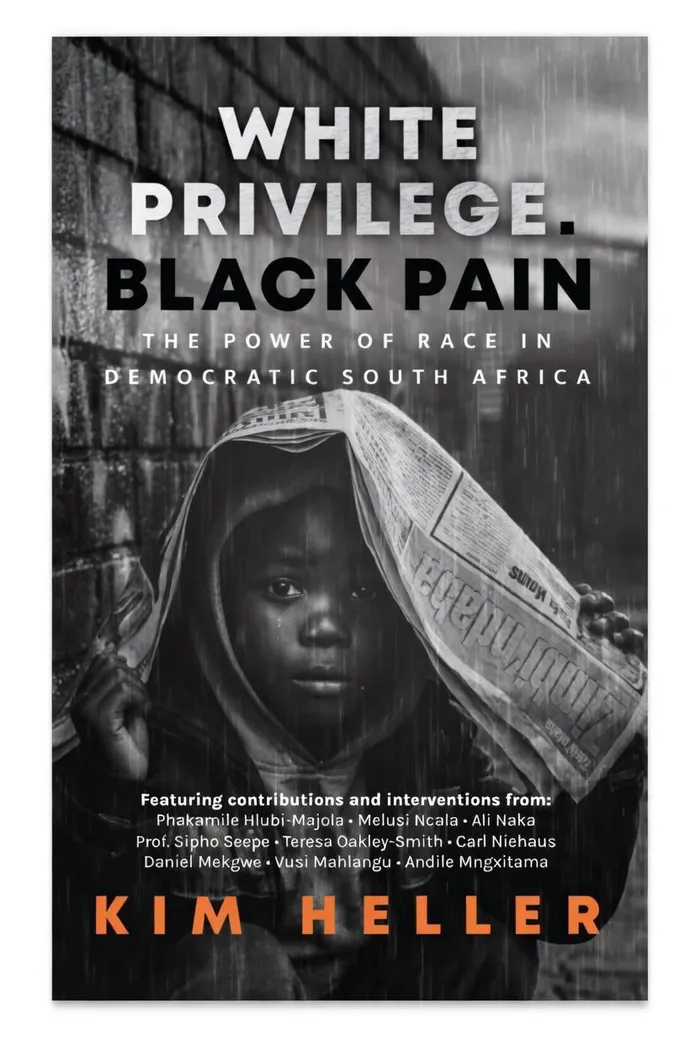
The cover of author and political analyst Kim Heller's latest book. If Heller intended to spark animated debates and discussions, then “White Privilege. Black Pain: The Power of Race in Democratic South Africa is certainly going to achieve that, says the writer.
Image: Supplied
Prof. Sipho Seepe
An academic based at the University of South Africa, David Letsoalo, once remarked that white supremacy and white privilege are subjects that too many writers, journalists, academics, and commentators are afraid to confront.
Kim Heller’s latest book, “White Privilege. Black Pain: The Power of Race in Democratic South Africa unwittingly responds to Letsoalo’s seemingly insolent provocation.
In anticipation of her usual detractors, especially those who read her with the sole intention of distorting her views, Heller has been quick to be upfront regarding what the book is about. In doing so, she unwittingly points out what it is not about. She writes.
“White Privilege. Black Pain: The Power of Race in Democratic South Africa is not a history book, nor is it an authoritative study of White power and privilege. Rather, it is a fusion of my writings, interviews, lived experiences, and observations—the perspective of a White participant in and witness to the long, unbroken story of White supremacy in this country. More importantly, it is a thought-scape that raises, rather than answers, critical questions about the persistence of White domination.”
With her profile in the media space and being a recognisable figure in social media, Heller has built a significant following comprised of like-minded friends and formidable foes.
In case she is misunderstood, Heller is quick to argue that the above is not a plea for sympathy. She writes.
“I expect this book to be criticised—both from the far right and the radical left. I welcome this, as it deepens the discourse. Any book written by a White author about South African politics and Black liberation must be regarded with suspicion. Dr Frantz Fanon was clear when he argued that the coloniser cannot feel the pain of the colonised because their worlds are irreconcilable (Black Skins, Black Masks).”
Heller draws inspiration from the words of James Baldwin. Baldwin argued. "You write to change the world … if you alter, even by a millimetre, the way people look at reality, then you can change it."
Heller is not unmindful of the risk that writing this book entails. Early on, she confesses.
“As a White settler, I cannot begin to comprehend the humiliation and indignity of an elderly Black father being called a boy by a young White policeman barely out of his teens, or an elderly Black woman who could not sit on the same bench as the young White children she looked after because the bench was reserved for Europeans.”
While Heller has sought to make the book a collaborative effort by enlisting the contributions of Phakamile Hlubi, Ali Naka, Melusi Ncala, Teresa Oakley-Smith, Vusi Mahlanga, Carl Niehaus, Daniel Mekgwe, Andile Mngxitama, writers and activists, and your truly, she remains the main protagonist.
This review cannot do justice to their insightful contributions, save to say each corroborates Heller’s thesis of the enduring legacy of apartheid colonialism in South Africa. Arguably, Heller’s decision to solicit different voices is an acknowledgement on her part of the complexity of the South African reality. Heller has, by design, created the requisite dialectical space to sophisticate the discussion.
To their credit, a few contributors have raised their disquiet regarding Heller’s appropriateness to reflect on her role as a white person to opine about the black pain and black struggle. For his part, Mngxitama is brutally forthright. He writes.
“Heller is upfront about her Whiteness and the challenge it presents in writing about the Black condition. But this very self-consciousness is part of the sophistication of how Whiteness reproduces itself. The book does the job of exposing White power and its inherent unethical nature. But her place as a White person is not diminished; instead, the unethical exercise of power by Whiteness is affirmed.”
It comes at a time when the faultlines of the post-1994 dispensation are glaringly obvious. The title calls for the juxtaposition of the South African reality. The master narratives of Rainbow and Miracle Nation, and the so-called New Dawn, have run their course. These were mere red herrings advanced to ensure that the apartheid and colonial architecture remain intact.
Regarding this, Heller observes. “To the White settlers we politely call 'White South Africans,' the democratic transition of 1994 was not a celebration of justice—it was an existential crisis. There were no Sunday prayers of thanks for racial equity. There was only fear and fury…. [White privilege and white supremacy were] constructed by violence and protected by law. We may feign ignorance about this brutal history. We may tell ourselves that apartheid is a past we didn't personally create. But we knew better.”
She continues. “The architecture of racial injustice was not hidden in apartheid, nor is it hidden today. It is present in the sprawling squatter camps that sit on the outskirts of manicured White suburbia. It lives in our boardrooms, where Whiteness chairs the meetings. It echoes in the languages we speak, and those we refuse to learn or even bother to pronounce.”
Heller’s observations should not exonerate the ANC in mismanaging the country and its electoral fortunes. The ANC can also not claim to have been ignorant of the challenges of the post-1994 dispensation. If anything, the party has fed the demon of white privilege and white supremacy by failing to fulfil its promise of a better life for all.
The former President Thabo Mbeki, then a deputy president (no angel himself), presciently noted that while whites were having it good, blacks languished in condition of squalor and had “virtually no possibility to exercise what, in reality, amounts to a theoretical right to equal opportunity, with that right being equal within this Black nation only to the extent that it is equally incapable of realization” (Mbeki, 1998).
Mekgwe concurs. He writes.
“To be born Black in South Africa is to inherit pain as a birthright—a pain that is not metaphorical, symbolic, or poetic but material, systemic, and institutional. Black skin is a site of assault, a canvas upon which the violence of capitalism, White supremacy, and the post-apartheid betrayal by the comprador bourgeoisie is painted daily in blood….[Being black] It is not only about exploitation—it is about erasure. This is the story of my skin. This is the story of Black pain.”
Recently reported statistics show that 64 per cent of Africans live under conditions of poverty as compared to only 1 per cent in the white population. It is this grotesque inequality that has made South Africa the poster child of global inequality.
The above notwithstanding, Heller is the first to distance herself from those who argue that the ANC government has failed in every respect. She writes. “I am not discounting the enormous advances made by the ANC, especially in its early years. It would be historically inaccurate and unfair to say that the ANC has done no good for Black people.”
In describing her own experience of political activism, Heller came face-to-face with the political reality of being white in the world and the ugly spectre of political intolerance. Her otherwise rewarding and lucrative professional career came to a screeching halt once she ditched the ANC to become a member of the EFF. The punishment of having been an EFF member, though brief, has somehow become permanent.
Instead of seeing her selection to the position of deputy secretary of the Gauteng Deputy Secretary of the EFF as a badge of honour, Heller describes this as evidence of how even in radical black politics "White privilege was alive, kicking, and vociferous."
Her experience of having a member of both the ANC and the EFF led her to come to the reality that even in radical black politics, white activists are romanticised, overvalued, and supersized. Whiteness continues to hold disproportionate symbolic and practical value in South African politics.
For Heller, this experience gave credence to precisely what Biko warned about whites becoming the default leaders in black spaces. Mainstream media became less interested in the perspective or plight of young Black people who have a real story to tell.
Instead, it sought to focus on white settlers in revolutionary garb. Heller concludes this experience by pointing out that the “danger of a White ally defaulting back to Whiteness is an ever-present danger to Black progressive parties.”
What is to be done, or precisely, what’s next for Heller? She writes.
“Once intoxicated by the Freedom Charter and the dream of a non-racial South Africa, I am no longer under the sway of this lullaby of reconciliation. I don’t believe non-racialism and reconciliation are the happy pills we need.
Reconciliation is a White man's medicine that has harmed, not healed. We need to shut down the rainbow nation and build a free South Africa, one that Pan-Africanists suggest that we call Azania. This is the revolutionary task of Black South Africans. Whether White settlers are invited to be part of this liberatory task is for Black South Africans to decide”.
If Heller intended to spark animated debates and discussions, then “White Privilege. Black Pain: The Power of Race in Democratic South Africa is certainly going to achieve that. Whether this is a timely and/or courageous intervention is for the readers to decide.
Without a doubt, it will invite sharp criticism from the defenders of the status quo and the radical black left that sees no role for a white voice on black pain.
* Professor Sipho P. Seepe is a Higher Education and Strategy Consultant.
** The views expressed do not necessarily reflect the views of IOL or Independent Media.