Cyril Ramaphosa's Indecisive Leadership Leaves Security Cluster in Disarray
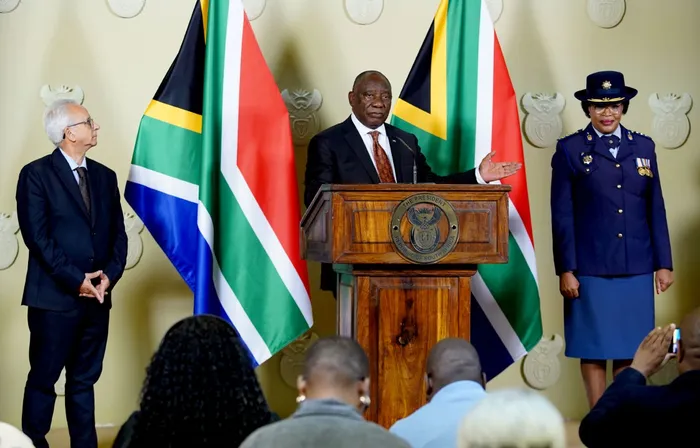
(From left) Acting Police Minister Firoz Cachalia, President Cyril Ramaphosa and Lieutenant General Puleng Dimpane. Ramaphosa appointed SAPS CFO Dimpane as the acting National Police Commissioner on April 23. The appointment of yet another person in an acting capacity calls into question decisive leadership, says the writer.
Image: Oupa Mokoena/Independent Newspapers
Dr. Reneva Fourie
Every effort to address South Africa’s security situation only reveals the depth of its predicament. Since the State of the Nation Address, President Ramaphosa has implemented several actions to improve conditions within the security cluster.
The measures appear sufficient to demonstrate activity, yet are less clearly aligned with the scale of reform required to meaningfully reduce corruption and crime.
The latest intervention involved suspending the National Commissioner of Police, General Fanie Masemola, on Thursday, 23 April, and appointing the Chief Financial Officer, Lieutenant General Puleng Dimpane, to act in his place. Masemola appeared in court on 21 April regarding alleged violations of the Public Finance Management Act (PFMA). These charges are not direct corruption allegations.
The case originates from the R360 million Medicare24 tender, a health services contract awarded to a company owned by Vusimuzi “Cat” Matlala. Masemola allegedly failed to intervene despite receiving warnings from the Investigating Directorate Against Corruption (IDAC) about irregularities prior to the contract being awarded in 2024. Masemola has stated that he sought clarification and was informed that the procurement process complied with regulations.
The role of the IDAC is central in this regard. As an entity formally established in 2024 to address corruption and to build on earlier state capture investigations, it operates independently of the police service.
Its mandate includes pursuing cases that involve financial misconduct and systemic irregularities. However, competing narratives exist about whether IDAC is legitimately pursuing corruption or selectively targeting senior police officials.
This divergence is illustrated by commentary from the Activists and Citizens Forum, which has questioned whether the focus on Masemola is proportionate. Their position is based on the observation that other senior officials implicated in forums such as the Madlanga Commission and the Parliamentary Ad Hoc Committee have not faced comparable legal action. This introduces a broader concern regarding the consistency with which accountability mechanisms are applied across the institution.
Beyond external oversight, internal dynamics within the police service further complicate the picture. Masemola’s own statements provide another concrete example. In testimony to Parliament in October 2025, he argued that criminal networks and internal actors were working to remove him, allegedly through parallel structures designed to destabilise leadership. Whether these claims are substantiated or not, they point to a larger concern regarding organisational cohesion.
A further institutional question results from the decision regarding his replacement. Masemola is being replaced by the CFO. Section 44 of the PFMA lists the role of the CFO as advising the accounting officer on compliance with PFMA provisions and Treasury regulations.
The bulk of the irregular expenditure flagged in the 2024/ 2025 financial year relates to bids and tenders awarded through the head office supply chain management. Responsibility in this regard falls directly within the domain of the CFO.
Given this overlap, the alignment between responsibility and accountability becomes less clear. Notably, Masemola was summoned for violating the PFMA, yet, unlike the CFO of Tshwane, who currently faces scrutiny at the Madlanga Commission, Lt Gen. Dimpane has not, at this stage, been subject to equivalent scrutiny.
Instead, she is being promoted to acting commissioner despite her lack of operational experience. This raises questions about the depth of the available leadership pool within SAPS and the criteria used to make such appointments.
The appointment of yet another person in an acting capacity also calls into question decisive leadership. South Africa currently has a suspended Minister of Police and an Acting Minister of Police, both of whom draw a salary.
The country now has a suspended Commissioner of Police, who draws a salary, and an Acting Commissioner of Police, who will receive an acting allowance. This pattern repeats in other divisions of SAPS.
There is a suspended Inspector General of Intelligence who receives a salary and an acting Inspector General of Intelligence who receives an acting allowance. There are acting heads of the South African State Security and the National Intelligence Coordinating Committee.
In several instances, these acting arrangements have extended beyond short transitional periods, reinforcing their systemic nature. These acting positions cause institutional instability while unnecessarily draining the national fiscus.
While such arrangements may provide short-term continuity, their cumulative effect has implications for both decision-making and public expenditure, particularly where suspended officials remain on full remuneration alongside acting counterparts.
Administratively, acting appointments can ensure continuity, but when prolonged, they constrain long-term planning and weaken accountability. Financially, the simultaneous payment of salaries to suspended officials and allowances to acting appointees creates avoidable additional expenditure.
The system demonstrates an ability to initiate accountability processes, such as investigations and suspensions, while also revealing constraints in finalising appointments and stabilising leadership. This creates a situation where action is visible, yet institutional outcomes remain uncertain.
There is clear evidence that President Cyril Ramaphosa is undertaking measures to address crime and governance challenges inside the security cluster. At a surface level, these interventions convey responsiveness and a degree of resolve.
A more detailed assessment, however, indicates that although the actions are procedurally significant, their capacity to produce sustained structural change remains uncertain. The emphasis appears to remain on reactive measures rather than comprehensive institutional reform.
Without addressing the underlying drivers of instability, including weaknesses in procurement systems, leadership continuity, and consistent enforcement of accountability frameworks, successive interventions may have limited long-term impact.
In this sense, the pattern of responses risks becoming cyclical, in which each intervention addresses immediate pressures without resolving the structural conditions that give rise to them. In this context, each new measure risks reinforcing concerns about the depth of the challenges facing South Africa’s security environment, rather than demonstrating a decisive shift in dealing with them.
* Dr Reneva Fourie is a policy analyst specialising in governance, development and security.
** The views expressed do not necessarily reflect the views of IOL or Independent Media.