Pope Leo XIV’s Complex Peace and Development Crusade in Africa
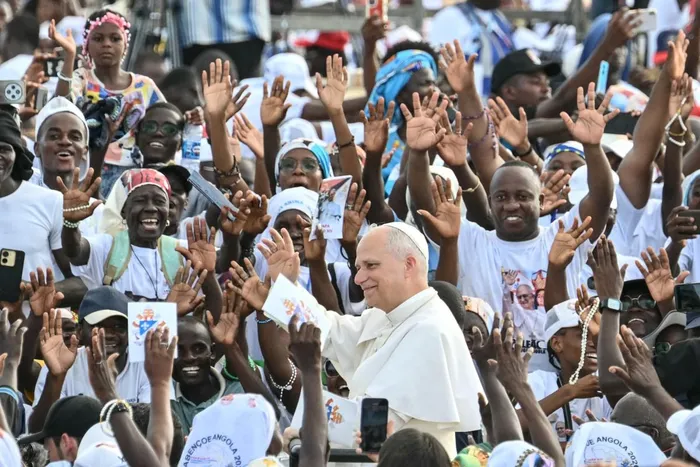
Pope Leo XIV waves to the crowd as he arrives to lead a Holy Rosary Prayer on the esplanade in front of the "Mama Muxima" Shrine in Muxima, Angola on the seventh day of an 11-day apostolic journey to Africa, on April 19, 2026.
Image: AFP
Kim Heller
Pope Leo XIV is a man of courage. That is crystal clear. His unflinching public condemnation of US President Donald Trump's military escalation against Iran has reverberated around the globe.
As the first-ever American pontiff, Leo kept his poise when Trump menacingly spat out that the Pope was "terrible for foreign policy." In an articulation of moral grit, which will not easily succumb to imperial power, he retorted.
"I have no fear of either the Trump administration or of speaking out loudly about the message of the Gospel” he said, “Blessed are the peacemakers." This was a courageous statement in a diplomatic realm which has become replete with empty praise and strategic silence.
The Pope conducted an 11-day visit to Africa from 13 April to 23 April 2026, during which he visited Algeria, Cameroon, Angola, and Equatorial Guinea. He was unambiguous about his distaste for war, violence, and injustice across the globe and on the continent.
Earlier in the year, when he spoke at Saint Joseph’s Cathedral in Bamenda, the pontiff made an especially powerful observation. "The world," he said, "is being ravaged by a handful of tyrants who pour billions into killing and devastation, while manipulating religion for gain."
These words transcended borders - it was as much about Yaoundé, Luanda, or Malabo as it was about Washington. He called Trump's threat to destroy "a whole civilisation" in Iran "truly unacceptable."
Leo XIV is the first Pope ever to visit the primarily Muslim nation of Algeria, where there are a mere 9,000 Catholics. At the Great Mosque of Algiers, he professed that Christians and Muslims can live together in peace, and emphasised the need for more interfaith dialogue.
His words were inspiring. "Violence, despite all appearances, will never have the last word," the Pope said. "Africa does not need more arms or more divisions. Africa needs the courage to choose dialogue over domination, forgiveness over revenge, and the common good over the greed of the few."
While his words were good, carrying ethical force, even the most eloquent calls for peace collapse into symbolism unless they have tangible structural pull.
The Pope's words on tyrants, although directed at Trump, apply just as strongly to many African leaders, who lord over nations where conflict, war and plunder prevail. In war-torn Bamenda, Cameroon, the 93-year-old President Paul Biya has been in power since 1982.
His political marginalisation of Anglophone regions of the country has fuelled armed insurgency and led to a humanitarian crisis. Allegations of systemic corruption have been rife. Although it has vast natural resources, including oil, timber and minerals, Cameroon remains desperately poor.
At Angola's Muxima shrine, a place of pilgrimage for millions of worshippers, the Pope spoke of justice, solidarity and peace, and the historical suffering of the people of Angola. He was speaking to an Angolan s government who channel earnings from its extensive oil and mineral resources into militarisation rather than human development.
In the oil-rich province of Cabinda, conflict continues to linger—an enduring reminder that a country's wealth, when captured by elites, is more curse than blessing.
Teodoro Obiang Nguema Mbasogo has presided over Equatorial Guinea for almost half a century. In this repressive regime, it is the elites, not the citizens, who benefit from the country's petro-wealth. Once again the Pope spoke of faith and the need for peace-building.
The Pope, unfortunately, was preaching to leaders who have long placed peace in peril through dictatorial rule. He was speaking to leaders who had enabled elite capture of natural resources. Moreover, they had weaponised rather than resolved poverty and ethnic divides.
All these ills, war, plunder, poverty, and disunity, are enabled by global economic interests and alliances. In this situation, moral appeals alone are unlikely to shift political realities.
The Pope's message was partially weakened by the flawlessly choreographed photo sessions with the very leaders he criticised. The palace handshakes created a disquieting sense of devout theatre and political accommodation.
As Thami Dickson observed in his article in the Sowetan this week, such moments risk affording these leaders international respectability—the very endorsement their regimes depend on.
Africa is important to the Vatican. The continent is currently home to 288 million Catholics and is the Church's fastest-growing region, making it vital to the future of global Catholicism.
Religious groups play an important role in reconciliation efforts.
In Cameroon, local churches and imams mediate ceasefires and offer support and shelter to people displaced by conflict. In Angola and the Sahel region, several grassroots peace-building programmes are run by Catholic and Protestant organisations. These community-based interventions may attract far less attention than papal visits, but they do the daily labour of building peace.
The Vatican would do well to invest more assertively in pushing for governance reform, driving conflict mediation, and helping to negotiate for binding peace pacts.
The Pope was astute enough to recognise the need for active, concrete intervention. He declared, "Peace is not the silence that follows a ceasefire imposed by force. Peace is the justice that prevents the next war."
It is a meaningful mantra—one that insists on confronting the root causes of injustice rather than merely its symptoms.
Violence, the Pope insisted, will never have the last word. However, violence stills only when sources of conflict are remedied, systems of exploitation dismantled and power and resources redistributed. In the absence of this, even the most courageous of voices are little more than spectacle.
* Kim Heller is a political analyst and author of No White Lies: Black Politics and White Power in South Africa.
** The views expressed do not necessarily reflect the views of IOL or Independent Media.