Diplomacy Versus Discord: Will XI, Trump Summit Pave a Pathway for Peace in the Middle East?
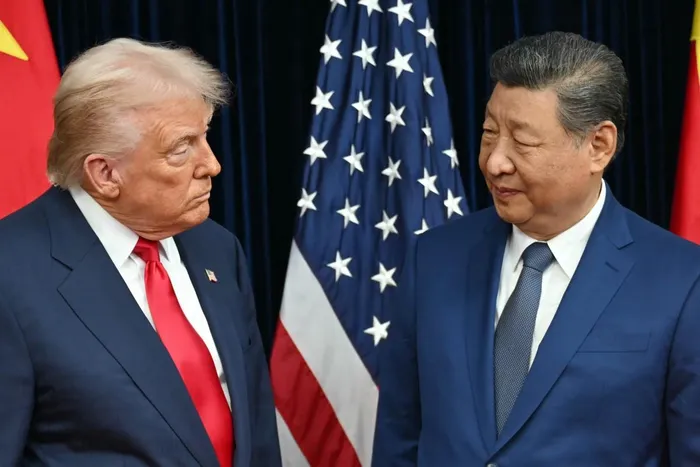
US President Donald Trump (left) and China's President Xi Jinping ahead of talks on US trade tariffs held at the Gimhae Air Base in Busan, South Korea on October 30, 2025. Trump's upcoming visit to China will be a perfect opportunity for major country diplomacy, which may unlock ways to end the conflict in the Middle East, says the writer.
Image: AFP
Prof. David Monyae
The Middle East has become a global flashpoint.
For the past two months, the region has been engulfed in relentless and devastating conflict following the United States and Israel’s unprovoked and ill-conceived attack on Iran on February 28. The given pretext for the attack, which was launched in the middle of diplomatic negotiations, was apparently to stop Iran from producing a nuclear weapon.
Iran responded swiftly through retaliatory attacks against Israel and targeting American military bases and infrastructure in neighbouring countries, including Saudi Arabia, Bahrain, the United Arab Emirates (UAE), Oman, Kuwait, and Qatar, thus turning the war into a regional conflict. The ramifications for the global economy were brutal and debilitating.
This is because the Middle East is not an ordinary region. Its geopolitical profile is elevated by the fact that, at 29.1 per cent (about 30 million barrels per day), it is the largest producer of oil in the world. To put it in perspective, the region produces more oil than Africa, Central and Latin America, Europe, and the Asia Pacific combined.
It thus enjoys a disproportionate influence on global energy markets. This influence was almost immediately felt following the US and Israel’s attack on Iran. The conflict led to attacks on oil infrastructure and, more importantly, the closure of the Strait of Hormuz, through which 20.3 million barrels of oil are shipped every day to the global markets to keep the global economy running.
This is equivalent to 25 per cent of the global maritime oil trade. As a result, global oil prices shot up almost instantly. At the time of writing, oil prices stand at US$107 per barrel, up from under US$70 per barrel before the war.
The global economic shock poses the risk of a global economic recession and is affecting vulnerable countries and populations mostly in the Global South, whose economies have been on a tailspin due to fuel shortages. If the war continues unabated, most countries in the Global South will be plunged into economic crises and possibly face political instability as well.
Beyond the economic shock, the war has precipitated a catastrophic humanitarian crisis. Over 3000 people, the majority being civilians, have been killed as a result of the war, with thousands more being injured. About 3.2 million people have been displaced. Israel’s attacks on Lebanon are reported to have killed over 2500 people and injured over 10000. The world cannot afford this conflict to go on indefinitely.
There is a need for an urgent, peaceful and diplomatic resolution. China, as one of the world’s major countries, has stepped up and been directly involved in the efforts to resolve the conflict peacefully and in a sustainable manner.
Chinese President Xi Jinping has put forward four propositions to end the conflict in the Middle East. These include a commitment to the principle of coexistence among the states in the Middle East, respect for national sovereignty and territorial integrity, adherence to international law and the United Nations Charter, and the pursuit of a balanced approach to development and security.
These propositions are derived from the Global Security Initiative (GSI) and the concept of a global community with a shared future for mankind, which were proposed by President Xi. Among the principles stressed in the GSI are commitment to the peaceful resolution of conflicts, taking both traditional and non-traditional security issues seriously, and taking the legitimate security concerns of all countries equally seriously.
Further, the GSI also outlined a list of priorities to preserve world peace and stability. These include formulating a New Agenda for Peace, promoting cooperation among the world’s major countries, upholding the Treaty on the Non-proliferation of Nuclear Weapons, prioritising the political settlement of international disputes and establishing a new regional security framework in the Middle East which advocates for mutual respect, equity and justice and non-proliferation among other things.
These proposals are quite spot on, and those involved in the Middle East conflict and the world at large should pay heed. The US-Israel war on Iran has proven beyond a reasonable doubt that no country will be able to restore peace through military escalation.
Despite uninterrupted airstrikes in Iran, the US and Israel have failed to militarily defeat Iran, whose military has fought back valiantly to defend its sovereignty. Peace can only be restored through peaceful dialogue and negotiations.
While a ceasefire was declared on the 8th of April to give diplomatic negotiations an opportunity, the warring parties are still struggling to find each other. This is largely because of the US’ maximalist approach to the negotiations, where it wants to impose a peace agreement on Iran without having to compromise.
As President Xi stressed in the GSI, Iran’s sovereignty and legitimate security concerns must be respected and acknowledged in the negotiations if peace is to be restored through negotiations. The world will be waiting with bated breath for President Xi’s meeting with his US counterpart, President Donald Trump, in Beijing a few weeks from now.
This would be a perfect opportunity for major country diplomacy, which may unlock ways to end the conflict in the Middle East.
* Prof. David Monyae is the Director of the Centre for Africa – China Studies at the University of Johannesburg.
** The views expressed do not necessarily reflect the views of IOL or Independent Media.