ANC, SACP Split a Watershed Moment for Left-Wing Politics
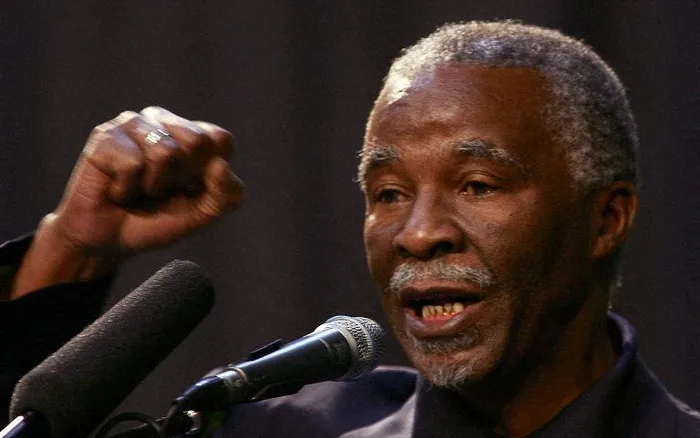
THEN ANC President Thabo Mbeki delivering his closing address to the party's policy conference in Johannesburg on June 30, 2007. For the SACP and COSATU, the adoption of Mbeki's GEAR strategy was not merely a policy adjustment—it was a betrayal, says the writer.
Image: AFP
Prof. Sipho Seepe
April 27 is no ordinary day in South Africa. It is Freedom Day—the moment when millions queued, united across race, class, and geography, to usher in the democratic dispensation of 1994. President Cyril Ramaphosa captured its spirit poignantly:
“The morning of 27 April 1994 did not begin like an ordinary day. It began with great anticipation, excitement, and a determination by millions of South Africans to participate in the birth of a nation… It was a celebration of the human spirit and its capacity to overcome adversity.”
Fast forward to April 27, 2026. The contrast could not be starker. On a day meant to embody unity and renewal, the President addressed an almost empty stadium in the Free State—an image as striking as it was symbolic. The optics were brutal. No spin could rescue it. No carefully worded statement could soften it. The image said everything: the people did not come.
One citizen, with biting clarity, described the scene as “quiet poetic, and quite justified that an empty man with empty promises stands in an empty stadium because that's all that he is – an empty vessel.”
Crude though this may sound, the sentiment captures a broader public mood. This was not merely a logistical failure or a poorly attended event. It was a political statement.
For years, the narrative was advanced that Ramaphosa’s personal popularity exceeded that of the ANC. That was a mainstream media-fabricated lie. Ramaphosa’s popularity was intrinsically linked to his position as the President of the ANC, just as Zuma's and Mbeki's were.
Under his leadership, the ANC has shed significant electoral support, losing over twenty percentage points since 2019. Any self-respecting leader would have stepped aside. The days of mass rallies filled with enthusiastic supporters are over. What remains is a party—and a leadership—struggling to command legitimacy.
The near-empty stadium was more than an embarrassment. It was a referendum. Not only on Ramaphosa’s presidency, but on the ANC itself and, crucially, on the tripartite alliance that once positioned itself as the “leader of society.” The 2024 national elections had already signalled this shift. April 27, 2026, rendered it visible in the most visceral way possible.
Internally, the alliance is fraying. Its leaders increasingly invoke history rather than articulate a compelling future. Yet this was not always the case. At the 9th Congress of the South African Communist Party,
Nelson Mandela spoke of an alliance forged in struggle and sealed in sacrifice.
“It is a relationship that has detractors in abundance; a relationship that has its prolific obituary scribes. But it is a relationship that always disappoints these experts. Because it was tempered in struggle. It is written in the blood of many martyrs. And, today, it is reinforced by hard-won victory.... Whatever seemingly powerful friends we might have today, the ANC cannot abandon those who shared the trials and tribulations of struggle with us.”
This was before the ANC government adopted the Growth, Employment and Redistribution (GEAR) strategy. With the adoption of GEAR, the seeds of rupture were planted.
For COSATU and the SACP, the GEAR strategy marked a decisive ideological shift away from the Reconstruction and Development Programme (RDP). Where the RDP promised a developmental state committed to redressing inequality, GEAR embraced fiscal restraint, liberalisation, and market-led growth.
For alliance partners, this was not merely a policy adjustment—it was a betrayal. Responding to their dissent, Mandela’s tone shifted. "Gear, as I have said before, is the fundamental policy of the ANC. We will not change it because of your pressure. If you feel you cannot get your way, you go out and shout like the opposition parties. Prepare to face the full implications of that line."
Thabo Mbeki deepened this divide, dismissing critics. Addressing the 2002 policy conference, Mbeki did not mince his words.
“[T]here are some among us who are easily seduced by revolutionary-sounding phrases that are both dangerous and have no meaning. Our movement and its policies are also under sustained attack from domestic and foreign left sectarian factions that claim to be the best representatives of the workers and the poor of our country.
"They accuse our movement of having abandoned the working people, saying that we have adopted and are implementing neo-liberal policies…. The essence of their assault against our policies is that these policies do not advance the socialist agenda. This is even though our movement, like all other national liberation movements throughout the world, is, inherently and by definition, not a movement whose mission is to fight for the victory of socialism.”
What followed was a relationship marked less by solidarity than by periodic conflict—oscillating between cooperation and confrontation. The formation of the Government of National Unity after the 2024 elections may well have been the breaking point.
For alliance partners, the ANC’s decision to form a grand coalition with the Democratic Alliance instead of ideologically aligned parties was deeply alienating. Complaints of exclusion and unilateral decision-making compounded the sense of betrayal.
COSATU, which has reduced itself to ANC’s labour desk, resigned itself to the unfolding development. The SACP, by contrast, was openly hostile.
Addressing the SACP fundraising dinner, Kempton Park, on Friday, 15 November 2024, the party’s General Secretary, Solly Mapaila, berated the ANC for going into a “coalition arrangements anchored in a collaboration with the beneficiaries of the racist and sexist economic, social and political regimes of colonial and apartheid oppression”.
Mapaila pointed out that “there can be no unity between millions of other revolutionary and progressive South Africans, on the one hand, and the DA with its counter-revolutionary agenda, on the other.”
The language was no longer that of uneasy partners, but of estranged adversaries. In this context, the image of an empty stadium takes on a deeper meaning. It reflects not just public disillusionment, but the hollowing out of a once-formidable political project. The alliance that helped deliver liberation now appears unable to sustain relevance.
For all intents and purposes, the tripartite alliance is no longer a living force. It survives as memory, as rhetoric, as nostalgia—but not as a coherent or functional political entity. The question is no longer whether the alliance can be revived. It is whether anything meaningful can emerge from its ruins.
The SACP’s decision to contest the local election is arguably a rejection of the policy shift taken by the ANC. With no solid branches on the ground, the SACP could be embarking on a suicidal path. Only time will tell.
* Professor Sipho P. Seepe, Higher Education and Strategy Consultant.
** The views expressed do not necessarily reflect the views of IOL or Independent Media.