Labour Movement’s Divisions a Betrayal of Working Class Interests
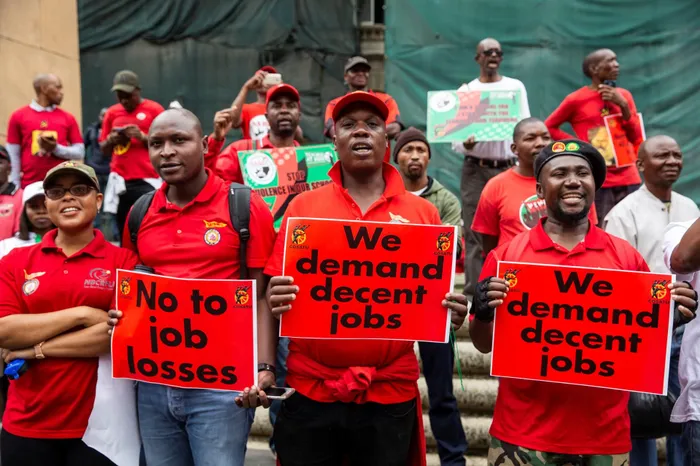
Congress of South African Trade Unions (COSATU) supporters protesting against high unemployment and government policies on February 13, 2019 in Johannesburg.
Image: AFP
Prof. Bheki Mngomezulu
May Day, which was celebrated two days ago, is an international workers' commemoration event. Its history dates to 1886. From the 1830s, workers in America had been fighting for the reduction of working hours from between 11 and 20 per day to eight. The Geneva Congress endorsed the 8-hour working day.
In response, the American government reduced working hours to 10, but only for government employees, not as a universal change. This decision annoyed workers outside of government. By the 1850s, the demand was more intense. Other countries like Australia and Canada joined this call. Ironically, Australian workers won, but not American workers who had initially made the demand.
Consequently, on May 1, 1886, the National Labour Union (NLU) organised around 500,000 workers to stage a peaceful mass strike. These workers converged in Haymarket in Chicago, Illinois. As the day progressed, the peaceful march descended into chaos when there was a confrontation between the workers and officials, leading to several casualties.
The global community decided that this day should be commemorated in honour of the workers of America who took an initiative to challenge long working hours and low wages. It was in this context that May Day became a global event.
In South Africa, the history of the labour movement began with the International Socialist League. The spear was picked up by the Industrial Workers Union of South Africa, which was launched in September 1917 in Johannesburg.
However, while all these mechanisms put the interests of the workers first, the real organisation which left indelible footprints was started by the Industrial and Commercial Workers Union (ICU), which was formed in 1919 under the leadership of Clements Kadalie.
As the liberation struggle intensified in the 1980s, the labour movement became more vocal and visible. After many months of negotiation, on December 1, 1985, the Congress of South African Trade Unions (Cosatu) was formed in Durban. It brought together 33 unions.
For years after that, Cosatu became the voice of the workers in South Africa. However, over time, there was a schism – occasioned in part by political infiltration and leadership squabbles. As Cosatu formed part of the Tripartite Alliance with the ANC and the SACP, other members felt excluded.
In the academic field, for example, the National African Teachers Union (NATU) was associated with Inkatha Freedom Party (IFP), while the South African Teachers Union (SATU) was associated with the ANC and its partners. There were also racial unions like Suid-Afrikaanse Onderwysers Unie (SAOU).
In 1998, Joseph Mathunjwa broke away from Cosatu and formed his own federation called the Association of Mineworkers and Construction Union (AMCU) in Mpumalanga. This was one of the signs that Cosatu was skating on thin ice, with its future becoming uncertain.
As friction among Cosatu-affiliated unions intensified, Cosatu’s Secretary General Zwelinzima Vavi mobilised some workers to establish another splinter federation called South African Federation of Trade Unions (SAFTU) on April 21, 2017. Over 20 trade unions joined this federation.
Irvin Jim, who was expelled from Cosatu in 2014, led the National Union of Metal Workers of South Africa (NUMSA) to join SAFTU. Recently, he has been leading a faction whose aim is to rejoin Cosatu.
Given this instability in the labour movement in South Africa, some questions arise. Has the labour movement become a shadow of itself in post-apartheid South Africa? How much damage has the labour movement done to itself by getting embroiled in politics instead of focusing on labour issues? Importantly, given the current dynamics, is it still possible for the South African labour movement to rebrand and transform itself? The simple question is: where to from here?
All these questions are critical. They implore us to look beyond labour issues and consider other factors that will determine if the labour movement has any chance to reprogram itself or to reset the button as it maps the way forward.
Firstly, each of the leaders mentioned above (and others too) has tasted power and the benefits that come with it. As such, it would be a mammoth (if not insurmountable) task to ask them to relinquish that power to save the labour movement for posterity.
Secondly, the political mood in the country and the political dynamics cast doubt on any possibility that the labour movement could regroup and return to its former glory.
Thirdly, political disunity, epitomised by ANC/COSATU relations, means that unity in the labour movement could prove difficult at best and impossible at worst.
Fourthly, the geopolitical environment has resulted in labour movements being pitted against one another. Ideological differences on political matters have made it difficult for labour movements to pull in the same direction. This is a global phenomenon with a direct impact on South Africa’s labour movement.
Fifthly. The mushrooming of political parties, which has seen political figures constantly changing their allegiances, means that labour movements that are associated with those politicians will find it hard to take principled positions on labour matters. Instead, they will continue to look at labour issues through the political lens, which is unstable.
This chain of events and various scenarios paint a pessimistic picture about the future of labour movements in South Africa. Addressing this situation will not be easy. However, certain steps can be taken to try to remedy the situation.
At the centre of it all is for the labour movement to find its identity and to stay on the correct lane. Ideally, labour movements should focus on labour issues and stay away from politics. If the labour movement could do this, there would be hope for its future.
Another factor that has weakened labour movements is that their leaders are easily bought by employers. This implores workers to elect people of integrity to lead them. Power brokers and greedy individuals are a liability to labour movements.
The post-apartheid labour movement has evidently become a shadow of itself. No Messiah will redeem it. The onus is on the labour movement itself to do self-introspection and plan its future accordingly.
* Prof. Bheki Mngomezulu is Director of the Centre for the Advancement of Non-Racialism and Democracy at Nelson Mandela University.
** The views expressed do not necessarily reflect the views of IOL or Independent Media.