ConCourt Ruling Exposes Parliament’s Struggle With Ethical Leadership
PHALA PHALA JUDGMENT
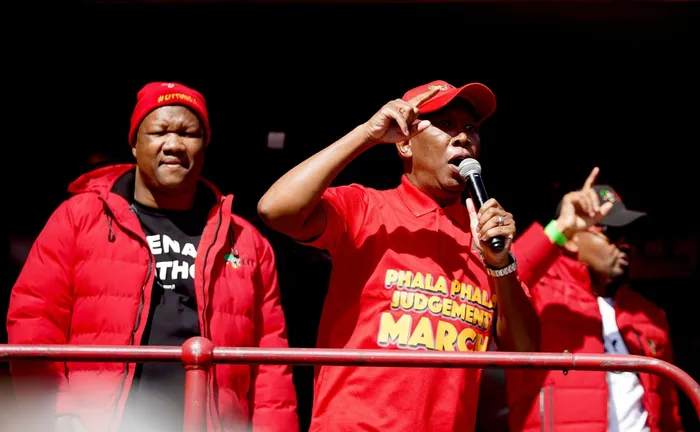
EFF leader Julius Malema (right) addressing party supporters outside the Constitutional Court in Braamfontein on May 8. Regardless of the eventual political consequences, the Phala Phala saga serves as a reminder that the credibility of anti-corruption campaigns depends on consistency and openness, says the writer.
Image: Oupa Mokoena
Dr. Reneva Fourie
South Africa often seems trapped in a cycle of progress followed by regression. Just as the country rediscovers a sense of optimism, another political controversy erupts, shifting attention back to scandal, dysfunction, distrust and instability. The country appears caught in a constant churn of crises, with its leadership dominating headlines for the wrong reasons.
On Friday, 8 May, the Constitutional Court delivered judgment on whether Parliament had acted lawfully in rejecting a Section 89 report recommending an impeachment inquiry into President Cyril Ramaphosa over the controversial Phala Phala saga.
The Phala Phala controversy began with a burglary at President Ramaphosa’s Limpopo game farm, where foreign currency was stolen. Questions quickly emerged about the origin of the money, whether it had been properly declared, and how the incident was handled. These concerns raised issues of transparency, accountability and potential misuse of state resources.
Under Section 89 of the Constitution, Parliament initiated a formal process to consider the removal of the President. It appointed an independent panel chaired by retired Chief Justice Sandile Ngcobo, which found sufficient evidence for Parliament to consider establishing an impeachment inquiry.
However, it made no final finding of guilt. In December 2022, Parliament voted against referring the report to an impeachment committee, triggering legal challenges over whether it had fulfilled its constitutional duty to hold the President accountable.
In a split vote, the Court clarified that once an independent panel finds sufficient evidence exists, matters must proceed automatically to an impeachment committee. This effectively removed parliamentary discretion to halt proceedings at that stage. The Court set aside the 2022 vote and referred the panel’s report directly to the impeachment committee.
This judgment carries significant implications for the separation of powers, a core constitutional principle that divides authority among the legislative, executive and judicial branches. Parliament makes laws and oversees the executive. The executive governs and implements laws. The judiciary interprets laws and resolves disputes.
The Constitutional Court clarified that courts may review the procedural legality of parliamentary decisions. Although Parliament has wide discretion, it is not unlimited, especially where constitutional processes are undermined.
Judicial intervention in such cases is not an intrusion into legislative power but an exercise of constitutionally mandated judicial review. The ruling affirms that no branch stands above legal scrutiny.
Beyond the legal arguments, the issue raises questions of public ethics and leadership. President Ramaphosa rose to power on a platform of fighting corruption and promoting clean, transparent governance.
He promised a “new dawn” distinct from previous administrations. This commitment to integrity became central to his political legitimacy within both the country and the African National Congress.
In constitutional democracies, public perception matters alongside legality. Citizens expect the head of state to uphold the highest ethical standards, and sustained doubt can quickly erode trust in government institutions.
The President’s conduct, therefore, has implications for the credibility of the state as a whole, given the extensive powers of the office, including the power to appoint senior officials and represent the country internationally.
When the head of state is perceived to operate outside established rules, public confidence in governance institutions can diminish. Conversely, when a president accepts scrutiny, even when it is uncomfortable, the rule of law is reinforced.
The Phala Phala matter is particularly significant because it concerns the President’s private conduct. The Section 89 panel did not find guilt but recommended an inquiry, a lower threshold. The Constitutional Court has ruled that Parliament must allow this inquiry to proceed, giving the President a formal opportunity to respond.
The implications for the ANC are, unfortunately, profound and potentially destabilising. The governing party has spent years attempting to rebuild its legitimacy after the devastation of state capture and persistent allegations of systemic corruption.
Ramaphosa’s presidency was deliberately positioned as the centrepiece of its renewal project, tied to promises of institutional reform, constitutionalism and ethical governance. This judgment therefore strikes at the heart of the ANC’s renewal narrative and is likely to affect it negatively, particularly in a local government election year.
Beyond the ethical and constitutional implications, the judgment raises urgent strategic questions. The ANC does not command the two-thirds majority required to shield the President from impeachment without external support. It must now decide which opposition parties it is prepared to rely on, what political concessions may follow, and whether those concessions will further erode public confidence.
The ANC may attempt to delay proceedings until its next National Conference and potentially transition to new leadership, but any effort to evade accountability risks deepening the perception that constitutional obligations are subordinate to political survival.
The judgment also arrives at a precarious moment for South Africa’s Government of National Unity, where political stability increasingly depends on public faith in constitutional institutions and the credibility of those entrusted to lead them. The Democratic Alliance in particular faces scrutiny over whether its claims of principled governance will translate into decisive action on Phala Phala.
Regardless of the eventual political consequences, the Phala Phala saga serves as a reminder that the credibility of anti-corruption campaigns depends on consistency and openness. Citizens are unlikely to place faith in reform agendas if leaders appear insulated from scrutiny. Public confidence is strengthened when accountability processes are conducted openly and fairly.
Ultimately, the Constitutional Court’s judgment, by affirming that parliamentary processes must give effect to constitutional requirements once a prima facie threshold has been met, reinforced the idea that oversight mechanisms are not discretionary gestures but binding duties.
Yet the effectiveness of these mechanisms does not rest solely on institutions. It also depends on the broader political environment in which they operate. Public scrutiny, civic engagement and informed debate remain essential in ensuring that constitutional procedures are not diluted by partisan calculation or institutional fatigue.
In this sense, accountability is not only exercised through courts or legislatures but also sustained by continued public vigilance over the institutions that define it.
* Dr Reneva Fourie is a policy analyst specialising in governance, development and security.
** The views expressed do not necessarily reflect the views of IOL or Independent Media.