Phala Phala Ruling Lays Bare the ANC's Moral Bankruptcy
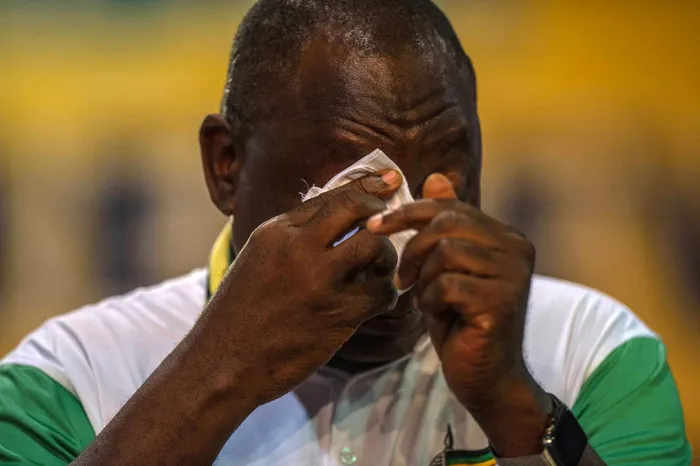
An emotional Cyril Ramaphosa following his election as President of the African National Congress (ANC) during the party's 54th National Conference on December 18, 2017 at the NASREC Expo Centre in Johannesburg. The Constitutional Court’s decision brutally exposes the dishonesty and moral bankruptcy that now define the ANC under Ramaphosa’s leadership, says the writer.
Image: AFP
Prof. Sipho Seepe
In making a compelling case for a contextual reading of developments and judicial decisions, former Deputy Chief Justice Dikgang Moseneke wrote powerfully in his book All Rise: “The judicial role calls for an unfailing attention to detail.
First, the facts must be understood in their proper context and sequence, and care must be taken to make findings supported by credible facts. A judicial officer must know the law… and apply it to the properly proven facts in the dispute.”
It is with this exacting standard in mind that the full political significance and devastating implications of the Constitutional Court’s landmark decision must be understood. For all intents and purposes, the apex court has cleared the way for the initiation of the impeachment process against President Cyril Ramaphosa.
This historic ruling cannot be divorced from the sordid facts, the troubling context, and the damning sequence of events surrounding the Phala Phala scandal — a saga that has laid bare the staggering hypocrisy at the heart of the ANC and its leader.
The narrative begins in earnest on 23 August 2020, when a triumphant Ramaphosa, still basking in the glow of his “New Dawn” rhetoric, penned a letter to his ANC comrades.
Assuming a messianic posture, Ramaphosa warned gravely: “The lack of integrity perceived by the public has seriously damaged the ANC’s image, the people’s trust in the ANC, our ability to occupy the moral high ground and our position as leader of society…. As the inheritors of the legacy of Luthuli, Tambo and Mandela, we must be honest with our people and ourselves”.
He continued with characteristic moral grandstanding: “Today, the ANC and its leaders stand accused of corruption. The ANC may not stand alone in the dock, but it does stand as Accused No. 1.” The National Executive Committee, he noted, had been forced to “dip our heads in shame and to humble ourselves before the people.”
Speaking to journalists, an ebullient Ramaphosa declared: “In my own history where I am conflicted, I have [had] a sense of integrity to step out of the way to say I’m conflicted on this and I have ingrained that in the way I do things so that fingers should not be pointed at one about favouring oneself when you are conflicted”.
These were lofty, sanctimonious pronouncements from a man who presented himself as the ethical successor to the legacies of Chief Albert Luthuli, Oliver Tambo, and Nelson Mandela.
How hollow those words ring today.
All pretence of moral rectitude collapsed when former State Security Agency director-general Arthur Fraser dropped a political bombshell. In an affidavit dated 1 June 2022, Fraser detailed how large sums of undeclared United States dollars, hundreds of thousands, by some accounts, had been concealed in furniture at Ramaphosa’s Phala Phala game farm in Limpopo.
The money, Fraser alleged, formed part of a sophisticated money laundering scheme in violation of the Prevention of Organised Crime Act. More damning were claims of a subsequent cover-up: the kidnapping and interrogation of suspects by presidential security details, alleged payments to secure their silence, and a failure to properly report the theft to the authorities as required by law.
Without Fraser’s courageous intervention, Ramaphosa might still be parading across the world stage as “Mr Clean.” Instead, the emperor was exposed, stark naked, before the nation.
Responding to public pressure and a complaint from the African Transformation Movement, former National Assembly Speaker Nosiviwe Mapisa-Nqakula appointed a Section 89 Independent Panel chaired by retired Chief Justice Sandile Ngcobo.
After careful consideration of the evidence, the panel delivered a sobering verdict: there existed prima facie evidence that President Ramaphosa may have committed serious violations of the Constitution and the law, along with serious misconduct. The panel raised serious doubts about the credibility of Ramaphosa’s explanation regarding the source, handling, and storage of the foreign currency.
It highlighted inconsistencies, unanswered questions about tax and exchange control compliance, and troubling indications that state resources may have been abused in the aftermath of the burglary.
Yet, when the report was tabled, the ANC deployed its parliamentary majority like a shield. In a vote on 13 December 2022, the party blocked referral of the report to an Impeachment Committee. Only one ANC MP, Dr Nkosazana Dlamini Zuma, displayed the integrity and voted with her conscience. Her action was not rebellion — it was fidelity to her oath of office and to the people of South Africa above blind party loyalty.
Former President Thabo Mbeki, never one to suffer political foolishness gladly, publicly excoriated the ANC’s position. He asked uncomfortable questions: “Are we saying that we suspect or know that [Ramaphosa] has done something impeachable and therefore decided that we must protect our President at all costs?”
Mbeki noted that nine months after Fraser’s complaint, critical questions remained unanswered. The subsequent revelation by SARS Commissioner Edward Kieswetter — that no record existed of the declared $580,000 — only deepened public suspicion of corruption at the highest level.
Unwilling to accept this blatant parliamentary whitewash, the Economic Freedom Fighters and African Transformation Movement approached the Constitutional Court. They challenged both the National Assembly’s vote and Rule 129I of the Assembly’s Rules, which had enabled the premature termination of the process.
In a judgment delivered on 8 May 2026, the Constitutional Court delivered a stinging indictment of Parliament’s conduct. It declared Rule 129I unconstitutional because it permitted the National Assembly to abort the impeachment process before a full and proper investigation could take place and before all relevant evidence had been ventilated.
The Court set aside the December 2022 vote and ordered that the Independent Panel’s report be immediately referred to the Impeachment Committee. In doing so, the justices underscored the constitutional imperatives of transparency, accountability, and the supremacy of the Constitution over narrow political interests.
This ruling opens the door to a rigorous public process. The Impeachment Committee will now have the authority to summon key institutions and individuals, SARS, the South African Reserve Bank, the SAPS, the Public Protector, and others, to account for their roles.
For too many of these bodies, the handling of Phala Phala appeared to follow a script of “see no evil, hear no evil, speak no evil” when the President was involved. Only SARS emerges with some credit for confirming the absence of a proper declaration.
As Chairperson of the Panel, retired Justice Sandile Ngcobo himself emphasised the gravity of their findings. Ngcobo remarked, “Dragging the president before an impeachment process is a huge decision. It cannot be done on flimsy grounds. There has to be something tangible that you can hold on to before you take that decision.”
The impeachment process would not be a walk in the park. The hearings will be brutal: public cross-examination of witnesses, testing of evidence, and scrutiny of the President’s own version. It does not help that the panel found the President’s version to be seriously wanting in several material respects.
For a president who has never relished unscripted questioning, this process promises deep embarrassment and political peril.
The Constitutional Court’s decision brutally exposes the dishonesty and moral bankruptcy that now define the ANC under Ramaphosa’s leadership. It stands in grotesque contrast to his earlier pious exhortations about integrity and the struggle legacy.
While the ANC’s predictable response, claiming the Court made no finding on guilt or innocence, is technically accurate, it is also deeply cynical. The Court has forced the very accountability the ruling party tried desperately to suppress.
The timing could scarcely be worse for an ANC already in catastrophic decline. Since 2019, the party has shed over 22% of its national vote and continues to lose ground in by-elections. It enters the era of coalition politics on its knees, its credibility in tatters.
South Africans deserve better. They deserve the full truth, tested in public, so that they can make informed choices. The impeachment process must now proceed without further obstruction. The era of shielding the powerful, no matter how high their office, must come to an end.
Accountability, however uncomfortable for the ANC and its president, has finally arrived. By the time the impeachment process would have run its course, they will be little to salvage of the ANC and its president.
* Professor Sipho P. Seepe, Higher Education & Strategy Consultant.
** The views expressed do not necessarily reflect the views of IOL or Independent Media.