Cyril Ramaphosa Straddles a Political Tightrope as Phala Phala Impeachment Hearing Looms
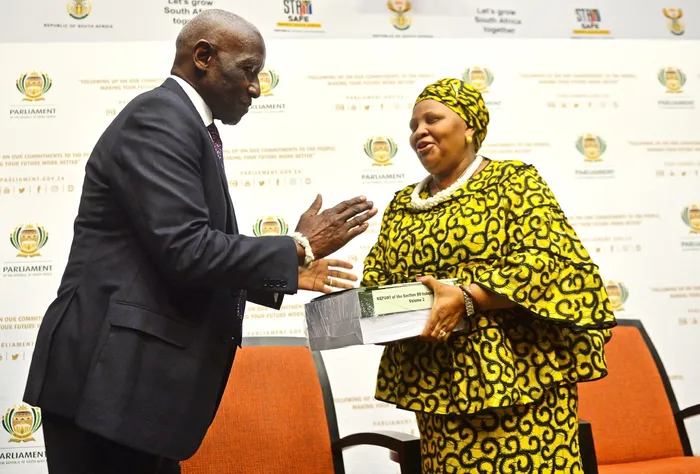
Retired Chief Justice Sandile Ngcobo presents the Section 89 Panel report to then Speaker of the National Assembly Nosiviwe Mapisa-Nqakula in Cape Town on November 30, 2022. The independent panel was appointed by Parliament to probe the burglary at President Cyril Ramaphosa's Phala Phala farm.
Image: Phando Jikelo
Dr. Reneva Fourie
On May 11, South Africans tuned in to hear President Ramaphosa respond to the Constitutional Court’s ruling on Parliament’s handling of the Phala Phala saga.
His address showed once again how the law is being used as a tool in a long-running power struggle, with all sides putting their interests ahead of accountability, truth and respect for the Constitution.
The African National Congress has expertly manoeuvred itself out of a tight corner through a masterful delaying tactic. Yet all political parties, from the African Transformation Movement and Economic Freedom Fighters to the Democratic Alliance and uMkhonto weSizwe Party, have played a part in turning legal processes into tools for political battles.
The heart of the issue is the independent panel report from November 2022 on the Section 89 motion to remove the president. The panel looked into allegations from the February 2020 burglary at Ramaphosa’s farm, where foreign currency was stolen.
Their investigation covered possible breaches of section 96(2)(a) of the Constitution, which deals with conflicts between official duties and private interests, and possible violations of section 34(1) of the Prevention and Combating of Corrupt Activities Act 2004. This included claims of not meeting legal reporting requirements and using state security for a private matter.
The panel concluded that there was prima facie evidence that the President may have committed serious misconduct and serious violations of the Constitution. Importantly, the panel did not make definitive findings of guilt. Its mandate was preliminary and confined to determining whether sufficient evidence existed to proceed with a fuller inquiry.
The impeachment committee envisaged under Rule 129 would have carried broader powers, including oral hearings, the subpoenaing of witnesses and examination of documentary evidence in greater detail.
In December 2022, the National Assembly voted against referring the independent panel report to an impeachment committee. The ANC used its parliamentary majority to halt deeper scrutiny. That should have been the end of the matter.
However, the ATM and other parties challenged the constitutionality of the parliamentary rules that permitted the vote. The case wound its way to the Constitutional Court.
On 8 May, the Constitutional Court, in a split vote, held that aspects of the National Assembly rules governing the process were inconsistent with the Constitution and that the 2022 vote cannot stand in its original form. The Court ruled that, once an independent panel determines that sufficient evidence exists, the matter must proceed to an impeachment committee for further inquiry.
The ruling placed the ANC in a difficult position. Complying with the judgment would have subjected its President to a committee empowered to summon witnesses, request documents, and review the allegations in detail. This process would likely have included public hearings and ongoing political scrutiny during a sensitive period before the local government election.
Ramaphosa’s response to the judgment was, therefore, carefully constructed around legality and constitutional procedure. In his address to the nation, he positioned his presidency within a broader narrative of national renewal, institutional rebuilding and anti-corruption reform. He argued that resignation would undermine those efforts and create instability at a difficult economic and political moment.
The President repeatedly stressed his respect for the Constitutional Court and the rule of law. He pointed out that the judgment did not make findings on whether he committed misconduct and argued that the panel report itself remains open to judicial review. He further announced that he will challenge the panel report in court before the impeachment committee process unfolds.
Legally, that approach is available to him. The Constitutional Court itself stated that the panel’s recommendation must proceed “unless and until” the report is set aside on review. The review application represents a high-stakes delaying tactic.
Litigation over the report’s lawfulness could take months or years. The Impeachment Committee process will likely be suspended pending the outcome. If a court finds the panel exceeded its mandate or committed material errors, the report could be nullified entirely.
Even if the review fails, the President still buys precious time. The ANC has successfully converted a moment of acute political vulnerability into yet another protracted legal process. It has escaped the immediate threat of televised impeachment hearings and wields the review as both shield and sword.
This saga reveals how political actors treat the constitution as a poker table rather than a sacred covenant. All major political actors involved have used legal and institutional processes to advance broader political agendas. The ATM initiated the original motion. The EFF amplified the allegations through parliamentary and public campaigns.
The MK Party and DA have each used the issue to reinforce narratives concerning executive accountability and institutional failure. The focus is on scoring points, making headlines, and keeping the President under pressure, rather than protecting constitutional integrity.
Opposition parties understand that sustained scrutiny of the President weakens the ANC politically and shapes public discourse around governance and corruption.
The ANC understands that procedural delay and legal review lessen immediate political exposure and preserve internal stability. The result is a political environment where constitutional mechanisms become extensions of electoral strategy.
The Phala Phala saga has drifted beyond the question of whether a theft was reported correctly or where the foreign currency came from. It is now a symbol of a broken political culture. The constitutional architecture intended to hold a president to account has been reduced to a procedural battleground where delay, technicality and raw power determine outcomes.
The process exposes that constitutional mechanisms do not operate in isolation from politics. They are shaped continuously by timing, interpretation, parliamentary arithmetic and strategic calculation. South Africa’s major political parties have shown themselves highly adept at using those mechanisms in pursuit of power, protection and political advantage.
South Africa faces institutions weakened by strategic delays and partisan interests, resulting in ongoing deferred accountability. However, citizens committed to the constitutional vision cannot afford resignation. Only civic vigilance, public pressure, and sustained engagement can restore accountability and rebuild democratic trust.
** The views expressed do not necessarily reflect the views of IOL or Independent Media.
** The views expressed do not necessarily reflect the views of IOL or Independent Media.