Weak Policies, Poor Governance Stoking Anti-Immigrant Sentiment
GOVERNANCE FAILURES
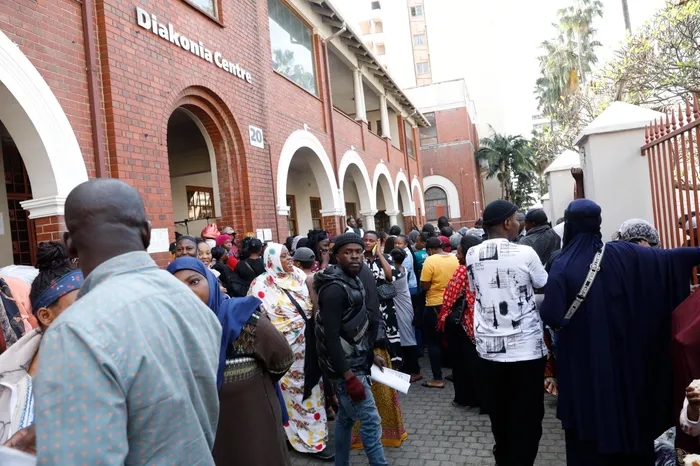
Foreign nationals fearing attacks by the March and March movement sought refuge in Durban's Diakonia Centre on May 21. While it is true that the South African government is to blame for its silence, the home governments of these foreign nationals are equally to blame, says the writer.
Image: Doctor Ngcobo/Independent Media
Prof. Bheki Mngomezulu
The ongoing protests across the country regarding undocumented or illegal immigrants have raised serious concerns about governance, both in South Africa as a host country and in their home countries. At the centre of these questions is the role played by these governments, or lack thereof.
Concerns about undocumented foreign nationals, especially those coming from other African countries, have been on the South African agenda for some time now. This was the case in 2008 and again in 2015. Each time this issue subsides, the government works on the wrong assumption that it has died a natural death. Before we know it, the issue resurfaces and becomes even more serious than before.
Historically, resentment against foreign nationals is not a new phenomenon. Equally important is that this anger has the same causal factors, which include, inter alia, high unemployment, high crime rate, and lack of service delivery. Whenever these things happen, citizens of the host country blame the situation on foreign nationals, with the undocumented ones receiving more attention.
In 1969, Ghanaian citizens complained about undocumented Nigerians, especially from the Yoruba clan. As more concerns were raised, national security was threatened. The Ghanaian government responded by expelling all undocumented Nigerians to ensure stability in the country. Once they had left, the government had to accelerate its effort to combat crime and create jobs since there was no excuse that could be used to explain the government’s failures.
In 1983, Nigeria faced the same situation when citizens complained that the crime rate and the unemployment rate were both high. They blamed this situation on illegal immigrants who could not be accounted for.
The Nigerian government responded by deporting about 300,000 illegal foreign nationals. Most of them who were from Ghana were transported by trucks. Others from various countries were taken to the airport on a one-way ticket. They were told to return once they had proper documents allowing them to live in Nigeria.
If the governments of Ghana and Nigeria listened to their citizens’ concerns and acted within the confines of their laws and international law, why has the South African government not taken action to address this matter?
In the context of Frustration Aggression Theory, when people are frustrated, they resort to action, which is sometimes in contravention of the law, both national and international law. This can be expected if the government fails to provide leadership.
The danger of the government’s failure to provide leadership creates fertile ground for populism. Some individuals use people’s genuine concerns to draw attention and to elevate themselves. Others use these genuine concerns to score political points.
Generally, when the government fails to provide leadership, other leaders will emerge. This could take the form of individuals such as Ngizwe Mchunu, Phakelumthakathi Ndabandaba and others. In other instances, groups such as Operation Dudula, March and March and others take up the leadership role relinquished by the government.
Another inevitable consequence of the government’s inaction is that criminal elements also seize the opportunity to advance their self-interests through criminal activities. Knowing that illegal immigrants are desperate, they approach them under false pretences that they will protect them. In the process, they charge them what they term a ‘protection fee.’
Ideally, the government should swiftly move in to address this criminal activity. Sadly, when some of the law enforcement officials are mandated to deal with this scourge, they accept bribes, thus becoming accomplices to the crime. Elements of this untrustworthiness have been witnessed in the Madlanga Commission. Thanks to Lt-Gen Nhlanhla Mkhwanazi, who spilt the beans and opened a can of worms.
Another concern is about those state departments linked to immigration. What role do they play in the increasing number of illegal immigrants? How many of these immigrants bribed their way into the country? Why is the South African government not acting against the perpetrators? To what extent do the Department of Home Affairs and the Border Management Authority deliver on their mandate?
While it is true that the South African government is to blame for its silence, the home governments of these illegal immigrants are equally to blame. What are the push factors that force their citizens to emigrate to South Africa? How do they exit their national borders? Why can’t these governments provide for their own citizens?
Foreign nationals who are in South Africa are not the problem. All countries across the globe host foreign nationals for various reasons. The concern is about those who are undocumented. They pose a security threat because when they commit a crime, no one knows where or how to find them. This leaves the country vulnerable.
The main concern about the call for undocumented foreign nationals to leave South Africa is that only Africans are targeted. Should we assume that all other races are in the country legally? If so, well and good. If not, this poses a huge ethical question about consistency and fairness. But in the absence of direction from government, such things are bound to happen.
It is an irrefutable fact that South Africa, as a country, has its own criminals and drug lords. It is also true that the population explosion has put a strain on job creation, especially because the economy is not growing as expected.
However, having a high number of undocumented foreigners creates the impression that South Africa’s woes can solely be attributed to them. The reality is that, like in both Ghana and Nigeria, once illegal immigrants have been deported while those with proper documents remain in the country, it will be easier for South Africans to vent their anger on their government, not on the undocumented foreign nationals.
The government must provide leadership. Failure to do so is an abdication of responsibility. Both individuals and groups will fill the void left by the government.
Similarly, instead of blaming the South African government for the ongoing situation against illegal immigrants, African governments should do self-introspection and create a conducive environment for their citizens. This would reduce the influx of illegal immigrants into South Africa.
* Prof. Bheki Mngomezulu is Director of the Centre for the Advancement of Non-Racialism and Democracy at Nelson Mandela University.
** The views expressed do not necessarily reflect the views of IOL or Independent Media.