More Turmoil Beckons as Abiy Ahmed Tightens Grip on Power
ETHIOPIA ELECTIONS
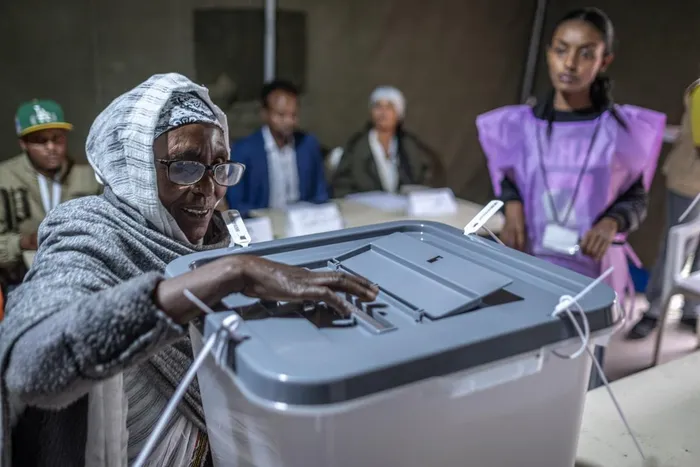
A voter casts her ballot at Shalla Park polling station in Addis Ababa, on June 1, 2026, during the 2026 Ethiopian parliamentary elections. Ethiopia's election shows that political independence does not always lead to democratic transformation or genuine popular power, says the writer.
Image: AFP
Kim Heller
There is little doubt that Ethiopia's Prime Minister Abiy Ahmed and his Prosperity Party would win this week's elections by a huge margin. The pressing question is what comes next. Will Ahmed tighten his iron grip or embrace the need for unity and cooperation?
Hopes were high when, in 2018, Abiy Ahmed came to power after mass protests ousted the long-ruling Ethiopian People's Revolutionary Democratic Front. In his early days as Prime Minister, he initiated a series of reforms that generated optimism both at home and abroad. Political prisoners were released from jails, and opposition politicians who had fled the country returned.
A welcome breeze of media freedom swept through Ethiopia. Ahmed's role in restoring peace with Eritrea was recognised globally, and he was awarded the Nobel Peace Prize in 2019. There was a wave of optimism that Ethiopia could become the pinnacle of African-led democratic revival.
However, today, Ahmed appears to have abandoned his reformist path. Under his administration, Ethiopia has become increasingly marked by centralised power, internal strife and political intolerance.
Opposition politicians are intimidated, with many detained and prosecuted. Independent media have been shut down or harshly restricted. Any sign of dissent appears to be interpreted as deadly disloyalty, rather than as a healthy symptom of a working democracy.
In Tigray, the aftershocks of the 2020-2022 war have been brutal. The 2022 Pretoria Agreement temporarily silenced the guns, but did not heal the political fracture or address the conflict's roots.
Today, millions of people in Tigray remain marginalised, and in Western Tigray, a large displaced population is trapped in an untenable state of crisis and uncertainty. There was no voting in Tigray during this week's election. This demonstrates the lack of meaningful political inclusion years after the peace agreement was signed.
Reports of over 100 polling stations nationwide remaining closed due to security concerns, particularly in Oromia and Amhara, are a sure signal of a state struggling to exercise authority across key parts of the country.
In Oromia and Amhara, conflict continues. Federal authorities battle armed groups over issues of identity and political representation. Allegations of mass detentions and aggressive security operations are a worrying signal of a government that relies on force to preserve power.
Internally, Ethiopia is festering with instability. A culture of political exclusion is steadily extinguishing the democratic promise that once inspired millions.
Market liberalisation, financial sector reforms, and greater integration into global markets are all steering Ethiopia's economic trajectory. It is not surprising that international financial institutions are cheering and projecting growth of 9.2% for 2026 (IMF), along with increased foreign investment.
However, despite this positive growth wave, there is widespread social distress among ordinary Ethiopians. Rising food prices, fuel costs and currency depreciation have eroded living standards. It is the textbook case of how economic reform without political inclusion produces wealth for elites and insecurity for the masses.
Regionally, relations with Eritrea are fraught despite Abiy's early reforms. Ethiopia's calls for direct access to the Red Sea have troubled neighbouring states.
Further to this, allegations of Ethiopia's involvement in Sudan's conflict have raised alarms about the prospect that the Horn of Africa may be heading into a protracted storm of turbulence and instability. To add to the wave of discontent are allegations that Eritrea is backing anti-government groups in Ethiopia.
The ignoble practice of leaders promising renewal yet exercising authoritarian governance needs to be addressed. This is hardly the hallmark of Pan-African leadership. Pan-Africanism cannot take hold if political systems are dislodged from or downgrade the inclusion and participation of ordinary people.
Ethiopia's democratic crisis is not unique. It is mirrored in many African states that use oppression and exclusion as weapons of governance.
It is unlikely that the African Union will step up and address either the Ethiopian governance transgressions or the flawed election. For too long, the AU has disregarded the Ethiopian Prime Minister's increasingly autocratic rule. One has to ask whether this reluctance stems, in part, from the fact that Ethiopia hosts the AU's headquarters.
The AU's cautious diplomatic posture is bereft of courage or principle. Passive procedural observation needs to be replaced by principled action. In a preliminary statement, the AU spoke of the election as proceeding well, but that is hardly the case, as entire regions were unable to participate fully. The continental body needs to move away from being a spectator to democratic decline and champion democratic accountability.
Ethiopia's election shows that political independence does not always lead to democratic transformation or genuine popular power. It is especially tragic because Ethiopia was the land of Adwa, where African resistance defeated European colonial expansion. For generations of Pan-Africanists, Ethiopia symbolised the dream of African self-determination.
What happens next in Ethiopia will depend on whether the incoming administration views its electoral victory as a licence to deepen political centralisation or as a possibility for national reconciliation.
Without genuine inclusion of marginalised regions, accountability for wartime abuses and a commitment to rebuilding democratic institutions, Ethiopia will remain a place of recurring strife. The Prime Minister would do well to note that elections may grant political power, but not necessarily political legitimacy.
Elections alone are incapable of creating democracy. Democracy requires African nations to honour participation rather than coercion, and prosperity for all rather than elite accumulation.
Abiy Ahmed may have won another election. But he has yet to win the trust of a nation that once believed in him and his ability to secure a better tomorrow for Ethiopia and the region.
* Kim Heller is a political analyst and author of No White Lies: Black Politics and White Power in South Africa.
** The views expressed do not necessarily reflect the views of IOL or Independent Media.