Call to Disband Human Rights Commission is 'Misguided, Flawed'
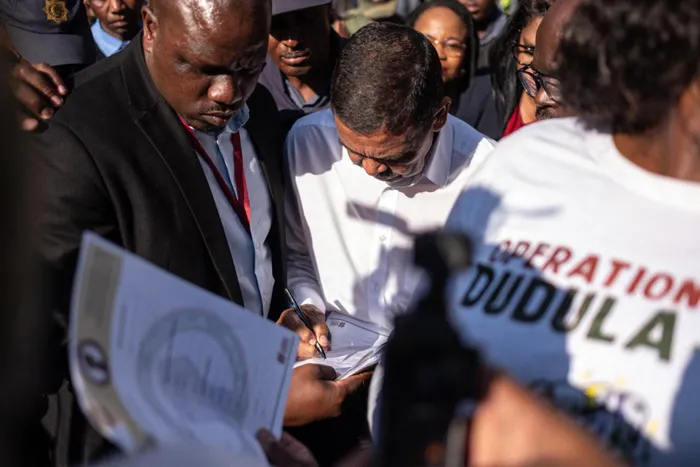
Chairperson of the South African Human Rights Commission Chris Nissen (centre) receives a memorandum from members of Operation Dudula demanding the disbandment of the Chapter Nine institution at a protest held in Johannesburg on July 17, 2025.
Image: AFP
Prof. Bheki Mngomezulu
Recently, Change.org hosted an online petition by Lwazi Gwijane, which calls for the immediate disbandment of the South African Human Rights Commission (SAHRC). A week after this petition began, over 44, 000 people appended their signatures.
The main accusation levelled against the SAHRC is that it has failed to uphold its constitutional mandate to protect the human rights of all South Africans. Gwijane further argues that the SAHRC has consistently prioritised certain groups over others, thus creating division and undermining the trust of the public. Those who support this view express their frustration and accuse the SAHRC of being biased.
Based on these reasons, Gwijane proposes that the SAHRC should be disbanded since what it is doing amounts to dereliction of duty. In his view, this institution should be replaced with a body that upholds impartiality and credibility, not failing to serve South Africans objectively. Only time will tell how this project will end.
But is this call genuine? If Gwijane was driven by patriotism, honesty, and genuine concerns, do those who support him subscribe to his motivation? What about those who concur with him that this institution should be started from scratch and that once it has been reformed, it should “prioritise South Africans and employ only local citizens?”
Are such arguments genuinely informed by an objective assessment of the work of the SAHRC, or is this call linked to the ongoing call for the repatriation of illegal immigrants? Importantly, how does this institution compare to others like it?
Put differently, does the problem reside solely in the SAHRC or do external factors impede its ability to deliver on its constitutional mandate? If the latter is the case, what purpose would the reforming or replacement of this institution serve?
These are some of the questions that should be ventilated. To do so would need a cogent and balanced analysis of similar institutions. Secondly, any criticism levelled against the SAHRC should not be mixed with other genuine concerns currently being raised by South Africans. To achieve these goals, one should trace the history of this institution and juxtapose it with similar institutions to be able to arrive at an objective conclusion, including fair criticism.
The heading for Chapter 9 of the Constitution of South Africa is “state institutions supporting constitutional democracy.” Implicit in this heading is that the six institutions listed in this chapter individually and collectively strive to consolidate democracy.
The six Chapter 9 institutions are the Public Protector; the SAHRC; the Commission for the Promotion and Protection of the Rights of Cultural, Religious and Linguistic Communities [also known as the Cultural, Religious, and Linguistic (CRL) Rights Commission]; the Commission for Gender Equality (CGE); the Auditor-General (AG), and the Independent Electoral Commission (IEC).
Given that there are so many institutions tasked to push the democratisation agenda, the question becomes: should we assume that the other five are executing their constitutional mandate while the SAHRC is the only one that should be accused of dereliction of duty? If not, why would it be singled out as the only one that is not delivering on its mandate?
Many human rights are enshrined in Chapter 2 of the Constitution, which states that “this Bill of Rights is the cornerstone of democracy in South Africa.” If that is the case, should the SAHRC be disbanded as per the call made by Gwijane and others? Which institution would serve as the cornerstone of democracy?
There is another very critical point which eludes the minds of those who propagate the idea of disbanding the SAHRC. To change or replace the SAHRC would call for a constitutional amendment.
According to the constitution of South Africa, any amendment to it would need a two-thirds majority. This means that for the constitution to be amended, such an amendment would require the support of 267 members out of the 400-member National Assembly. This amounts to 66.6%.
As things stand, there is no single political party that has any of these figures. Even the ANC, which was the governing party from 1994 to 2024, only obtained a two-thirds majority once. This was during President Thabo Mbeki’s second term in office in 2004, when the party obtained 69.7.
However, the ANC squandered this opportunity when it failed to use its majority to amend the constitution – including the topical Section 25 commonly referred to as the ‘property clause.’
Moreover, what remains unclear with this call for the disbandment of the SAHRC is whether its advocates have seriously considered external forces.
Firstly, is the government funding this institution adequately to enable it to perform its duties? If not, why should the focus be on the SAHRC and not the government? If this institution continues to get less than R224 million, two-thirds of which goes to personnel costs, leaving the balance to go to operations, it cannot be expected to perform miracles.
Secondly, linked to the above is stuffing itself. Does the SAHRC have enough staff to perform its duties? The view that the focus should be on South African employees is not backed up by facts. Out of 169 staff, only 7 are from outside South Africa. Staff appointments are done in line with the Labour Relations Act (LRA) and related employment regulations. Now, where is the problem?
Thirdly, does the SAHRC have enforcement powers, or does it rely on the court systems? If the latter is the case, why should the blame not be directed to the courts instead of this institution? An implicit question is whether the envisaged replacement institution would do better if the current situation remained unchanged.
Flowing from the discussion above, the call for the disbandment of the SAHRC and the reasons put forth are misguided and flawed. Any assessment of Chapter 9 institutions is welcome. But this should be done fairly, objectively, and through an analysis of empirical evidence and an appreciation of the context.
Failure to do so would result in emotional and unsubstantiated populist arguments.
* Prof. Bheki Mngomezulu is Director of the Centre for the Advancement of Non-Racialism and Democracy at Nelson Mandela University.
** The views expressed do not necessarily reflect the views of IOL or Independent Media.