Courage of 1976 Generation a Rallying Cry in the Fight for Economic Justice
SOWETO UPRISING 50TH ANNIVERSARY
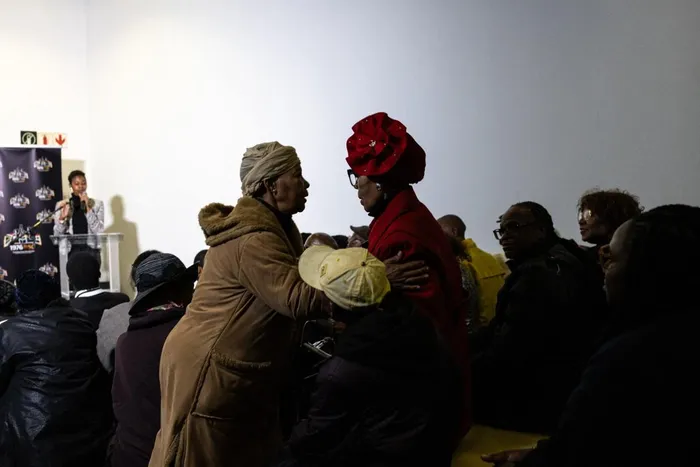
Antoinette Sithole (left), sister of Hector Pieterson, greets a fellow veteran of the June 16, 1976 Soweto Uprising, at the launch of “Finishing What Was Started”, an event reflecting on the legacy of the June 1976 generation and a call to action for today’s youth, at the Hector Pieterson Museum in Soweto on April 30, 2026.
Image: AFP
Dr. Reneva Fourie
Half a century has passed since the 1976 student uprisings against compulsory Afrikaans and inferior education in schools.
State security forces killed hundreds of young people, the most well-known of whom was twelve-year-old Hector Pieterson. That generation of youth, together with the youth of the 1980s, played a significant role in the broader struggle that contributed to the end of apartheid.
Today, a different form of subjugation endures. The earlier systems of pass laws and race-based job reservations have been replaced by an economy that systematically excludes young people from productive life.
The commemoration of the fiftieth anniversary of the June 16 massacre must therefore serve as a moment of critical reflection and analysis. It calls on young South Africans to remember the past and actively reshape the present.
The International Labour Organisation has rated South Africa among the countries with the highest youth unemployment in the world. More than half of young people who are available for work cannot find employment. The scale and persistence of youth unemployment point to long-standing structural weaknesses in the economy.
Long-term joblessness corrodes mental health. Young people are increasingly vulnerable to poverty, crime, depression and substance abuse. Many turn to survival strategies that have nothing to do with career aspirations. They wash car windows at intersections, work as informal car guards, or perform acrobatics and dances at traffic lights for spare change. Some enter exploitative labour, including sex work, because the formal economy offers little alternative.
The government has responded with a range of funding mechanisms. These include the National Youth Development Agency, the Presidential Youth Employment Fund, skills development enablers such as Sector Education and Training Authorities (SETAs), and the National Student Financial Aid Scheme (NASFAS). Millions of rands flow through these institutions each year.
However, the impact on youth unemployment remains negligible. Thousands of university graduates, including many with honours and master's degrees, cannot find work that matches their qualifications.
The reasons are institutional. These entities are run like private corporations rather than developmental agencies. Executive pay packages, tender-driven service delivery and short-term performance targets have replaced long-term planning for youth absorption into the economy.
Another structural weakness lies in the education system. South African schools continue to emphasise academic subjects that do not always align with practical survival needs or the needs of the economy.
Disciplines such as needlework, woodwork, arts and crafts and home economics were largely removed from the curriculum in past decades, often because they were associated with outdated gender or class socialisation.
However, these subjects have intrinsic value. Their reintegration would serve a different purpose. It would equip children with basic life skills. A young person who can sew, repair wooden furniture, cook nutritious meals from cheap ingredients or make simple handicrafts for sale is less vulnerable to exploitation. These capabilities are not substitutes for formal employment. They are essential buffers against absolute destitution.
Vocational training also requires elevation. The economy needs gardeners, plumbers, electricians, carpenters and communications technicians. These occupations constitute a critical foundation for economic productivity, infrastructure development and social wellbeing.
Yet the public sector, including municipalities and state-owned enterprises, cannot absorb such workers at scale. The reason is a sustained policy of outsourcing and privatisation. When a municipality contracts a private company to maintain its water pipes, that company hires labour at the lowest possible cost.
It does not train or retain young South Africans on decent wages. The same pattern repeats across energy, transport and sanitation services. Public assets remain publicly owned in name only because their operational functions are handed to private contractors.
This outsourcing model also produces endemic corruption. A private company that wins a tender has a direct financial interest in inflating costs and reducing labour expenses. The result is a cycle of kickbacks, overpriced contracts and precarious work.
Ending outsourcing is therefore a necessary condition for ending corruption. If municipalities and state-owned enterprises directly employed their own plumbers, electricians and technicians, the money saved from private profit margins could be used to pay proper wages and absorb more young people.
Young South Africans must therefore reject several policy frameworks that have dominated economic governance over the past few decades. Austerity measures that reduce public spending on youth programmes should be opposed. Neoliberal assumptions that private markets will automatically generate sufficient employment have been disproven by thirty years of evidence.
Instead, young people should demand industrialisation, which means expanding local manufacturing capacity. They should demand beneficiation, meaning that South Africa processes its own minerals and agricultural goods rather than exporting raw materials for others to refine.
They should demand public control over the commanding heights of the economy, including energy, transport, telecommunications and mining. These priorities are essential requirements for large-scale job creation, economic expansion and national development.
The values of the anti-apartheid youth movements from the 1950s, 1960s, 1970s and 1980s remain relevant. Those activists rejected ethnicity and tribalism. They opposed discrimination based on nationality and gender. They understood that division among the oppressed serves only the oppressor.
A contemporary youth movement must similarly refuse xenophobia. A young person from Zimbabwe, Mozambique or Lesotho is not a threat to South African employment. The same system benefiting from outsourcing public services in South Africa also extracts wealth and stirs conflict in the Democratic Republic of Congo, Sudan and Somalia.
The threat is an economic system that pits workers against each other for a shrinking number of jobs. Gender-based discrimination must also be rejected. The struggle for economic justice includes transgender and non-binary people, as well as women who face higher unemployment rates than men.
Building social cohesion and national unity requires sustained commitment, practical initiatives and active participation from all sectors of society. It requires shared organisation across lines of ethnicity, nationality and gender. Furthermore, South African youth should embrace the unity of the continent and international solidarity against imperialism.
The generation of 1976 did not have the luxury of gradual reform. The youth of today do not enjoy that luxury either. Having the second-highest youth unemployment rate in the world demands the restructuring of the economy from the ground up.
Young South Africans must lead that effort as active architects of a new system, embodying the true legacy of June 16 and its call for courage and agency.
* Dr Reneva Fourie is a policy analyst specialising in governance, development and security.
** The views expressed do not necessarily reflect the views of IOL or Independent Media.