The Futility of a Constitutional Review Without Political Support
AMENDING THE CONSTITUTION
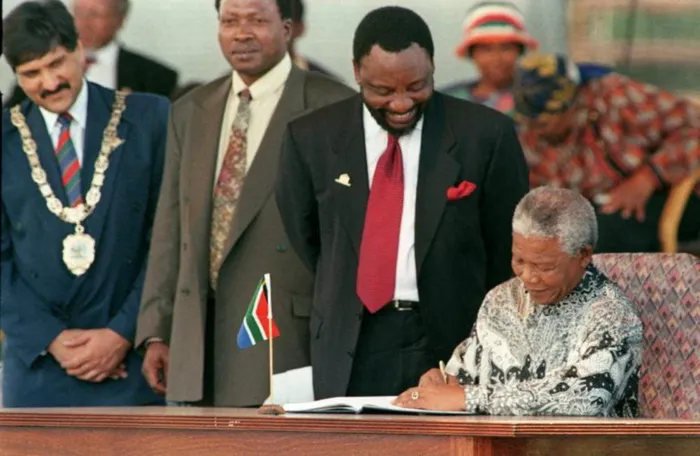
Then President Nelson Mandela, observed by Cyril Ramaphosa, signs the country’s new Constitution at the Sharpeville stadium near Vereeniging on December 10, 1996. A constitutional review without political will is a futile exercise, says the writer.
Image: AFP
Prof. Bheki Mngomezulu
The Constitution of South Africa has generally been hailed as one of the best in the world. Among the reasons cited to buttress this assertion is Chapter 2 of the Constitution, which focuses on the Bill of Rights.
Several rights are enshrined in this chapter which remain an envy to many countries. Those who look at these rights reach the conclusion that our constitution is a stark difference from those of many countries, including those of the developed world.
But while South Africans are said to be lucky because they enjoy so many rights, questions have constantly been asked by various critics about the same constitution. One of them is: if the Constitution is one of the best, it is best for whom? Secondly, does what appears in Chapter 2 translate into reality, or is it a far-fetched dream like a mirage?
For example, Section 9(1) of the Constitution states that “everyone is equal before the law and has the right to equal protection and benefit of the law.” Given the expenses litigants and defendants incur, would it be correct to say that all South Africans enjoy these rights or are the rights applicable only to those who have the money?
This becomes clear in high-profile cases that drag on indefinitely because those involved have the money to sustain them. By contrast, those who are not financially stable want to see their cases concluded as soon as possible.
In a nutshell, the same Constitution that is perceived to be among the best in the world is being frowned upon in South Africa, inter alia, for the reasons articulated above.
Moreover, in the context of the ongoing discussion about illegal immigrants, our Constitution has been cited by some as one of the reasons South Africa is carrying a heavy burden of immigrants, but more especially illegal immigrants.
The preamble of the Constitution states that “South Africa belongs to all who live in it, united in our diversity.” Some interpret this statement to mean that ‘everyone’ who is in the country – whether legally or not – should enjoy the same rights as all other South African citizens.
A counter view is that this sentence in the preamble of the Constitution envisioned and applied solely to South African citizens.
Such varied interpretations, coupled with different readings of Section 25 on property and land rights, have triggered the call for a constitutional review. This is seen to be a better option than a constitutional amendment, which needs a two-thirds majority. Since no political party has the chance to meet this threshold, a constitutional review is seen as a better and more practical option.
Within this context, the joint Constitutional Review Committee (CRC) was established as a statutory parliamentary body in terms of Section 45(c) of the Constitution. Its mandate is to carry out an annual review of the constitution.
To achieve this goal, the CRC welcomes public submissions which propose constitutional amendments and conducts public hearings for this purpose. It then considers these public opinions in making its informed decisions on what to include in its reports.
Regarding its composition, this committee comprises 14 members of the National Assembly (NA) and nine members from the National Council of Provinces (NCOP). Once it has conducted its business, it reports to both Houses of Parliament because it does not have the mandate to draft constitutional amendments on its own.
As part of its work, the CRC considers topical issues, listens to public opinions, and compiles its reports meant to respond to public concerns. The idea is that, where necessary, there would be specific amendments to the Constitution so that citizens feel comfortable that it serves their interests.
But while this process is legal and constitutional, the question remains: is the problem with the constitution (or parts thereof) or a lack of political will to implement what is already contained in the Constitution? In other words, once those amendments have been made, would the change automatically come or would such a change depend on the implementers to do their job?
The two questions posed above are given credence by the fact that, even about policies, the country has many policies which look good on paper.
However, such policies fail to produce the desired change, not because they are deficient but because they are not being implemented. If that is the case, what would be different with the amended constitution?
Historically, our constitution is a product of CODESA talks. The Interim Constitution of 1993, which came into effect in 1994, was built on reconciliation. The current Constitution, which was adopted in 1996, did not deviate much from its predecessor.
Given this historical context, one can safely submit that there is little or no political will to implement the Constitution. There are various reasons for that. One of them is to avoid being seen as instigating racial animosity.
Unwittingly, by protecting the interests of the white racial group, those races that were the victims of apartheid feel ignored. In that sense, there can be no racial harmony.
If policies such as affirmative action and BBBEE are not implemented because they are deemed ‘unconstitutional’, what does that do to the would-be beneficiaries? Is the problem a lack of policies to correct the wrongs of the past or a lack of political will to implement them? If the latter is the case, then what would make an amended Constitution deliver positive results if the political leadership has no political will to do the right thing?
Ideally, in a constitutional democracy, the will of the majority prevails. However, in South Africa, the elected representatives who are the minority decide the fate of the majority by not implementing policies and constitutional imperatives to improve the lives of the people.
Before amending the Constitution, we should implement what we already have. This includes proper land restitution, which breeds poverty among the previously oppressed.
Therefore, a constitutional review without political will is a futile exercise!
* Prof. Bheki Mngomezulu is Director of the Centre for the Advancement of Non-Racialism and Democracy at Nelson Mandela University.
** The views expressed do not necessarily reflect the views of IOL or Independent Media.