Soweto Uprising 50th Anniversary: The Unfinished Business of South Africa's Youth
JUNE 16
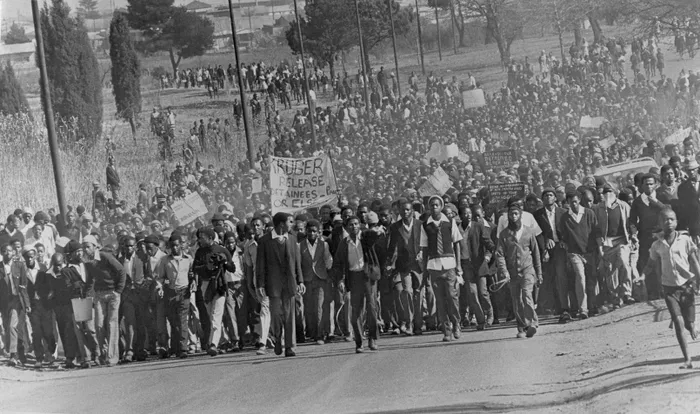
On June 16, 1976, thousands of students in Soweto took to the streets to demonstrate against Bantu Education and the imposition of Afrikaans in their schools. South Africa has travelled a remarkable distance since 1976. Yet the journey towards a prosperous, inclusive and equitable society remains incomplete, says the writer.
Image: AFP
Zamikhaya Maseti
The fiftieth anniversary of June 16 presents South Africa with an opportunity not merely to remember, but to reflect deeply on the long march of our history and the unfinished journey of national liberation.
Someone who was born on June 16, 1976, is already fifty years old. Someone who was exactly ten years old on that historic day is undoubtedly sixty years old today. Those who were in their late twenties when the students of Soweto confronted the brutality of the Apartheid State are now in their eighties.
Time has indeed travelled a very long distance. Entire generations have been born, have matured and have grown old since the fateful events that unfolded on that winter morning in Soweto.
Yet despite the passage of five decades, June 16 remains one of the defining moments in the history of modern South Africa.
The students who marched through the streets of Soweto were not merely protesting against the imposition of Afrikaans as a medium of instruction. They were expressing a broader rejection of an oppressive political order that sought to deny Black South Africans their humanity, dignity and future. Their struggle transcended language. It was fundamentally a struggle for freedom.
The courage displayed by those young people altered the trajectory of South African history. Their resistance inspired a new wave of internal mobilisation, revitalised the liberation movement and exposed the moral bankruptcy of the Apartheid regime before the international community. The youth of 1976 became the conscience of a nation and the catalyst for a new phase of struggle.
Today, fifty years later, South Africa finds itself reflecting not only on the heroism of that generation but also on the journey that has unfolded since then.
The generations that emerged from June 16 share a common denominator.
Those who were children in 1976, those who were young adults and those who were already mature members of society all lived long enough to witness the Democratic Breakthrough of 1994. They all experienced the transition from Apartheid to democracy. They all shared in the hopes, expectations and aspirations that accompanied the birth of a democratic South Africa.
They believed that freedom would bring dignity.
They believed that democracy would bring opportunity.
They believed that political liberation would eventually lead to economic emancipation.
The central question confronting us today is whether those aspirations have been realised.
The answer is neither a simple affirmation nor a complete rejection.
To argue that democracy has failed would be historically inaccurate and intellectually dishonest. Equally, to suggest that all the objectives of the liberation struggle have been achieved would be an exercise in self-deception.
The truth lies somewhere in between.
The democratic government inherited a deeply unequal society. It inherited an economy deliberately structured to privilege a racial minority while excluding the overwhelming majority from meaningful participation. It inherited fragmented institutions, unequal schools, inadequate infrastructure and communities trapped in cycles of poverty and underdevelopment.
The challenge confronting the democratic State in 1994 was therefore immense.
Against this background, South Africa has recorded achievements that should neither be underestimated nor casually dismissed.
Millions of South Africans gained access to electricity, clean drinking water and decent housing. Millions of young people who would never have entered institutions of higher learning under Apartheid have obtained university degrees and professional qualifications.
Social grants have provided a critical safety net for vulnerable households. Roads, clinics, schools and public infrastructure have been extended to communities that had been deliberately neglected for generations.
The Constitution has entrenched rights and freedoms that were unimaginable under Apartheid. The right to vote, freedom of expression, freedom of association and human dignity have become part of the democratic fabric of our society.
These achievements matter.
They represent real and tangible improvements in the lives of millions of South Africans. The dream of a better life was indeed delivered, albeit unevenly and incompletely. However, the democratic journey has also been characterised by serious disappointments.
Corruption emerged as one of the greatest threats to the democratic project. Resources intended to uplift communities and improve public services were diverted for private enrichment. Public institutions that should have served as instruments of development were weakened by patronage, maladministration and poor governance.
State Capture, in all its colours and manifestations, inflicted severe damage upon the capacity of the State to drive transformation and development. Institutions painstakingly built over decades were compromised. Public confidence in government was weakened. The promise of democracy was diminished by the conduct of those who placed personal interests above the national interest.
The consequences of these failures continue to confront us today.
South Africa remains one of the most unequal societies in the world. Poverty continues to define the daily reality of millions. Violent crime undermines social cohesion and threatens the sense of security that citizens require to pursue productive lives. Many communities continue to struggle with inadequate economic opportunities and persistent underdevelopment.
The democratic State succeeded in transferring political power. The transfer of economic power has proven far more difficult. This remains one of the defining contradictions of post Apartheid South Africa. Political liberation was achieved. Economic liberation remains a work in progress.
Perhaps nowhere is this contradiction more visible than among the youth. The youth of 1976 fought against political exclusion. The youth of 2026 confront economic exclusion.
The challenge facing today's generation is fundamentally different in form, yet remarkably similar in substance. Young South Africans are no longer denied the right to vote. They are no longer subjected to racial segregation in educational institutions. They are no longer legally excluded from citizenship.
Yet millions remain excluded from meaningful participation in the economy.
Youth unemployment remains one of the greatest challenges confronting South Africa. For many young people, unemployment has ceased to be a temporary condition and has become a permanent reality. The latest labour statistics indicate that unemployment among young South Africans remains alarmingly high, particularly among those between the ages of fifteen and twenty-four.
Behind these statistics lie human stories.
A graduate carrying a qualification but unable to secure employment. A young artisan is unable to obtain workplace experience. A young entrepreneur is unable to access finance. A young woman or young man trapped between hope and despair.
Every unemployed young person represents unrealised potential. Every young person denied an opportunity represents a loss not only to themselves but also to society as a whole.
History teaches us that societies that fail their youth ultimately mortgage their future.
The lesson of June 16 is that young people possess the capacity to change the course of history. The students of 1976 were not political leaders. They were not ministers, business executives or parliamentarians. They were ordinary young people who refused to accept injustice as a permanent condition of life.
Their courage transformed South Africa.
The challenge before contemporary South Africa is therefore not merely to commemorate its sacrifice. It is to honour it through action.
The unfinished business of June 16 is the creation of a society in which every young South African has access to quality education, meaningful employment and economic opportunity. It is the construction of a developmental economy capable of absorbing the energies, talents and creativity of millions of young people.
This requires capable institutions, ethical leadership and a developmental State committed to the public good. It requires economic growth that is inclusive rather than exclusive. It requires investment in productive sectors of the economy. It requires a national consensus around the imperative of creating opportunities for the next generation.
The generation of 1976 believed that history could be changed. They believed that injustice was neither natural nor permanent. They believed that a better South Africa was possible. Their convictions remain relevant today.
As we commemorate the fiftieth anniversary of June 16, we must resist both romantic nostalgia and cynical pessimism. We must acknowledge the progress that democracy has delivered while honestly confronting the challenges that remain unresolved.
South Africa has travelled a remarkable distance since 1976. Yet the journey towards a prosperous, inclusive and equitable society remains incomplete.
June 16, therefore, remains more than a historical event. It remains a living reminder that every generation inherits responsibilities from those who came before it.
The generation of 1976 confronted Apartheid. The generation of 1994 confronted the democratic transition.The generation of today confronts the challenge of economic transformation.
The real test before our generation is whether we can bequeath to the youth of tomorrow a society more just, more inclusive and more prosperous than the one we inherited. If we succeed in that endeavour, we would have honoured not only the memory of the youth of 1976, but also the aspirations that animated the Democratic Breakthrough of 1994.
That, ultimately, remains the unfinished business of June 16.
* Zamikhaya Maseti is a political economy analyst.
** The views expressed do not necessarily reflect the views of IOL or Independent Media.