Police Oversight: Political Theatre or Accountability?
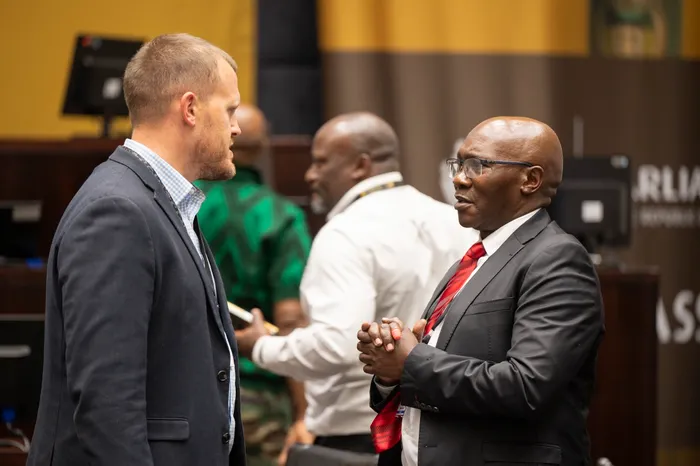
Democratic Alliance Member of Parliament and Chairperson of the Police Portfolio Committee Ian Cameron in discussion with Crime Intelligence Head Lt-Gen. Dumisani Khumalo at a Ad Hoc Committee hearing probing corruption and political interference on January 15. Parliamentary oversight must never become an instrument for political theatre. It must remain a tool for strengthening democratic accountability, says the writer.
Image: Armand Hough/Independent Media
Benson Ngqentsu
This article is written in response to a growing, dangerous tendency by the Democratic Alliance's Chairperson of the Portfolio Committee on Police in the National Assembly, Ian Cameron. He uses parliamentary oversight not primarily as an instrument to strengthen governance and improve policing, but increasingly for two reasons: a vehicle for political grandstanding on the one hand and to serve as a professional informant for the criminal network on the other hand.
Cameron's approach to oversight, particularly his public disclosures regarding the state of police stations, police resources and operational challenges following his recent visit to Bishop Lavis and Khayelitsha, respectively, risks undermining the effectiveness of the South African Police Service (SAPS).
He published detailed information on social media regarding police capacity, including the number of personnel and vehicles available at these stations. Wittingly or unwittingly, such conduct seeks to aid criminal elements with valuable information about the strengths and weaknesses of our policing capacity.
Ian Cameron’s conduct seeks to serve two objectives: at best, to further erode public confidence in the police by projecting an image of an institution incapable of fulfilling its constitutional mandate, and at worst, to arm criminal syndicates and organised crime networks with information that may assist them in identifying vulnerabilities within the policing system and adapting their activities accordingly.
Neither outcome serves the interests of public safety.
Further, Cameron's approach to oversight raises important questions about the distinction between genuine accountability and political grandstanding. I contend that his conduct increasingly resembles the latter.
Oversight should be aimed at identifying challenges, mobilising solutions and strengthening institutions. It should not become a vehicle for media spectacles, political point-scoring or self-promotion at the expense of public confidence in the Police.
I also want to argue that the Democratic Alliance's long-standing campaign for the devolution of policing powers cannot be advanced through the weakening of public confidence in the South African Police Service.
If the objective is genuinely to improve policing, then oversight must contribute towards building institutional capacity rather than relentlessly portraying the police as incapable and ineffective. Yes, the police have structural challenges as a result of neoliberal austerity policy measures, which the DA espouses. The devolution debate must stand or fall on its own merits and not on the deliberate erosion of confidence in national policing institutions.
Equally concerning is Cameron's selective and often overzealous focus on policing matters in the Western Cape. At times, he appears less like the Chairperson of a national parliamentary committee and more like the Chairperson of a Western Cape Standing Committee, given his disproportionate focus on the province in general and Cape Town in particular.
This naturally raises questions about whether his oversight activities are informed by national priorities or by the Democratic Alliance's broader political agenda in the Western Cape.
It was for this reason that, during the sitting of the Western Cape Provincial legislature on 11 June 2026, I tabled a Motion Without Notice arguing that the public disclosure of sensitive security matters for political mileage by Ian Cameron serves neither transparency nor accountability.
On the contrary, it risks emboldening criminal elements, undermining public confidence in state institutions and weakening the operational integrity of the South African Police Service.
The motion, therefore, called on the House to condemn Ian Cameron's irresponsible approach to matters of national security and policing and to reaffirm the principle that parliamentary oversight must always be exercised in a manner that protects the security interests of the Republic and strengthens, rather than compromises, the operational effectiveness of the South African Police Service.
The question remains, though, when parliamentary oversight becomes a political campaign, who really benefits? It is certainly not the communities living under siege from violent crime. It is certainly not the police officers risking their lives daily to keep our people safe under difficult conditions, given the impact of the neoliberal austerity policy measures. Nor is it the broader struggle to build a capable, professional and effective police service.
The beneficiaries are those who derive political mileage from public outrage and those criminal elements who gain insight into the weaknesses of the very institutions tasked with combating them.
Parliamentary oversight must never become an instrument for political theatre. It must remain a tool for strengthening democratic accountability, improving governance and supporting the institutions entrusted with safeguarding our people. Anything less is a disservice to the cause of public safety and to the constitutional mandate Parliament is obliged to uphold.
* Benson Ngqentsu is the ANC's Spokesperson for Police Oversight and Community Safety and the South African Communist Party Provincial Secretary in the Western Cape.
** The views expressed do not necessarily reflect the views of IOL or Independent Media.