Immigration Crisis a Smokescreen for Governance Failures Plaguing SA
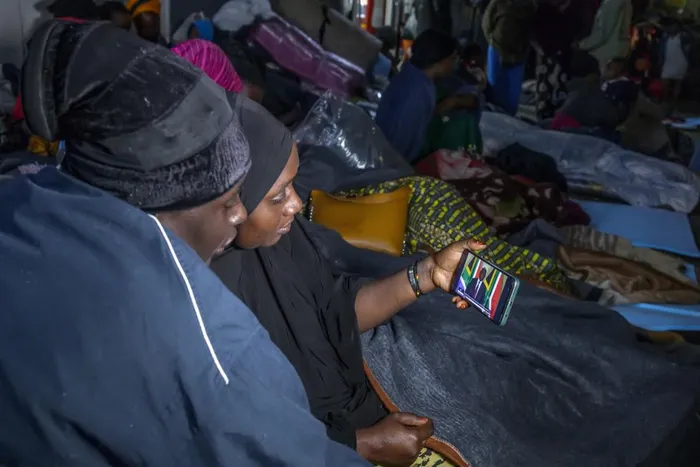
Foreign nationals camped outside the Department of Home Affairs offices in Durban on June 7 use their mobile phone to watch President Cyril Ramaphosa's address to the nation on the country's immigration crisis. While every sovereign state retains the right to regulate immigration, The elevation of deportation into a central political spectacle risks obscuring the broader dynamics that drive migration, says the writer.
Image: AFP
Dr. Reneva Fourie
South Africa has been battling with ethical leadership for some time. While President Ramaphosa’s recent address on foreigners within our borders was balanced, the practical manifestations of this directive, as led by DA minister Leon Amos Schreiber, demonstrate that we have now truly reached rock bottom.
We recently commemorated the fiftieth anniversary of the Soweto Uprising of 16 June 1976, when young South Africans confronted a system that denied their humanity and demanded recognition of their dignity.
We are also approaching the seventy-first anniversary of the Freedom Charter, whose vision was of a country founded on equality, justice and shared citizenship. These historical milestones are reminders of the moral foundations upon which democratic South Africa was built.
Yet at a time when corruption continues to hollow out public institutions, state ineptitude undermines economic growth and public trust, and millions of citizens face deepening economic insecurity, political attention is being directed towards the deportation of foreigners.
The message being conveyed is repugnant. It advances the fiction that many of South Africa's deepest challenges would somehow become more manageable if only there were fewer foreigners within its borders.
The argument may be politically expedient, but it is intellectually shallow and morally disturbing. It invites the public to focus its anger on some of the most vulnerable people within our borders while diverting attention from the systemic failures that have inflicted far greater damage on the country.
The central crisis confronting South Africa is not immigration. It is corruption.
The treatment of foreigners by Home Affairs is too often absent from public debate. Many refugees, students, skilled professionals and entrepreneurs seeking to regularise their status have found themselves trapped in a system characterised by delays, inefficiency and elements of endemic corruption.
Those willing or able to pay bribes frequently obtain access. Those who refuse to participate in corruption are left waiting, sometimes for years, despite having legitimate claims and lawful intentions or even resorting to legal action. The victims of a dysfunctional system are being scapegoated and publicly condemned, leaving the architects of that dysfunction largely beyond scrutiny.
The growing emphasis on removing foreign nationals who obtained documentation through fraudulent means or who are undocumented may satisfy a public appetite for visible action. Still, it does little to address the underlying malaise that enabled such fraud. A serious and principled government would not merely pursue those who navigated a compromised system.
It would also confront the institutional failures, corrupt officials and entrenched networks of bribery that transformed immigration administration into a marketplace of desperation. Without that reckoning, deportations risk becoming little more than a spectacle of enforcement that leaves the root causes untouched.
The selective nature of contemporary migration politics becomes even more apparent when viewed alongside South Africa's economic priorities. Foreigners capable of committing millions of rand are actively courted.
Cape Town, in particular, has become an increasingly attractive destination for wealthy international property owners, remote workers and high-net-worth individuals. Luxury developments continue to reshape parts of the city while property prices place home ownership further out of reach for many residents.
The contrast is difficult to ignore. The affluent foreigner is welcomed as an asset. The refugee, the worker and the asylum seeker are portrayed as liabilities. The distinction is not fundamentally about legality, contribution or social value. It is overwhelmingly about wealth and still about race.
This trend is particularly concerning in a world defined by unprecedented interconnectedness. Capital, information, technology and labour move across borders with increasing ease. Entire industries now operate through hybrid and remote working arrangements that challenge traditional assumptions about national boundaries. Human mobility has become a structural feature of the modern global economy rather than an exceptional phenomenon.
Against this backdrop, an excessive reliance on deportation as a political response appears increasingly archaic. It reflects an instinct to retreat behind borders at precisely the moment when economic and social realities are becoming more interconnected.
While every sovereign state retains the right to regulate immigration, the elevation of deportation into a central political spectacle risks obscuring the broader dynamics that drive migration in the first place.
South Africa is not alone in this reactionary tendency. Across the world, populist movements have gained traction by attributing complex economic and social challenges to immigrants. In the United States, migration has become a focal point of political polarisation.
Across Europe, several right-wing parties have built electoral support by promoting narratives that portray foreigners as threats to national prosperity and social cohesion. Such movements thrive by converting legitimate public frustrations into hostility towards vulnerable groups.
South Africa should approach this trajectory with extreme caution. Our history ought to instil a deeper sensitivity to the dangers of exclusionary politics. Apartheid was sustained by ideologies that categorised human beings according to identity, restricted movement and denied fundamental rights.
Contemporary immigration enforcement is not equivalent to apartheid. Nevertheless, any political culture that encourages suspicion of outsiders, reduces human beings to administrative categories and treats vulnerable communities as convenient scapegoats risks echoing elements of a past that South Africans pledged never to repeat.
Acknowledging this reality does not diminish the hardships experienced by South African citizens. Communities across the country face immense pressures. Public services are strained. Economic opportunities remain scarce. Crime is unmanageable. Social frustration is both understandable and legitimate.
Yet directing that frustration towards foreigners neither resolves these problems nor advances the public interest. It simply diverts attention away from the weaknesses of governance that demand urgent scrutiny.
The true test of a constitutional democracy lies in its ability to uphold human dignity during periods of uncertainty and social strain. South Africa's democratic project was founded upon principles of equality, justice and human rights. These values carry meaning only when they are extended to the vulnerable and unpopular as well as to the powerful and protected.
The debate on migration goes to the heart of our national character. As we reflect on the legacy of 16 June and prepare to commemorate the Freedom Charter, we should remember that the struggle against apartheid was, at its core, a struggle for human dignity. That principle remains as relevant today as it was half a century ago.
* Dr Reneva Fourie is a policy analyst specialising in governance, development and security.
** The views expressed do not necessarily reflect the views of IOL or Independent Media.