Why Africa's Failing Systems Fuel the Migrant Crisis
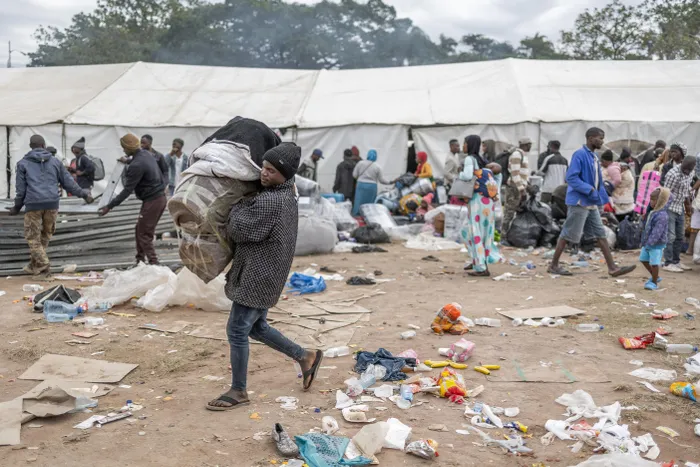
Displaced migrants at Sherwood Park in Durban are demanding that they be sent back to Malawi and not to the Lindela Repatriation Centre in Gauteng.
Image: AFP
Kim Heller
The latest surge of anti-immigrant sentiment in South Africa is both painful and polarising. Tensions are rising as increasingly strident calls by some political formations for undocumented migrants to leave the country grow louder by the day.
With the November local government elections looming, South Africa is becoming an ignitable political battleground where legitimate frustrations over unemployment, poor service delivery, crime and economic hardship are being weaponised.
Grievances are real. For millions of Black South Africans, life remains a daily struggle for survival. Community fury is constantly fuelled by crumbling infrastructure, poor service delivery and lack of economic opportunities. The rage of Black South Africans is justified. However, the African migrant being scapegoated for South Africa's socio-economic crisis is more of a victim than a villain.
The overwhelming majority of African migrants in South Africa are ordinary people propelled by circumstances beyond their control. They are often fleeing countries marked by economic ruin, political instability, conflict, and governance failures. The migrant is always an easy target for frustrations that should be directed at the political and economic systems that have failed to deliver prosperity and dignity for ordinary citizens.
The current wave of Afrophobic sentiment is a deadly symptom of a continent in crisis. The promise of post-independence Africa has been repeatedly frustrated by the failure to dismantle colonial structures, build self-reliant economies and establish accountable governance.
The foremost duty of any government is to ensure the well-being and dignity of its people. Citizens should not be forced into migration because their countries are failing them. Nor should they have to compete for crumbs while political elites feast.
A Zimbabwean father risking his life by crossing the Limpopo River in a desperate search for work in another country is not pursuing privilege but survival. Sudanese families fleeing their war-torn country do so out of a real fear for their lives. Highly educated professionals from across Africa who seek work opportunities in South Africa do so because their own economies are in ruins.
The very concept of Afrophobia vandalises a core pillar of Africa's liberation struggles: solidarity across borders. To counter the hostile anti-immigrant chants, the African Union should have called a dedicated summit long ago to address the interconnected challenges of governance, development, migration, and regional integration.
The Migration Policy Framework for Africa and the Joint Labour Migration Programme require an implementation jolt. A continent-wide migration strategy built on regional economic integration and labour mobility accords could recast migration as a developmental asset rather than a source of conflict, particularly if this is linked to the African Continental Free Trade Area.
Ideally, such a framework would include coordinated border control strategies, joint law-enforcement and reintegration programmes. There is a pressing need for regional and continental economic plans to reduce the conditions that compel citizens to flee their countries. A coordinated continental approach to migration would make the management of undocumented migration far more effective.
It is always easier to target powerless individuals than to confront powerful interests. The African Union and African governments need to call out the economic peddlers who profit from the vulnerability of migrants. Across Africa, corporations in sectors varying from mining and agriculture to construction and retail profit from migrant labour.
Migrant workers are often exploited because of their precarious legal and economic status and battle to survive on paltry wages. Governments need to act decisively and courageously against ruthless private capital that profits from desperation rather than contributes to development.
The United Ulama Council of South Africa has criticised xenophobic violence and pleaded for calm. Leaders within the Anglican Church have reminded South Africans that many young people who fled after neighbouring African countries accommodated the 1976 Soweto uprising.
Both organisations support the enforcement of immigration laws and border management and oppose vigilantism, intimidation, and violence. To normalise vigilantism as an anti-immigrant response is to violate the rule of law and human rights.
The current crisis should be a wake-up call to governments across the continent. African countries need to examine and correct the conditions that compel their citizens to leave. It is distressing that many liberation movements have become detached from the daily realities of the most marginalised and vulnerable.
Until Africa confronts the unfinished project of economic liberation, migrants will be blamed for socio-economic crises that they did not create.
For South Africa, it is particularly painful that Afrophobia is unfolding during the 50th anniversary of the 1976 Soweto uprising, one of the most significant chapters of Black pain and resistance in the country's apartheid-colonial history.
The 1976 moment is engraved not only in the history of South Africa but also in the history of Africa when the apartheid regime unleashed violence on Black youth, neighbouring African countries opened their borders, their homes and their institutions to those seeking shelter, schooling and assistance.
Black South Africans have every reason to be outraged. The democratic government has failed to deliver economic justice or shift the deeply entrenched colonial power relations. African migrants are also casualties of a broader continental crisis of neo-colonialism, poor governance, underdevelopment, and inequality.
The solution to Africa's migration challenge can never lie in a group of marginalised people turning on another group of marginalised people. Rather, it lies in building strong, secure African nations, focused on accountability, people-driven development and sovereignty.
In the absence of this, migrants will continue to cross borders in search of safety and survival. Africa's migration crisis is a development crisis, and without peace and prosperity, migration will remain a defining feature of Africa's geopolitical reality.
* Kim Heller is a political analyst and author of No White Lies: Black Politics and White Power in South Africa.
** The views expressed do not necessarily reflect the views of IOL or Independent Media.