Israel’s Disdain for Peace Casts an Ominous Shadow Over West Asia
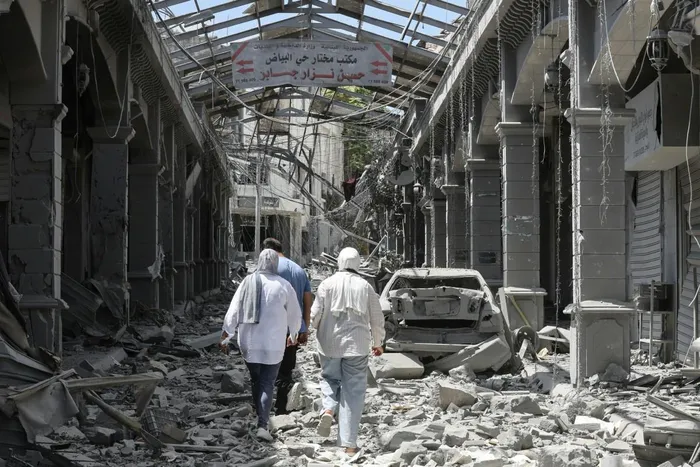
People make their way through the heavily damaged historic market of Nabatieh in Southern Lebanon following air strikes by Israel on June 15. The right to self-determination for the Palestinian people is not a threat to peace but a prerequisite for it, says the writer.
Image: AFP
Dr. Reneva Fourie
My Palestinian friend recently spoke with a deep and troubling despair. He remarked that before, Israel killed hundreds of people a week, and now they kill just seven or ten. In his view, the numbers have changed, but the indifference remains.
I have observed him exhaust himself under the weight of grief while members of his family, who also originate from Gaza, struggle to support him despite carrying their own trauma and heartbreak. I battle to find words that might ease his pain, overwhelmed by the shame of watching some in our government proclaim solidarity while acting in ways that undermine it.
It is impossible to recall 16 June 1976 and not reflect on the brave youth of Palestine. Across Gaza and the occupied Palestinian territories, children and teenagers continue to endure violence, displacement and insecurity. Many resist in whatever ways they can.
Many are killed. Others take their place and face the same horror. Others still are detained, tortured and exposed to horrific sexual violence. The nefarious cycle continues with devastating consequences. Just recently, Israel killed eight children and injured seventeen more across five locations in Gaza in a single weekend. Among the victims were children who were playing football.
Between 16 June 1976 and February 1977, an estimated 575 South Africans were killed due to apartheid state violence. The atrocity caused global outrage at the time. It is a trauma still etched in the marrow of the bones of those who experienced it.
Half a century later, those memories remain vivid. But the scale of death in Palestine since October 2023 has been vastly greater. Israel has murdered over 21,000 children in Gaza and more than 240 children in the West Bank. Still, some justify this horror.
The humanitarian situation is catastrophic. According to UNICEF, the attacks on Gaza and the West Bank, including East Jerusalem, have triggered mass fatalities, displacement and extreme protection risks for children.
In Gaza, damage to infrastructure and restrictions on humanitarian access have produced critical shortages in water, sanitation and healthcare services. Waterborne diseases and the threat of polio remain serious concerns. Around 132,000 children are considered at risk of malnutrition. More than one million children require psychosocial support, and 765,000 children need access to education.
Conditions in the West Bank are also alarming. Violence, displacement and economic hardship have affected more than 800,000 people. More than 150,000 children face barriers to attending school and accessing basic services. Communities are uncertain about their safety and future as attacks on them, their property and holy sites escalate.
The impact of Israeli military operations extends beyond Palestine. In Lebanon, more than 1.2 million people have been displaced, many of them several times. Around 400,000 of those displaced are children. Between March and June 2026, Israeli attacks are reported to have killed at least 3,711 people in Lebanon, including 132 healthcare workers and 247 children.
The mass protests across the world have had little impact on the ground. The European Union continues to trade with Israel, and as a bloc, it collectively remains Israel's biggest overall trading partner. South Africa has increased coal sales and now, embarrassingly, is Israel's largest coal supplier.
The United States overwhelmingly remains Israel's largest arms supplier. Trump publicly rebukes Netanyahu at the G7, but the flow of weapons continues. Trump, meanwhile, assigns Jolani to serve as his proxy to continue attacking the people of Lebanon, while enabling Israel's occupation of the Golan Heights and southern Syria.
Last week, the United States and Iran formalised a memorandum of understanding towards ending active hostilities. The MoU includes provisions for ending conflict across several fronts, lifting the United States naval blockade, gradually reopening the Strait of Hormuz, returning part of Iran's frozen assets, establishing a reconstruction fund for damaged areas in Iran and continuing negotiations on nuclear issues alongside a phased reduction of sanctions.
The deal is typical of Trump’s transactional style of diplomacy, which prioritises a high-profile, low-cost off-ramp for a war he should never have started. In remarks that affirm his lack of integrity, he proclaimed, "The agreement is not final ... If I don't like it, we'll go back to shooting at them, dropping bombs on their heads."
The reliability of the MoU depends heavily on Israel's compliance. Israeli media report that Israelis from across the political spectrum reacted angrily to the news of a deal between the US and Iran. They called it a disaster for Israel.
This reflects a culture of impunity in which Palestinian rights are routinely subordinated to Israeli expansionary interests. Peace can never be a disaster. Peace agreements should ultimately be measured by their ability to save lives, reduce suffering and create conditions for coexistence.
The uproar is because the deal threatens their privileged status of being regarded as superior to their fellow Semites. The mindset of superiority that permeates Israeli society is false, deeply troubling and immoral. It mimics the racist mindsets of the apartheid regime that continues to prevail among some South Africans; hence, the DA and its ilk are defending it. Disgustingly, this mentality is very close to that of Adolf Hitler.
Israel's disdain for human rights has no bounds. Lasting peace cannot be built upon domination, discrimination or permanent occupation. A sustainable future requires a genuine commitment to equality, human dignity and political rights. The right to self-determination for the Palestinian people is not a threat to peace but a prerequisite for it.
The global community watches as history repeats itself, and the cries of the oppressed are met with indifference. The memory of 1976 is a stark reminder of the cost of silence. The world must not forget the children of Gaza and Lebanon. The world must not forget the brave youth of Palestine who resist against overwhelming odds. Their suffering is a call to conscience.
The path to peace is clear, but it requires a fundamental change in attitude. It requires rejecting the myth of superiority and embracing shared humanity. Without that, the cycle of violence will continue, and the despair of my friend will become the despair of many more.
* Dr Reneva Fourie is a policy analyst specialising in governance, development and security.
** The views expressed do not necessarily reflect the views of IOL or Independent Media.