Our Youth: A Catalyst for Change or a Growing Concern?
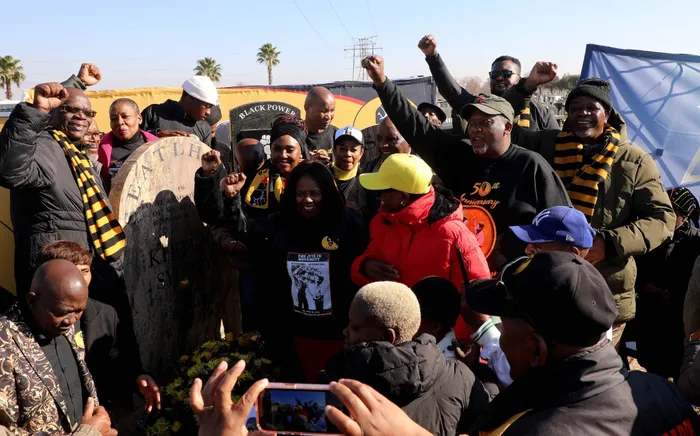
Veteran activists gathered at Avalon cemetery in Soweto on June 16 to pay tribute to the victims of the 1976 Soweto uprising. Our youth can be a powerful catalyst for change if we listen, review and act, says the writer.
Image: Timothy Bernard / Independent Newspapers
Prof. Saths Cooper
Now that we’ve appropriately celebrated the 50th anniversary of the June 16 uprisings, it’s time to start to take stock of our youth, defined by the National Youth Development Agency Act in South Africa (SA) as between 14 and 35 years of age, while the United Nations posits that the period of 15 to 24 transitions one from childhood to the independence of young adulthood.
We live in a fast-changing, instantly globally connected era, where might is displayed in a variety of forms, including crass wealth, ever-present and all-consuming technological advancement, deadly forms of death and destruction, and overwhelming dependence, and brave, visionary, and competent leadership is in short supply.
In this era, it can be exhilarating but also terrifying to be young. Youth has generally been regarded as a problem that often seems incapable of being solved. It’s easy to be seduced into being dismissive and reactive to what many adults wish to forget or simply ignore. Yet we can’t escape what stares us in the face daily. Our children, our youth, are the majority, and increasingly dominate the statistics, which we ignore at our collective peril, damning SA’s future.
Being involved in youth issues from my teens in various sectors of society here and abroad, it’s clear that we’re avoiding listening to our youth, who mostly affirm the rich cultural fabric that we’re endowed with, while they are streets ahead of us in appreciating what’s trending in many facets of life, especially that which attracts or repels them.
This may not be part of what may consume adult concerns and needs. The tendency to disregard, to problematise our children, who didn’t ask to be born but are here in our lives, whether we like it or not, fuels our distance and apathy, disabling us from incorporating our children’s needs as our own, preventing progress on the statistics that have been terribly inflicted on our youth, through our lack of care and commitment.
Trotting out the figures is not good enough, especially when these figures are dangerously rising.
Creating various entities without a clear vision and deliverables that often compete in the children/youth space just clouds our ability to move forward. An analysis of what we spend and the outcomes – e.g., in education, social services – is telling. Announcing another programme when the previous ones haven’t been evaluated for efficacy is part of the syndrome SA has to confront, not aid and abet.
Each of us as adults should be asking ourselves if we’re not blaming our offspring for what we may have missed. Have we indulged or denied them? Do we only see them when they grab our attention, often in behaviours that they’ve learned from us, at home (whatever form home assumes), in school, in higher education (if they’re lucky), in sport, recreational, social and belief environments, and in neighbourhoods (whatever spatial form these may be)?
It’s time to really start conversations with our future. Our offspring have ideas for their enablement, which may be beyond our grasp, and which will be seriously enriching in the range of answers that they proffer.
Should we not do things for our children so that they can give their opinion on? Of course, we don’t have to pander or humour them, but we should be in the position of informing them why we differ. Sometimes they’ll get it, sometimes they won’t, but they will remember it and raise it when we’ve forgotten.
Our youth can be a powerful catalyst for change if we listen, review and act. Some ideas may not see immediate fruition. Is this not better than the prevailing system of grand announcements, throwing borrowed money at high interest, which our children’s grandchildren will be unable to liquidate? This is what we need to overcome.
Our children are asking for what we should be doing: protecting them, really educating and socialising them to better mediate a complex socioeconomic environment which has been traditionally hostile to them, often demanding “Do as I say, not as I do!” A striking example is youth articulating that their schools – in what are still called townships, and the growing informal settlements – are dominated by shebeens where there’s very little recreational and sporting offerings, which, when created, are not maintained.
Their world is dominated by addictions (including substances, gaming/betting, which we’ve fanned), promises that aren’t kept, and laws that are not enforced. They want to be saved from such dangers that lurk in their world, which enable predators to thrive. They want to be part of the solution rather than being considered the problem, which we have allowed to perpetuate.
In reflecting on the supreme sacrifices made by our children 50 years ago, let our conscience guide us to continue to strive for the restoration of our common humanity, despite the attempts to ensure apartheid continues in new forms all around us.
We should be celebrating and consolidating our hard-won freedoms, cherishing our diversity as one of the most diverse countries in the world, as we are confronting another perilous and troubling period in the short history of our democracy, where rampant racism, ethnicity, sexism, violence, poverty, hunger, unemployment, and corruption appear endemic.
SA deserves – we can and should be – better!
* Prof Saths Cooper, PhD, is the former President of International Union of Psych Science & Psychological Society of South Africa (PsySSA), Chair of the Robben Island Museum and the The 70s Group.
** The views expressed do not necessarily reflect the views of IOL or Independent Media.