Zanu-PF's Constitutional Changes: Implications for Zimbabwe's Democracy
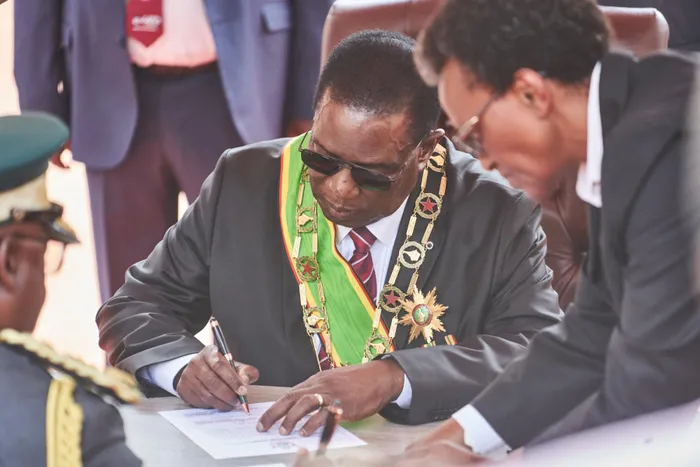
Emmerson Mnangagwa being sworn in as Zimbabwe's President in Harare on September 4, 2023. The way the government of Zimbabwe went about the amendment of the constitution was clearly an infringement on the principles of democratic change of government, says the writer.
Image: AFP
Dr. Sizo Nkala
It was during Zimbabwe’s ruling party Zanu-PF’s annual conference in October 2024 that the intention to amend the country’s constitution to pave the way for the extension of the presidential term from five years to seven years was first officially adopted by the party through the so-called conference resolution number 1.
The former liberation movement unanimously resolved that “the President and First Secretary of ZANU PF Party, His Excellency, Cde. Dr E. D. Mnangagwa’s term of office as President of the Republic of Zimbabwe and First Secretary of ZANU-PF be extended beyond 2028 to 2030. The Party and Government should, therefore, set in motion the necessary amendments to the National Constitution to give effect to this resolution.”
This was followed by a spirited campaign by President Mnangagwa’s most ardent supporters to sell the resolution to the public and push the Zanu-PF led government to formally kickstart the process of amending the constitution.
The argument was that the President needed more time to complete the national development projects his administration had started. However, the Vice-President, Retired General Constantine Chiwenga’s conspicuous lack of endorsement of the constitutional amendment betrayed divisions within the ruling party over the 2024 conference resolution.
When the Bill to implement Zanu-PF’s resolution was finally gazetted by the government as the Constitutional Amendment Bill Number 3 of 2026 (CAB3), it outlined a raft of provisions amending various sections of the constitution with far-reaching impact.
Among the amendment provisions are the transfer of responsibility for registering voters and compiling and maintaining the voters’ roll from the Zimbabwe Electoral Commission (ZEC) to the Registrar-General. Secondly, the Bill repealed section 92 of the Constitution to introduce a new method of electing the president.
It scraps the direct election of the president by voters, replacing it with the parliamentary method, where the president is elected by parliament in a joint sitting of the National Assembly and the Senate and must receive an absolute majority to win.
Thus, the amendment effectively switches Zimbabwe from a presidential to a parliamentary electoral system. The two most controversial provisions amend sections 95 and 143 of the constitution to extend the length of a presidential and parliamentary term, respectively, from the current 5 years to 7 years.
This means that the current president and parliamentarians will continue their stay in office until 2030 instead of 2028. These provisions effectively postpone the 2028 elections to 2030. Other significant provisions include the expansion of the Senate from the current 80 members to 90 members, with the additional 10 being appointed by the president and the creation of the Zimbabwe Electoral Delimitation Commission, which will be responsible for the demarcation of parliamentary constituencies.
This function was previously exercised by the ZEC.It is important to note that public debate on the amendments was stifled by the government. Individuals who came out to oppose the amendments were subjected to harassment by state agents. For example, renowned academic and prominent government critic, Ibbo Mandaza, had his offices in Harare petrol bombed in October 2025.
This was just before his office was meant to host prominent politicians, including Tendai Biti and Job Sikhala, in a news conference where they intended to announce a coalition to campaign against the proposed constitutional amendment.
Further, the government strenuously resisted calls for the CAB3 to go through a public referendum, arguing that a referendum was not a prerequisite for the amendment. This was, quite rightly, widely interpreted as an attempt to evade democratic accountability.
After three months of the public consultation process, the bill was submitted to parliament for debate and vote. On the 18th of June, Zimbabwe’s National Assembly voted 216-42 in favour of the Bill and the Senate also overwhelmingly voted 75-5 in favour of the amendments on the 24th of June.
This essentially means that the Bill has been passed and is awaiting the assent of its major beneficiary, President Mnangagwa, before the amendments become effective.
Although the Bill can still be challenged in the courts of law, it is unlikely that the Zimbabwean judiciary will act in any manner that undermines the ruling party. As such, what is happening in Zimbabwe is a sad travesty of democracy.
The actions taken by the government constitute a violation of Article 23(5) of the 2007 African Charter on Democracy, Elections and Governance, which states that “any amendment or revision of the constitution or legal instruments, which is an infringement on the principles of democratic change of government” constitutes an unconstitutional change of government, which should invite sanctions from the African Union (AU).
The way the government of Zimbabwe went about the amendment of the constitution was clearly an infringement on the principles of democratic change of government.
However, the AU has long overlooked dubious constitutional amendments that have happened in some of its member states, including Uganda, Djibouti, Togo and Rwanda, aimed at maintaining the incumbents in power.
Hence, it is unlikely that the continental body will hold Zimbabwe accountable for the flawed constitutional amendment process. Without any effective pushback, this will soon become the norm on the continent, which will reverse the democratic gains that have been made thus far.
This development may also have far-reaching implications for Zimbabwean politics going forward. This is because the constitutional amendment is reportedly being used as a succession battle tactic by President Mnangagwa’s faction within Zanu-PF against Vice President Chiwenga’s faction.
Chiwenga would have been the natural successor to Mnangagwa, who is serving his second and final term. However, Mnangagwa’s faction is not convinced they will benefit from his presidency, hence they would prefer a different candidate.
A lot will now depend on the extent of Chiwenga’s influence both within the party and, most importantly, within the military, which will determine his faction’s response to this apparent setback.
* Sizo Nkala is a Senior Research Fellow at the University of Johannesburg Centre for Africa-China Studies.
** The views expressed do not necessarily reflect the views of IOL or Independent Media.