From Apartheid to Pan-Africanism: SA’s Africa Policy Gains Reversed
MIGRANT CRISIS
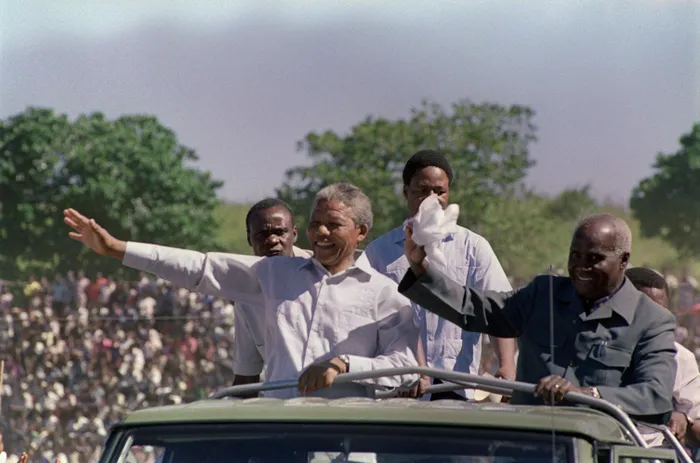
Nelson Mandela (left) and Zambian President Kenneth Kaunda wave to the crowd as they arrive at a ANC mass rally held at the Independent Stadium in Lusaka on March 03, 1990. Zambia was the seat of the exiled ANC. To express gratitude for African countries’ unwavering support during the anti-Apartheid struggle, South Africa left no stone unturned in appeasing its fellow African countries, says the writer.
Image: AFP
Dr. Sizo Nkala
Since the end of apartheid in 1994, South Africa has painstakingly built a reputation as a model continental citizen in Africa.
In a seminal article he published in 1993, just a few months before he became the first president of a democratic South Africa, Nelson Mandela declared that “South Africa cannot escape its African destiny”.
In part to atone for the sins of the apartheid regime, which wreaked untold havoc in neighbouring countries housing anti-Apartheid forces and in part to express gratitude for African countries’ unwavering support during the anti-Apartheid struggle, post-Apartheid South Africa left no stone unturned in appeasing its fellow African countries.
The country unambiguously asserted its identity as an African country and became one of the most fervent crusaders of the Pan-Africanist ideals. In the past 32 years, South Africa has been almost omnipresent in African peacekeeping and conflict resolution missions in countries such as the Democratic Republic of Congo (DRC), Burundi, Mozambique, Zimbabwe and Madagascar, to mention a few, where it has expended a significant amount of its own resources.
It is one of the few countries on the continent that has established a fund, namely the African Renaissance Fund (ARF) created in 2001, dedicated mainly to fellow African countries. Since its establishment in 2001, about R3 billion has been disbursed towards humanitarian, welfare, nation-building and peace-building projects in several African countries.
Moreover, at the turn of the twenty-first century, South Africa played a significant role in the birth of a new continental governance architecture embodied by the emergence of the African Union (AU), which succeeded the Organisation of African Unity (OAU).
The AU and its concomitant institutions such as the New Partnership for Africa’s Development (NEPAD), the Pan-African Parliament (PAP) and the African Peer Review Mechanism (APRM) were at the core of the African Renaissance vision so ably articulated by former South African President Thabo Mbeki.
Perhaps in the quest to further prove its pan-African credentials, South Africa made it rather easy for immigrants from other African countries fleeing wars, conflicts, and poverty to settle in the country legally or otherwise.
To date, the country hosts about 3.2 million international immigrants, about 90 per cent of whom are from around the continent. The country’s investment in building a good reputation on the continent over the last three decades appears to have paid off handsomely.
South Africa’s trade with the African continent grew from just R11 billion in 1994 to R759 billion in 2024, with a significant trade surplus of R379 billion. This attests to its success in negotiating access to Africa’s increasingly lucrative markets.
To date, South Africa is the biggest source of intra-African foreign direct investment and the sixth biggest source of FDI for Africa overall, with an FDI stock of over $32 billion in about 40 African countries.
No other African country can match the size of South Africa’s economic footprint on the continent. Its development finance institutions (DFIs), namely the Industrial Development Corporation (IDC) and the Development Bank of Southern Africa (DBSA), have secured huge infrastructure and industrial contracts across the continent, which have enhanced regional integration and forged regional supply chains.
Moreover, South Africa is also the most popular destination for intra-African tourism. Between 2000 and 2024, South Africa recorded an average of almost 6 million African tourist arrivals, which make up about 80 per cent of overall tourist arrivals.
According to the Department of Tourism, African tourists spent an average of R36 billion annually between 2015 and 2024, which demonstrates the important role they play in sustaining tens of thousands of jobs in the country’s tourism and hospitality sectors.
By all indications, it does look like South Africa has managed to forge a profitable economic relationship with the rest of Africa over the last three decades.
However, the current wave of anti-immigrant protests (arguably the most intense and widespread in the recent past) that have gripped the country for the better part of this year threaten to undo South Africa’s hard-won diplomatic capital and undermine its economic foothold on the continent.
The groups leading the protests – March and March and Operation Dudula – argue that immigrants are responsible for the high rates of crime in the country, shut South Africans out of the job market, and compete for limited resources like healthcare and education.
The protests have seen some African countries, including Lesotho, Malawi, Zimbabwe, Mozambique, Nigeria, and Ghana, repatriate thousands of their citizens residing in South Africa who have been hounded out of their homes following threats of violence.
Uganda is also preparing to repatriate its citizens who it says are under threat of xenophobic attacks. Scores of Congolese, Malawian and Zimbabwean immigrants have been forced to seek refuge in open and overcrowded spaces while waiting for repatriation.
The fact that immigrants from other African countries, including children, have to live in open spaces under inhumane conditions because some citizens are chasing them out of their communities is not a good look for South Africa on the continent.
The South African government has appeared more prepared to assist with the repatriation of the immigrants back to their countries than to stop their evictions from the communities where they live. The treatment of African immigrants, who make up 90 per cent of the 3.2 million immigrants in South Africa, has triggered an unprecedented diplomatic uproar, with the Nigerian and Ghanaian governments explicitly criticising how the South African government has handled the protests.
The Nigerian Foreign Minister, Bianca Ojukwu, characterised the actions of the anti-immigrant groups as Afrophobic due to black immigrants being disproportionately targeted. The Ghanaian Foreign Minister Samuel Okudzeto Ablakwa went as far as formally writing to the African Union to have South Africa included on the agenda of the organisation’s Mid-Year Coordination Meeting, which took place on the 24th of June.
The letter lamented that the “targeting of nationals from African countries presents a challenge to the shared principles of African solidarity, brotherhood, and continental unity.” While this may have been a tad dramatic, as reflected by the fact that Ghana’s request to the AU was not successful, it may very well represent a shift in African countries’ perception of South Africa.
These unfortunate developments will complicate South Africa’s economic diplomacy efforts on the continent, coming as they do at a time when the country has set its sights on increasing its exports to the continent from R569 billion to R1.1 trillion by 2030.
The Department of Tourism has also set a target of 15 million African tourist arrivals by 2030. In the current diplomatic climate, achieving these targets will be an uphill task because economic cooperation does not happen in a vacuum.
This also places at risk South Africa’s unofficial status as the regional leader, which has opened so many doors for it at the global level. This has seen the country gain access to such influential global platforms as BRICS and the G20 by virtue of its putative status as the African spokesperson.
If not carefully managed, these protests will do more harm than good for South Africa’s image in Africa.
* Sizo Nkala is a Senior Research Fellow at the University of Johannesburg Centre for Africa-China Studies.
** The views expressed do not necessarily reflect the views of IOL or Independent Media.