Ramaphosa's National Dialogue A Political Failure Amid Afrophobia Crisis
MIGRANT CRISIS
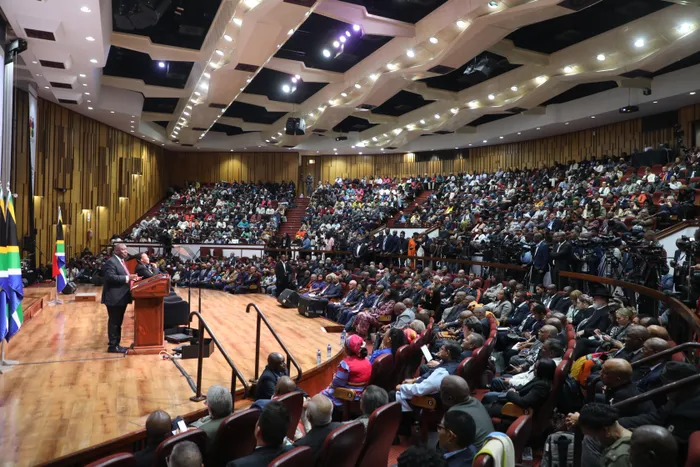
PRESIDENT Cyril Ramaphosa delivering the keynote address at the National Dialogue's National Convention held at Unisa, Pretoria on August 15, 2025. If the National Dialogue were truly and visibly underway, the migration issue could have been addressed differently, says the writer.
Image: Oupa Mokoena / Independent Media
Dr. Reneva Fourie
As hundreds of people marched through South Africa’s streets claiming to highlight the challenges associated with undocumented migration, one question became impossible to ignore. Whatever happened to the National Dialogue?
The marches were neither surprising nor particularly exceptional. Across societies experiencing deep economic insecurity, stagnant growth and declining public confidence in state institutions, migration frequently becomes the target against which broader frustrations are expressed.
The National Dialogue, announced in June 2025 with significant public attention and formally launched at its first National Convention in Tshwane from 15 to 16 August 2025, was intended as a pivotal intervention to address grassroots discontent.
It was heralded as a citizen-led process to address the country’s most intractable social and economic challenges, including poverty, unemployment and social divisions. It promised to emulate the spirit of the Freedom Charter and restore people-centred, people-driven governance while rebuilding the relationship between the state and society.
The National Dialogue was expected to unfold through a series of public consultations held across communities and sectors throughout South Africa over several months. These engagements were scheduled to commence immediately after the inaugural National Convention and continue into early 2026. Initially estimated to cost R700 million, the budget was revised downward to R485 million, with approximately R348 million earmarked for ward-level dialogues.
Yet, at the very moment when dialogue is needed most, the process appears conspicuously absent. Instead, we are witnessing two equally inadequate responses. On one side are protest movements that increasingly reduce highly complex structural crises to the presence of undocumented migrants.
On the other side is a state that appears increasingly inclined to manage political discontent through policing and security operations rather than meaningful political engagement. Neither approach addresses the underlying causes of the crisis.
To attribute unemployment, failing municipalities or violent crime primarily to migration is to mistake symptoms for causes. South Africa's social and economic crisis long predates the recent intensification of debates over migration.
Decades of uneven development, deindustrialisation, hollowing out of the state and neoliberal economic policies have produced conditions within which frustration has accumulated. Migration has become the language through which much of that frustration is now expressed, but it did not create those conditions.
Equally, the state cannot police its way out of a crisis of legitimacy. Reports that approximately R600 million was allocated to security operations surrounding the 30 June march and associated protest activity illustrate an increasingly familiar pattern. Faced with rising social tensions, the state invests in maintaining order while the political processes capable of addressing the causes of disorder remain dormant.
Furthermore, the use of repression as a primary tool of governance has a deeply corrosive effect on the state itself. It diverts resources from essential services, it normalises the use of force against citizens, and it breeds further resistance. Repression does not resolve contradictions; it merely suppresses them temporarily, allowing them to fester and re-emerge in more violent forms.
It is an admission that the state has no strategy for winning hearts and minds, only for controlling bodies. This is a sign of ideological bankruptcy. A state that cannot persuade its citizens to embrace a common national project has lost its moral authority. It becomes a hollow shell, capable only of coercion, not of genuine leadership.
This is precisely why the National Dialogue mattered. Its purpose was never simply to organise conferences or public meetings. It was supposed to create mechanisms through which competing interests, conflicting experiences and divergent political perspectives could engage one another before those differences hardened into permanent antagonisms.
The Dialogue was meant to build social cohesion, to break down the divisions between ‘insiders’ and ‘outsiders’. Instead, we are witnessing a surge in Afrophobic sentiment, culminating in the protests organised by groups like March and March.
If the National Dialogue were truly and visibly underway, the migration issue could have been addressed differently. It could have been a platform to rationally discuss the pressures of migration, to distinguish between legitimate concerns about border control and the irrational hatred of the foreigner. It could have created a space in which concerns over border governance and economic insecurity were debated openly, without allowing them to harden into disorder and violence.
Instead, the National Dialogue has been rendered impotent. It has become a parallel process, existing in a vacuum, while the real social contradictions play out on the streets. Its silence, at this critical juncture, is an abdication of responsibility.
The infrastructure is in place, the secretariat is employed, but the engine of social engagement has stalled. There is no visible action to steer the national conversation away from the abyss of ethnic chauvinism.
In the final analysis, the situation is a stark illustration of a fundamental political failure. The National Dialogue, conceived as a project of national renewal, has become a symbol of the state’s paralysis. It represents the triumph of form over substance, of bureaucratic process over genuine popular participation.
The money spent on the dialogue and on security could have been combined to create a transformative social programme of democratic participation, social investment and institutional recapacitation. It could have helped to address the material conditions that fuel public frustration while rebuilding trust between citizens and the state.
Instead, South Africa is left with the worst of both worlds: a wave of protesters bent on creating instability and securocractic responses that cannot resolve the underlying crisis.
The path forward does not lie in more security or more marches, but in a fundamental reorientation of the state’s priorities towards the material and ideological empowerment of the people.
The longer the National Dialogue remains impotent, the greater the likelihood that both public anger and state repression become normalised. Neither offers a path towards lasting stability. Both merely deepen the conditions from which future conflict will emerge.
South Africa does not suffer from a shortage of grievances. It suffers from a shortage of credible political spaces within which those grievances can be collectively understood and constructively addressed. That was precisely what the National Dialogue promised to provide. Its silence has become politically consequential, undermining the very purpose for which it was established.
* Dr Reneva Fourie is a policy analyst specialising in governance, development and security.
** The views expressed do not necessarily reflect the views of IOL or Independent Media.