State's Paralysis On Delinquent Municipal Officials Eroding Public Trust
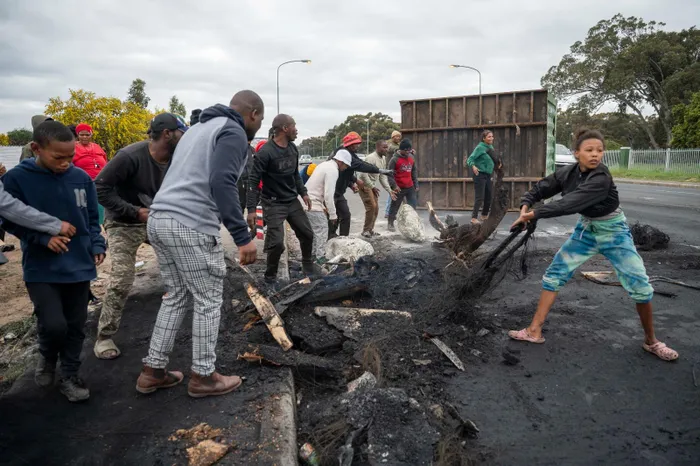
The community of Cape Town's Gate 7 informal settlement protests over the lack of service delivery. Concepts such as ‘accountability’ and ‘consequence management’ are critical in improving the audit outcome of a municipality, says the writer.
Image: Armand Hough / Independent Newspapers
Prof. Bheki Mngomezulu
On June 24, 2026, South Africa’s Auditor-General, Tsakani Maluleke, tabled her consolidated report presenting the 2024-2025 audit outcomes as part of her constitutional obligation.
One of the main observations made by the AG was that the sixth administration, whose term of office ended in May 2024, did not achieve the desired turnaround in local government. This was a serious indictment of government’s failure to act on delinquent officials.
What was glaring in the audit report was that only 39 municipalities obtained a clean audit opinion. This translated to 15% of all the 257 municipalities nationally. The figure was less than the 41 municipalities that obtained a clean audit in the previous annual report.
The AG was particularly concerned that the 2024-25 audit outcomes reveal serious regressions at metropolitan municipalities across the country. The unqualified audits for Cape Town, eThekwini, and Johannesburg were not enough to bring hope that the situation will improve. Issues such as lack of ethical behaviour and conflict of interest influenced the audit outcome.
In the past, Cape Town Metropolitan Municipality has been touted as a good example of how to run a municipality. Addressing over 4000 ANC councillors, President Cyril Ramaphosa sparked an intense debate when he conceded that the country’s best-performing and best-run municipalities are led by the DA. He went on to cite Cape Town and Stellenbosch as some of those municipalities.
But according to this year’s audit report, regression was reported even in Cape Town. This opinion was attributed to the findings on procurement and contract management that were not handled properly.
Even in areas where positive results were recorded in this year’s report, some concerns were still raised by the AG. For example, the number of disclaimed municipalities went down from 29 to 8. This looks good and progressive.
However, of this figure (8), seven municipalities were repeats for anything between three and ten years in succession. This means that there is no determination to improve, and there are no consequences for failure to deliver on the mandate.
President Ramaphosa is on record saying that government is concerned about the state of municipalities in the country and their failure to deliver services to the people. He promised the nation that government will intervene and punish those municipal officials who fail to execute their mandate.
For example, he committed to hold municipal managers personally accountable for failing to deliver services to the people.
Water shortages and misuse of infrastructure funds were cited as some of the reasons why municipal managers would be reprimanded for failing to provide leadership. Ramaphosa reported that criminal charges had already been laid against 56 municipalities to set an example. Municipal managers were told that they can face criminal charges or even jail time if they fail to perform their responsibilities.
To breathe life into this warning, Ramaphosa subsequently signed the Local Government: Municipal Systems Amendment Act. This Act bars municipal managers and senior managers from holding political office in their political parties.
Such mechanisms look good and promising on paper. But, as we all know, the problem in South Africa is not the enactment of laws or policies, since the country has proven beyond any doubt that it is capable of doing so. Instead, the main problem is the lack of implementation of these laws and policies. This is caused by weak monitoring and evaluation mechanisms.
Therefore, neither Ramaphosa’s threat nor the amended legislation will automatically get our municipalities out of their current quagmire. What is needed is intentional and deliberate action against those who contribute to municipalities receiving a negative audit opinion.
Noticeably, municipal managers are not the only culprits. Focusing solely on them would be ill-conceived. Municipal councils and mayors at these municipalities have the responsibility to provide oversight. Failure to execute this mandate amounts to dereliction of duty on their part. As such, those tasked to provide oversight cannot suddenly claim innocence and make municipal managers their sacrificial goats.
In her audit report, the AG noted that these oversight structures remain ineffective, thus resulting in municipalities performing so badly. The AG lamented that controls continue to deteriorate; and “non-compliance with legislation is frequently trivialised as merely procedural, despite a heightened risk of fraud in procurement and significant financial loss arising from inadequate contract management.”
Such observations mean that the problem is more serious than it seems. There is a lot of work to be done to change this situation. Any attempt to solely focus on municipal managers while letting other role-players go scot-free would not change the current performance of our municipalities. For these municipalities to improve their audit outcome, all stakeholders must up their game. This includes both the municipal political leadership and administrators alike.
While municipal managers play a major role in the running of municipalities, most audit outcomes are linked to the performance of Chief Financial Officers (CFOs). If the latter fail to put systems in place and implement them, the AG will continue to produce negative audit outcomes.
Conversely, in cases where municipal CFOs know what should be done but lack support from their principals, they will not be able to change the current situation.
Concepts such as ‘accountability’ and ‘consequence management’ are critical in improving the audit outcome of a municipality. But if these concepts only exist on paper but are not implemented, no positive change will miraculously come from somewhere. In the process, our municipalities will keep on receiving negative audit outcomes.
From case law, we can invoke the case against Fannie Masemola, the suspended National Police Commissioner. There was no evidence available to confirm that he personally benefited from corruption.
However, the main issue is that if accounting officers fail to maintain oversight over state spending falling under their mandate, they are held accountable for the outcome of their inaction. It was on these grounds that Masemola found himself on the wrong side of the law.
The same approach should apply to delinquent municipal officials and oversight structures.
* Prof. Bheki Mngomezulu is Director of the Centre for the Advancement of Non-Racialism and Democracy at Nelson Mandela University.
** The views expressed do not necessarily reflect the views of IOL or Independent Media.